 Starcycle
State Guide
You've built something. Now you're ready to close it down. Whether your New Hampshire LLC has served its purpose, you're moving in a different direction, or circumstances have changed, understanding how to dissolve an LLC properly matters more than most business owners realize. Skipping steps or filing incorrect paperwork with the New Hampshire Secretary of State can leave you facing unexpected tax obligations, personal liability, and administrative headaches that linger for years. This guide walks you through the complete process of dissolving your New Hampshire LLC cleanly and efficiently, covering everything from filing Articles of Termination to settling final tax returns and notifying creditors.
Business closure doesn't have to feel overwhelming when you have the right support. Starcycle specializes in helping business owners wind down their LLCs smoothly, handling the documentation, compliance requirements, and state filings so you can move forward without loose ends.
Starcycle organizes New Hampshire LLC dissolution into structured timelines that track member approvals, creditor notifications, tax filings, and the submission of the Certificate of Cancellation, compressing what typically takes months of scattered effort into weeks of coordinated progress while ensuring required steps follow the RSA 304-C sequencing.

Most founders assume dissolving an LLC means simply stopping operations and walking away. The reality is more complex. Under RSA 304-C of the New Hampshire Limited Liability Company Act, dissolution triggers a formal winding-up process that continues to impose legal obligations until the state officially terminates the entity.
Shutting down your website, closing your bank account, and ceasing operations feels like closure. But from the state's perspective, your LLC remains active until you file the proper dissolution documents with the New Hampshire Secretary of State.
While that entity sits dormant on the registry, it continues to generate responsibilities. Annual report requirements don't pause. Your registered agent must remain in place. Tax filings are still due, even if revenue stopped months ago. I've watched founders discover this reality when they receive penalty notices for reports they assumed were no longer required. The LLC existed on paper, so the state expected compliance.
This creates an uncomfortable gap between what feels finished and what's legally complete. You've moved on emotionally and operationally, but the state hasn't received the signal that your business formally ended. That disconnect costs time and money, sometimes years after the last customer transaction.
Another common misunderstanding centers on the order of operations during dissolution. Many founders believe they can distribute remaining assets to members immediately, then handle outstanding debts as they arise. New Hampshire law requires the opposite sequence.
RSA 304-C mandates that an LLC wind up its affairs before termination. This means settling known debts, addressing creditor claims, and making reasonable provisions for contingent obligations before distributing anything to members. If you reverse that order and pay yourself first, creditors can challenge those distributions later. The statute protects creditors during dissolution, not members eager to recover their investment.
The practical challenge is determining what counts as "reasonable provision" for unknown claims. A lease with six months remaining is straightforward. But what about a customer who might file a warranty claim three months from now? Or a vendor dispute that hasn't surfaced yet? These gray areas make dissolution more than a simple checklist. They require judgment about risk and exposure that most founders aren't prepared to make.
State business registries serve a public function. They tell customers, lenders, vendors, and regulators which entities are active and who's responsible for them. When your LLC remains on that registry without filing a dissolution, third parties assume it's operational and capable of entering into contracts.
This creates liability exposure that extends beyond your awareness. Someone could attempt to do business with your dormant LLC, relying on the public record showing it as active. Or a regulator might pursue the entity for a compliance matter, expecting a response. The registry doesn't distinguish between an LLC that's thriving and one that's been abandoned. Both appear equally legitimate until formal dissolution updates that record.
For founders ready to move forward, this administrative overhang becomes a source of ongoing stress. You can't fully close the chapter because the legal structure persists, carrying potential obligations you thought you'd left behind.
Operating agreements often define how dissolution must be approved. Most require a member vote or written consent following specific procedures outlined in the agreement. If you skip those steps or ignore the governance requirements, other members can challenge the dissolution's validity.
This matters most when relationships have deteriorated or members disagree about timing. One member might want to dissolve immediately, while another believes the business still has value worth extracting. The operating agreement provides the framework for resolving that conflict, but only if founders follow it. Informal dissolution attempts that bypass proper authorization create disputes that delay closure and increase costs.
The challenge compounds when founding teams are fragmented. Members who were once aligned now have different priorities, different financial needs, and different levels of urgency about closing the business. Coordinating their consent and navigating the governance requirements becomes its own project, separate from the operational work of winding down.
Treating dissolution as a simple administrative task creates downstream problems that are expensive to fix. Founders who file dissolution paperwork without addressing debts face creditor claims later. Those who distribute assets prematurely might need to return funds to satisfy obligations. And founders who never file at all continue to incur compliance costs and penalties for an entity they've mentally abandoned. Starcycle helps founders navigate this structured process by organizing the required steps, tracking compliance requirements, and ensuring dissolution follows the proper sequence. Their platform provides clarity on what needs to happen and when, reducing the risk that casual treatment leads to costly problems months later.
The real misunderstanding isn't about any single requirement. It's about the nature of dissolution itself. Founders expect a clean break, but New Hampshire law requires a methodical unwinding that respects creditor rights, member governance, and public accountability. That gap between expectation and legal reality is where most dissolution problems begin.

Dissolution is a formal legal process that terminates your LLC's existence as a recognized entity. It's not the same as closing your doors or stopping sales. When you dissolve an LLC in New Hampshire, you're notifying the state and relevant authorities that the business will no longer exist, triggering a specific sequence of obligations before the entity can be removed from the registry.
Your LLC holds a legal identity separate from you as an individual. That identity persists until the state acknowledges its end. You can shut down operations tomorrow, cancel your lease, and stop answering the business phone. But if you never file a Certificate of Cancellation with the New Hampshire Secretary of State, that legal entity continues to exist in the state's records.
This creates a strange limbo. The business feels finished to you, but the state still recognizes it as active. Annual report deadlines still arrive. Your registered agent remains obligated to accept service of process on behalf of an entity you've mentally abandoned. Tax authorities expect filings because their records show an active LLC, regardless of whether it generated revenue. According to Tailor Brands, this administrative overhang can persist for years if left unaddressed. The gap between operational closure and legal termination becomes a source of ongoing liability and expense that most founders don't anticipate.
Filing for dissolution initiates a winding-up period governed by RSA 304-C. During this phase, the LLC must settle its affairs before it can be terminated. That means identifying creditors, addressing outstanding obligations, and making provisions for potential future claims. Only after these steps are completed can the entity be formally canceled.
The winding-up phase isn't optional or symbolic. It's a legally mandated process designed to protect creditors and ensure orderly closure. If you skip it and distribute assets to members first, those distributions can be challenged and reversed. The statute prioritizes creditor rights over member recovery, which reverses the instinct most founders have when closing a struggling business. This sequence matters because it determines what you can do with the remaining assets and when you can do it. You can't simply write yourself a check for the LLC's bank balance and consider the matter closed. Dissolution requires methodical settlement before distribution.
Multi-member LLCs face an additional complexity. Your operating agreement likely specifies how dissolution must be authorized. Some require unanimous consent. Others allow a majority vote. A few tie dissolution authority to specific triggering events or member classes.
If you bypass these governance requirements, other members can contest the dissolution's validity. That challenge doesn't just delay closure. It can invalidate the dissolution filing entirely, forcing you to restart the process after securing proper authorization. The state won't adjudicate internal disputes about whether dissolution was properly approved. They assume you followed your own governing documents before filing.
The practical challenge emerges when founding teams are fractured. Members who once agreed on everything now have conflicting priorities about timing, asset distribution, and who should handle the administrative work. Coordinating their consent becomes its own negotiation, separate from the operational tasks of winding down.
Dissolving your LLC doesn't erase debts or eliminate liability for past actions. If the business owes money, those obligations survive dissolution. Creditors can still pursue claims against the dissolved entity's remaining assets or, in some cases, against members who received improper distributions.
It also doesn't automatically close tax accounts or cancel licenses and permits. Those require separate filings with the IRS, New Hampshire Department of Revenue Administration, and any regulatory bodies that issued permits. Dissolution is one step in a larger shutdown process, not a single action that resolves everything. Founders who treat dissolution as a magic reset button discover these limitations later, usually when a creditor surfaces or a tax notice arrives for an entity they thought was fully closed. The filing signals intent to wind down, but it doesn't instantly sever all obligations.
Dissolution can happen voluntarily when members decide to close, or involuntarily when the state initiates it for non-compliance. Voluntary dissolution gives you control over the process and timing. Involuntary dissolution happens on the state's schedule, often after years of missed filings and accumulated penalties.
The difference matters because voluntary dissolution lets you wind up affairs in an orderly way. You choose when to notify creditors, how to liquidate assets, and which obligations to prioritize. Involuntary dissolution forces those decisions into a compressed timeframe, often with less favorable outcomes for both the business and its members. According to Tailor Brands, addressing dissolution within two years of ceasing operations prevents most compliance issues and keeps administrative costs manageable. The longer you wait, the more complex the unwinding becomes.
State business registries serve as public notice systems. They tell third parties which entities are active, who's authorized to act on their behalf, and where to direct legal correspondence. When your LLC remains on that registry after operations have ceased, it creates false signals that can expose you to unexpected liability. Someone might attempt to contract with your dormant LLC, relying on the public record showing it as active. A regulator might pursue the entity for a compliance matter, expecting a response. The registry doesn't distinguish between thriving businesses and abandoned ones until dissolution, when it updates that record.
Dissolution corrects the public record, formally signaling that the entity is no longer available for new business and is winding up existing obligations. That correction protects you from future entanglements with an entity you've already left behind.
New Hampshire law recognizes three different ways to close an LLC: voluntary, administrative, and judicial dissolution. According to NH Business Review's analysis of LLC dissolution, the one you choose directly affects the timeline, cost, paperwork, and legal exposure after closure. Knowing the difference is the difference between finishing on your terms and finishing on someone else's.
"Which dissolution type you choose affects the timeline, cost, paperwork, and legal exposure after closure." — NH Business Review
🔑 Takeaway: Not all LLC closures are created equal — the type of dissolution you face determines how much control, cost, and legal risk you carry through the process.
⚠️ Warning: Failing to understand which dissolution type applies to your situation can result in unexpected legal liability and a timeline that is entirely out of your hands.
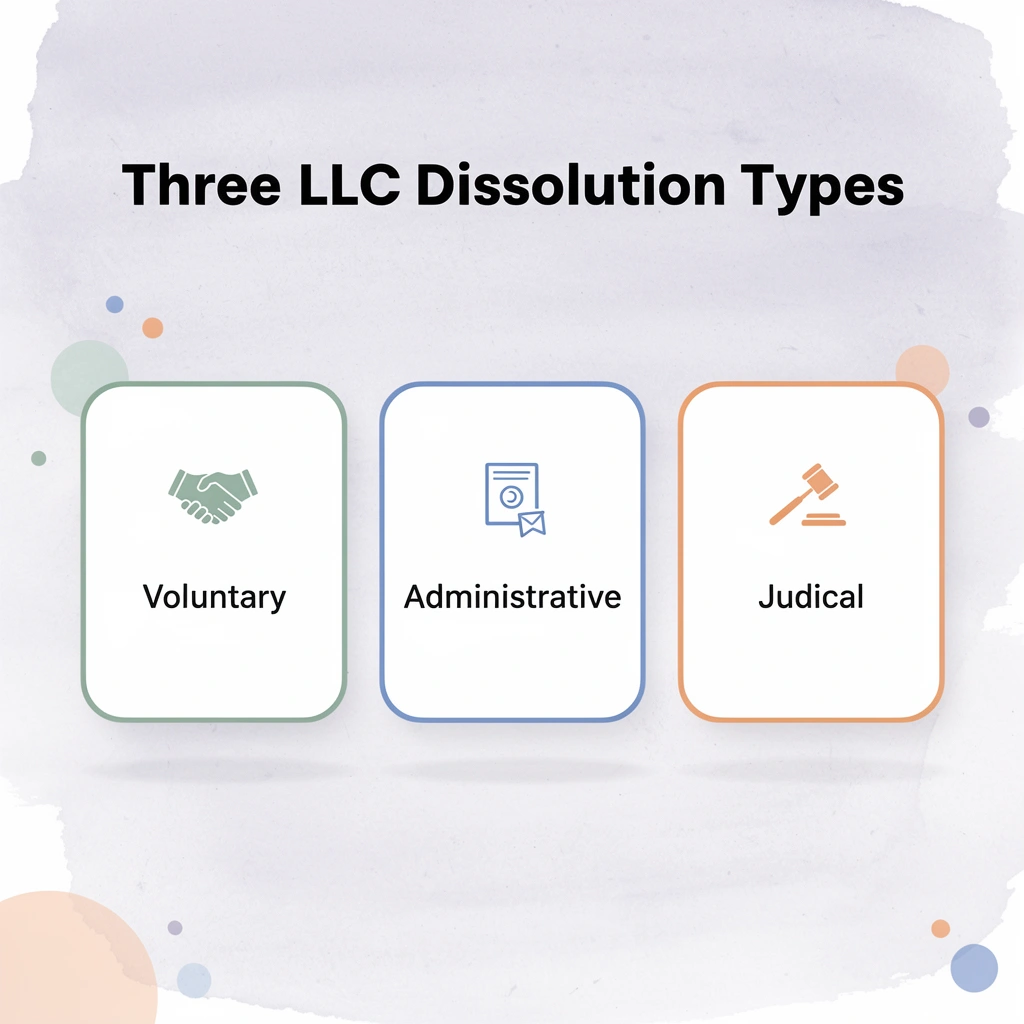
Voluntary dissolution is the path most founders take. When LLC members agree to wind down, they control the sequence: settling debts, notifying creditors, distributing assets, and filing Articles of Dissolution with the New Hampshire Secretary of State. This control lets you time closure around your financial and legal obligations rather than react to external pressure. Northwest Registered Agent notes that the filing fee is $100, making a clean exit modest compared to unresolved liabilities.
Administrative dissolution occurs when the state takes action due to a missed Annual Report filing or loss of a registered agent. Unlike an informal closure, an administratively dissolved LLC requires a formal reinstatement process, with additional fees and filings, before it can legally operate again. Founders often discover months later that unresolved obligations remain attached to the entity.
Most administrative dissolutions result from missed notices or forgotten deadlines rather than intentional action. A structured shutdown process prevents this by tracking important dates, organizing documents, and identifying outstanding obligations before state involvement. Our business closure platform eliminates these compliance gaps.
Judicial dissolution is the least common and most disruptive way to end an LLC. A New Hampshire court can order dissolution when it is no longer reasonably practicable for the business to continue, typically due to member deadlock, serious disputes, fraud, or breaches of fiduciary duty. Because it involves legal proceedings, judicial dissolution is slower, more expensive, and less predictable than voluntary or administrative dissolution. Multi-member LLCs are most vulnerable, particularly when the operating agreement lacks clear dispute resolution or wind-down provisions.
The type of dissolution you choose determines your liability exposure, timeline, and ability to move forward cleanly. Voluntary dissolution produces a clear termination date, a paper trail that protects former members, and a final tax return filed with the New Hampshire Department of Revenue Administration that closes the state's books on your entity. Administrative and judicial dissolutions rarely produce that clarity without additional legal work. For most founders, choosing voluntary dissolution before compliance failures or member disputes force the issue is the smarter, cheaper, and faster way to finish strong.
Even founders who choose the right path often stumble on questions they didn't know to ask until it was almost too late.
Obligation tracking, document organization, and stakeholder coordination — in one platform, in the right order.
Get my shutdown planMost New Hampshire LLC dissolutions don't fail outright. They stall quietly, often months after founders believe the business is closed. The breakdown happens in the gap between what feels finished and what remains legally unresolved.
State dissolution filings are completed, but tax obligations continue in parallel systems that have never received closure signals. Founders file their Certificate of Cancellation with the Secretary of State and assume the process is finished. Three months later, a notice arrives from the New Hampshire Department of Revenue Administration requesting an overdue Business Profits Tax return for a quarter that occurred after operations stopped.
Tax agencies operate independently from the Secretary of State's registry. Filing dissolution paperwork doesn't automatically close your accounts with the IRS or state tax authorities. Each requires separate final filings and explicit closure requests. Without those steps, the systems assume the entity remains active and expect compliance.
The consequence isn't just an administrative annoyance. Missed tax filings generate penalties that accumulate monthly. According to the IRS, failure-to-file penalties start at 5% of unpaid taxes per month, capping at 25% of the total amount due. For a dissolved LLC with no revenue, that means penalties on a return that should have shown zero activity.
Software subscriptions, service contracts, and vendor agreements continue billing after operations stop. Most founders don't maintain a comprehensive list of recurring charges because they signed up for tools gradually over months or years. When dissolution begins, there's no central record of what needs to be canceled.
The failure mode looks like this: you close the business bank account after transferring remaining funds. Two months later, a subscription renewal attempt charged that closed account. The vendor's system flags the failed payment, sends collection notices to an email address you've stopped monitoring, and eventually reports the debt. You discover the issue when a collections agency contacts you about a $47 monthly charge that's been accumulating late fees.
Annual reports, final tax returns, and contract termination windows don't pause just because you've stopped operating. Each has its own deadline, and missing one creates consequences that compound.
New Hampshire requires annual reports by April 1st. If you cease operations in February but don't file dissolution paperwork until May, you're still liable for that year's annual report and the associated fee. The state doesn't prorate based on operational months. The LLC existed on the registry during the filing period, so the obligation stands.
The same pattern repeats across tax jurisdictions. Federal tax returns follow the calendar year or your chosen fiscal year, regardless of when dissolution occurred. State tax returns have separate deadlines. Local business licenses and permits each carry their own renewal dates and cancellation requirements. When these deadlines arrive out of sync, founders miss them because they're focused on one system while another quietly generates penalties.
Recordkeeping breaks down when information lives across email accounts, cloud storage platforms, and physical files that were never centralized. You need to confirm whether the final tax return was filed, but the accountant's confirmation email is buried in an inbox you haven't checked in weeks. The registered agent's contact information is in a folder somewhere, but you can't remember if it was Google Drive or Dropbox.
This fragmentation forces founders to retrace steps they thought were complete. You believe you cancelled a vendor contract, but without the confirmation email, you can't prove it. The vendor claims the agreement auto-renewed and sends an invoice. Now you're negotiating a dispute that could have been prevented with organized documentation.
The emotional weight of this uncertainty is heavier than the administrative burden. You want to be done, but you can't confirm you're done. That ambiguity prevents closure and keeps the dissolved business occupying mental space you need for what comes next.
Creditors don't receive automatic notification when you file for dissolution. Unless you proactively inform them, they will continue to operate under the assumption that the LLC is active and able to fulfill its obligations. This creates confusion, delays resolution, and sometimes generates legal disputes.
A lease agreement might include an early-termination clause requiring 60 days' notice. If you file for dissolution without notifying the landlord, that notice period never starts. The landlord expects rent payments to continue because it has not received a termination notice, even though the LLC is winding up. By the time the miscommunication surfaces, you've missed the termination window and may owe additional rent for those months.
The same gap appears with lenders, vendors, and service providers. Each relationship has its own notification requirements and termination procedures. Dissolution doesn't automatically satisfy those contractual obligations. It just signals your intent to wind up affairs, which still requires methodical communication with everyone who holds a claim.
When founding teams are fragmented, coordinating the dissolution process is challenging in itself. One member might handle state filings while another manages vendor cancellations, but without clear task ownership and progress tracking, critical steps fall through the gaps between them. The failure happens in the handoff. You assume your co-founder contacted the registered agent about resignation. They assumed you were handling it because you managed state filings. Three months pass before either of you realizes the registered agent never received notice and is still expecting to serve process on behalf of a dissolved entity.
This coordination problem intensifies when members have different levels of urgency about closure. One founder needs the dissolution completed quickly to move on to their next venture. Another is traveling and responds to requests slowly. A third is dealing with personal issues and has mentally checked out. The dissolution process requires sequential steps that can't proceed until previous tasks are confirmed complete, but confirming completion requires coordination that's breaking down.

Dissolving an LLC in New Hampshire requires completing a specific sequence mandated by RSA 304-C. You can't skip steps or reorder them based on convenience. The statute protects creditors first, members second, which means settling obligations before distributing assets, and filing state paperwork only after internal approvals are documented and the wind-up process is substantially complete.
Your operating agreement controls how dissolution must be authorized. Some require unanimous member consent. Others allow a simple majority. A few specify that certain triggering events automatically initiate dissolution without a vote.
If you file dissolution paperwork without following these governance requirements, other members can challenge the validity of your filing. The Secretary of State won't verify that you followed your own internal rules. They assume you did. When that assumption proves wrong, the entire dissolution can be invalidated, forcing you to restart after securing proper authorization. Single-member LLCs face a simpler path. The sole owner can approve the dissolution by a written decision recorded in the company's records. No vote required, no coordination needed. But even single-member entities must document the decision and maintain that record for future reference.
Multi-member LLCs need formal approval through the method specified in the operating agreement. This typically means either written consent signed by the required percentage of members or a properly noticed meeting at which dissolution is voted on and recorded in the minutes. The documentation matters because it establishes when dissolution was authorized and who approved it. If a creditor later challenges the timing of asset distributions or questions whether the LLC followed proper procedures, these records provide proof that dissolution was legitimate and properly authorized.
The challenge surfaces when founding teams are scattered. One member is overseas and hard to reach. Another has moved on emotionally and responds slowly to requests for signatures. A third is dealing with personal issues and has mentally checked out. Getting everyone aligned on timing and process becomes its own negotiation, separate from the operational work of winding down.
Winding up means completing the LLC's remaining obligations before termination. This includes:
RSA 304-C requires that creditors be paid before members receive distributions. If you reverse that order, creditors can challenge those distributions and potentially recover funds from members who received them. The statute creates a hierarchy:
The practical difficulty is determining what counts as a reasonable provision for unknown claims. A vendor invoice that hasn't arrived yet is easy to anticipate.
These gray areas require judgment about exposure and risk that most founders aren't equipped to make confidently.
Most founders track this manually across email threads, spreadsheets, and memory. Contracts live in different folders. Vendor contact information is scattered across inboxes. Confirmation emails get buried. Platforms like Starcycle centralize contract inventories and cancellation workflows into a structured timeline, organizing vendor notifications, tracking confirmation responses, and ensuring nothing results in surprise charges months after you thought the closure was complete.
Before the state processes your Certificate of Cancellation, you need confirmation that tax obligations are settled. This means filing final federal returns with the IRS (typically Form 1065 for partnership-taxed LLCs) and final state returns with the New Hampshire Department of Revenue Administration, including Business Profits Tax and Business Enterprise Tax where applicable.
The Department of Revenue Administration issues a Tax Clearance Certificate (sometimes processed through Form AU-22) confirming the LLC has no outstanding tax liabilities. Processing typically takes two to four weeks. Without this clearance, the dissolution filing can be delayed or rejected. The disconnect happens because tax systems operate independently from the Secretary of State's registry. Filing dissolution paperwork doesn't automatically notify tax authorities that the entity is closing. Each system requires its own final filing and explicit closure signal. Miss one, and penalties accumulate on returns that should have shown zero activity.
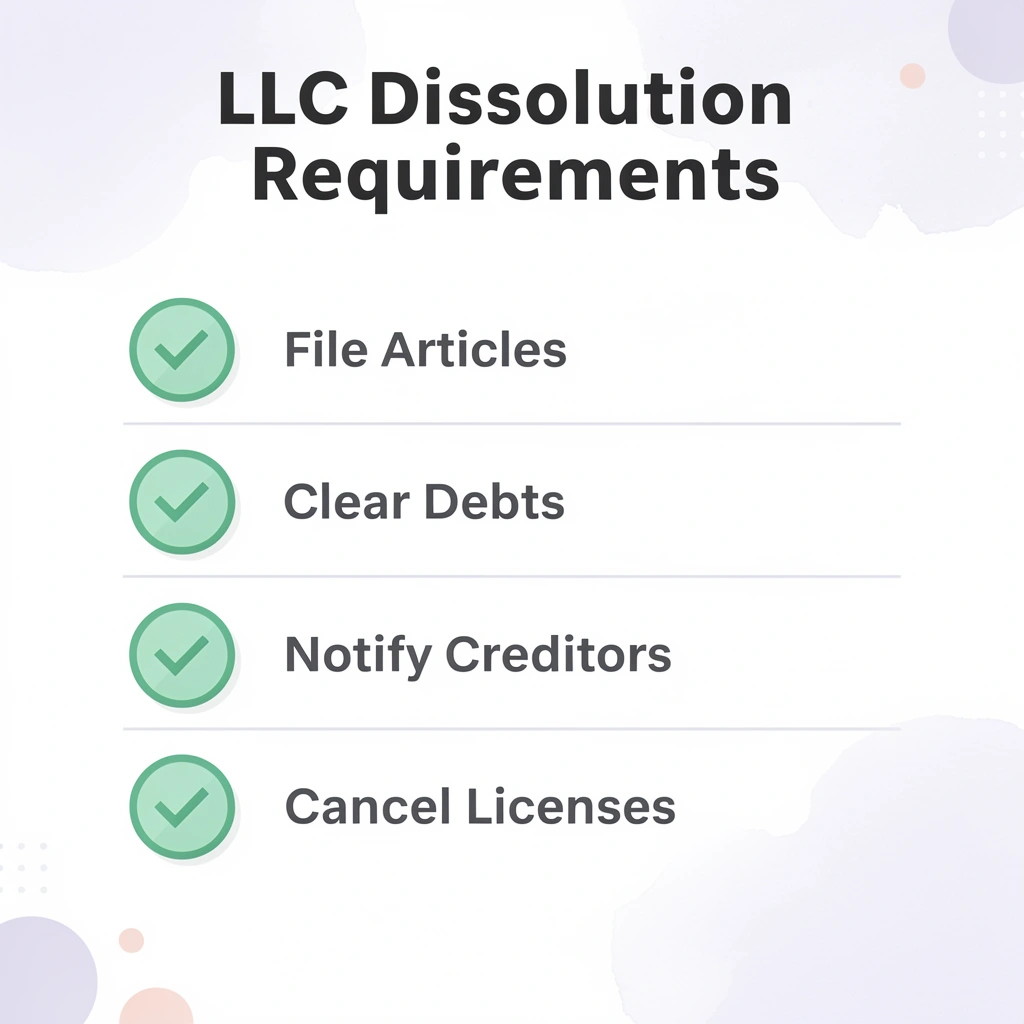
After internal approvals are documented, operations are wound up, and tax clearance is obtained, you file Form LLC-7 (Certificate of Cancellation) with the New Hampshire Secretary of State. The form requires the LLC's legal name, state file number, effective date of cancellation, and confirmation that the wind-up process is complete. The filing fee is $35. Online filings typically process within three to seven business days.
But before the state accepts the filing, RSA 304-C requires that assets be distributed in a specific order.
The form itself is simple. Four fields:
The complexity isn't in completing the form. It's in confirming that everything required before filing has actually been completed.
After the state confirms cancellation, close remaining business bank accounts, cancel insurance policies, and notify the IRS that the entity is no longer active. Some LLCs taxed as corporations also submit IRS Form 966 to formally report dissolution. But closing accounts doesn't erase the obligation to maintain records. New Hampshire law and IRS regulations require that business records be retained for at least seven years after dissolution. This includes:
These records protect you if questions arise later about:
Without them, you're relying on memory to defend decisions made years earlier under circumstances you've since moved past.
75% of closures leave unresolved obligations that create long-term exposure. A structured winddown saves 40–60 hours and cuts legal risk ~80%.
Get a quote
Dissolution isn't a knowledge problem. Most founders can find the steps online in under ten minutes. What breaks down is execution. You know you need to:
But knowing what to do doesn't tell you when each step must happen, which actions depend on others being completed first, or how to track what's actually finished versus what you only think you've handled. The gap between understanding the process and completing it is where most dissolution timelines stretch from weeks into months, and where costs accumulate in ways founders don't anticipate.
Each dissolution action enables the next.
Break that sequence, and you create problems that ripple forward.
The challenge intensifies because these dependencies span different systems that don't communicate with each other. The Secretary of State doesn't know whether you've filed final tax returns. The Department of Revenue Administration doesn't track whether you've notified creditors. Your bank doesn't verify that all vendor contracts are cancelled before closing your account. You're the only point of connection between these separate processes, so you're responsible for ensuring the sequence happens correctly.
According to Seed A Founder, 70% of early-stage startups fail due to a lack of structure and planning. That same structural deficit shows up during dissolution. Founders who built businesses through improvisation struggle to execute a methodical shutdown that requires precise sequencing and documentation.
During normal operations, you track dozens of moving pieces because the business generates energy and forward momentum. During dissolution, that energy disappears. What remains is administrative cleanup that feels emotionally draining while demanding the same level of attention to detail. The cognitive load problem surfaces in small ways that compound. You need to remember whether you notified the landlord about the lease termination, but that conversation happened:
Did you send that email, or just planning to send it? Is the confirmation in your inbox, or did they never respond?
Without a system that externalizes this tracking, you're relying on memory during a period when stress and transition fatigue make memory unreliable. The result is duplicated effort (contacting the same vendor twice because you forgot you already did) or missed steps (assuming something was handled when it wasn't).
Founders who manage dissolution manually often discover gaps months later. A subscription they thought was cancelled generates a collections notice. A tax account they assumed was closed triggers a penalty for a missed filing. The registered agent they believed resigned is still listed and receiving service of process. Each gap requires time to investigate, explain, and resolve, extending the emotional timeline of a closure that should have finished months earlier.
Completing the dissolution generates dozens of confirmations, receipts, and official responses that must be preserved for 7 years.
Most founders store these across email accounts, cloud folders, and local drives without a consistent filing system. When you need to prove that a specific step was completed, you're searching through fragmented records, hoping the confirmation still exists and you can find it.
The cost of this fragmentation appears later. A former vendor claims they never received a contract termination notice and demands payment for services that weren't rendered. You know you sent that notice, but you can't locate the email. Now you're in a dispute that could have been prevented with organized documentation showing exactly when notice was sent and to whom. Tax audits create similar pressure. The IRS questions whether final returns were filed correctly. You need supporting documentation about:
If those records are scattered or incomplete, defending your dissolution decisions becomes exponentially harder.
Structure means three things that instructions alone can't deliver.
Most founders handle dissolution through spreadsheets, email threads, and memory. As complexity grows and emotional bandwidth shrinks, that approach creates the exact conditions for important steps to be missed. Platforms like Starcycle organize dissolution into a structured timeline with built-in dependency tracking and document management, compressing what typically takes months of scattered effort into weeks of coordinated progress while ensuring nothing falls through the gaps.
You can complete every required step and still feel uncertain about whether dissolution is truly finished.
That uncertainty persists because manual tracking doesn't provide visibility into what's left undone. You know what you've completed, but you're less confident about what you might have missed. The result is ongoing anxiety about a business you've already mentally left behind.
Structure closes that confidence gap by making completion visible and verifiable. When every required action has a confirmed status and supporting documentation, you know you're done. Not because you hope you haven't forgotten anything, but because the system shows that every dependency has been satisfied and every obligation has been addressed. That's the difference between following instructions and having structure. Instructions tell you what to do. Structure ensures it gets done completely, in the right sequence, with proof that it happened.

Closing cleanly means completing every required step in the correct sequence with documentation that proves it happened. Founders who move forward with confidence don't rush the paperwork. They finish the wind-down, so nothing resurfaces six months later as a surprise:
That confidence comes from verifiable closure, not assumed.
The emotional weight of shutting down a business makes administrative precision harder, not easier. You're managing member conversations that might be tense, notifying customers and vendors that relationships are ending, and making decisions about assets while processing the fact that this venture didn't work out the way you planned.
The administrative burden compounds during a period when your capacity to handle complexity is already strained. Founders describe:
The uncertainty about what's truly finished versus what you only think you've handled creates ongoing anxiety that prevents the emotional closure you need to move forward.
Starcycle organizes New Hampshire LLC dissolution into a structured timeline that tracks:
Instead of piecing together requirements from the Secretary of State, Department of Revenue Administration, IRS, and scattered online guides, founders receive a sequenced plan aligned with RSA 304-C that shows exactly what must happen and when. This becomes especially valuable during a transition that already feels overwhelming.
Member approval is documented in accordance with your operating agreement.
Only after these steps are substantially complete should you file the Certificate of Cancellation with the Secretary of State. Filing too early creates complications if liabilities or obligations remain unresolved. The state expects the wind-up process to be completed, not just started, before it terminates the entity.
Closing also requires addressing operational commitments that may still be generating charges or obligations.
Insurance policies, payroll systems, and payment processing platforms each require separate cancellation procedures. Without addressing these systematically, recurring charges continue even after the business stops operating. Founders discover this months later when a collection notice arrives for a subscription they assumed was cancelled or when a vendor claims breach of contract for services that were never terminated.
Proper documentation isn't administrative theater. If the Secretary of State, IRS, lenders, vendors, or former partners request clarification later, you need to access clear records showing the company was properly wound down. Tax clearance certificates, member consent forms, creditor notification records, final filing confirmations, and asset distribution documentation should be centralized and retrievable. Scattered across email accounts and cloud folders, these records become effectively inaccessible when you need them years later to defend dissolution decisions during an audit or dispute.
Maintaining organized documentation reduces the risk of challenges to:
The seven-year record retention requirement isn't optional. It protects you from having to reconstruct decisions from memory during a period you've already moved past emotionally.
When dissolution is completed properly, it stays closed. There are no lingering compliance obligations surfacing months later. Founders avoid unexpected state notices about:
Dissolving an LLC isn't a failure. Businesses close for legitimate strategic reasons:
A clean closure protects you both legally and emotionally. It clarifies your standing with regulators, creditors, and stakeholders while creating space for what comes next, whether that's launching a new venture, joining another company, or simply regrouping before the next idea.
The difference between dissolution that lingers and dissolution that finishes is a structure that ensures every dependency is satisfied and every obligation is addressed with proof. That's what allows founders to close this chapter completely and move forward without unfinished business following them.
💡 Tip: If you still have burning questions about dissolving your LLC in New Hampshire, you're not alone — this process involves critical legal steps, filing deadlines, and financial obligations that every business owner should understand before moving forward.
"Properly dissolving an LLC is just as important as forming one — skipping steps can leave owners personally exposed to ongoing fees, penalties, and legal liability." — Business Law Experts
⚠️ Warning: Failing to formally dissolve your LLC means you may continue to owe annual fees and remain legally responsible for the entity — even if it's no longer operating.
🔑 Takeaway: Review every FAQ thoroughly before beginning the dissolution process — small oversights can lead to significant financial and legal consequences down the road.
According to Northwest Registered Agent, dissolution filings in New Hampshire are typically processed within one to two weeks once submitted. The variable is everything before that filing: resolving liabilities, notifying creditors, distributing assets, and obtaining member sign-off. A single-member LLC with clean books might complete the entire winding-up process in a few weeks. A multi-member LLC with outstanding contracts or employee obligations can take several months before the paperwork is ready to file.
Yes, but dissolution does not erase what you owe. Outstanding debts follow the winding-up process, not the filing date. Before distributing remaining assets to members, the LLC must satisfy known creditors and resolve pending obligations. Skipping this step does not make liabilities disappear; it shifts the risk onto the members personally. The NH Small Business Development Center notes that New Hampshire requires 60 days' notice to creditors during dissolution, treating debt resolution as a prerequisite.
Filing a certificate of dissolution with the Department of Revenue Administration costs $30, and filing the certificate of cancellation with the Department of State costs $35—$65 total in state fees. Your requirements depend on your operating agreement. Many multi-member LLCs require a formal member vote before dissolution. If your operating agreement doesn't specify the process, New Hampshire law provides the default rules.
Most founders track deadlines in spreadsheets, forward creditor notices through email, and store documents across cloud folders and inboxes until dates slip or notices get buried. Our Starcycle platform provides structured action plans, contract and subscription tracking, and centralized document organization to prevent details from falling through the cracks.
If you stop running your LLC without officially dissolving it, the LLC remains a legal entity subject to state requirements. You must still file annual reports and maintain a registered agent. An administratively dissolved LLC can be reinstated, but only by resolving the compliance issues that led to the dissolution and paying additional fees. Inaction costs more than formal dissolution.
Not for every situation. A single-member LLC with no active lawsuits, no employees, and a clean balance sheet can often complete dissolution without legal representation. The situation changes with multiple owners, ownership disputes, or significant assets and pending claims: legal guidance becomes protection rather than a luxury.
Getting the paperwork right is only part of the challenge. The real problem is the one nobody warns founders about until it becomes one.
If you're ready to dissolve your New Hampshire LLC without confusion or loose ends, Starcycle helps make the process:
Sign up to get a quote and see how we can simplify your business closure starting at $399, with no hidden fees. The platform organizes member approvals, creditor notifications, tax filings, and state paperwork into a sequenced plan that prevents the gaps that most dissolutions stall on.
Clean closure isn't about perfection. It's about finishing what you started so you can move forward without administrative debris following you into the next chapter. Whether that's launching a new venture, joining another company, or simply regrouping before the next idea, you deserve an ending that feels complete.