 Starcycle
State Guide
Closing an LLC in Missouri involves more than locking the doors and walking away. From filing articles of dissolution with the Secretary of State to settling debts, notifying creditors, and canceling business licenses, each step carries real legal and financial consequences. Skipping or mishandling any part of the process can leave owners exposed to liability long after the business stops operating.
Knowing how to dissolve an LLC in Missouri the right way protects members from future claims and keeps the process moving without costly delays. Tax clearance, member approval, and final state filings all require attention at the right time and in the right order. Starcycle helps LLC owners navigate every stage of business closure so nothing critical gets missed.
Many Missouri business owners think their LLC automatically closes when they stop doing business. However, a Missouri LLC continues to legally exist until the owner files dissolution documents with the Missouri Secretary of State, regardless of how inactive the business becomes.

💡 Tip: If you've stopped operating your Missouri LLC but haven't filed to dissolve it, your business is still legally active — meaning you may still owe annual fees, taxes, and compliance filings.
"A Missouri LLC continues to legally exist until the owner files dissolution documents with the Missouri Secretary of State, no matter how inactive the business becomes." — Missouri Business Law
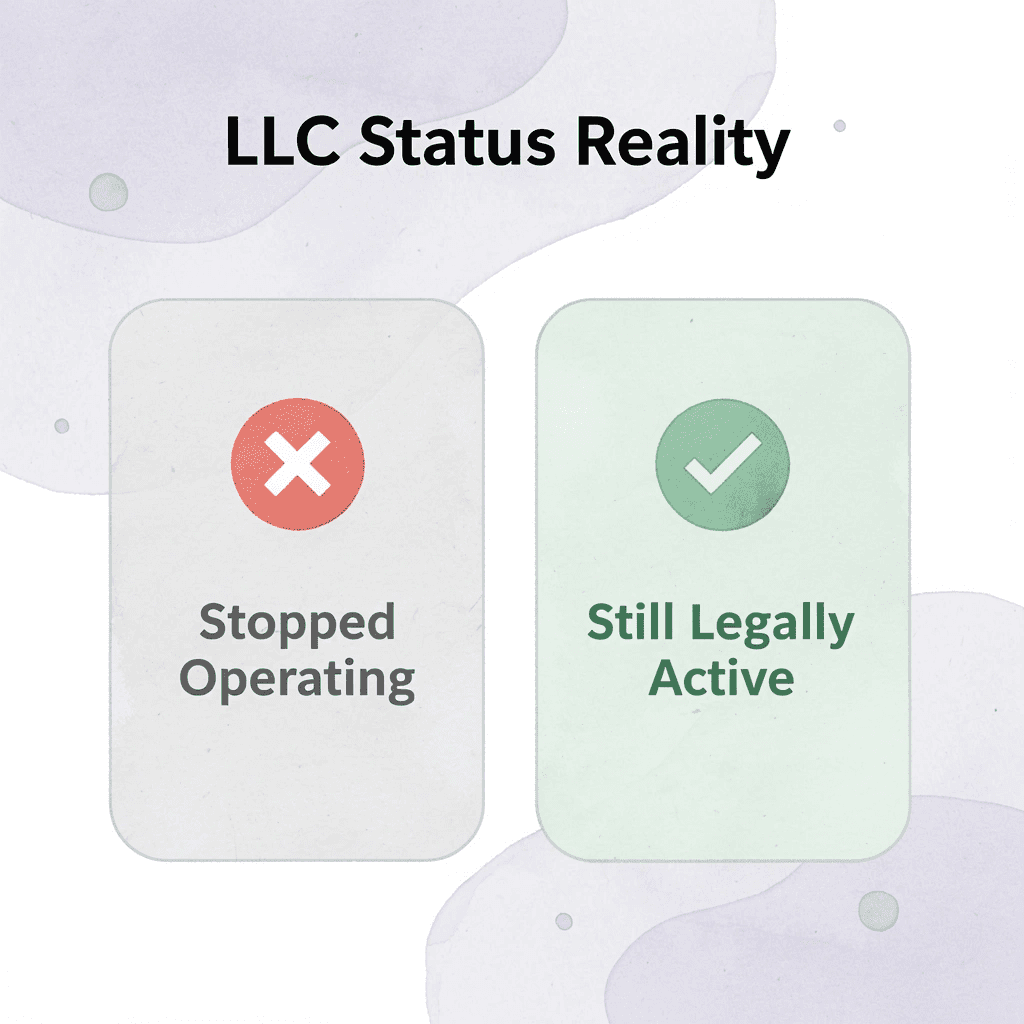
⚠️ Warning: Assuming your LLC is closed without formally dissolving it is one of the most common and costly mistakes Missouri business owners make — leaving them exposed to ongoing legal obligations and unexpected liabilities.
Owner Assumption | Legal Reality |
|---|---|
LLC closes when business stops operating | LLC remains legally active until dissolved |
No filings needed after inactivity | Dissolution documents must be filed with the Missouri Secretary of State |
Liabilities end when operations stop | Legal and financial obligations continue until formal closure |

The failure point is the gap between stopping operations and completing legal closure. During that time, the LLC remains a legal entity with real obligations. Contracts can still be enforced against it, tax liabilities can accrue, and if a registered agent is not maintained, the Missouri Secretary of State can move toward administrative cancellation, creating complications to untangle later. Missouri does not require LLCs to file annual reports. According to FormLLC's Missouri LLC Annual Report Guide, Missouri LLCs have no annual report filing requirements. Without this deadline reminder, a dormant LLC can remain open on the state's records indefinitely while the owner assumes it has dissolved.
Most owners who find themselves in this situation did not make a careless mistake; they simply stopped operations and moved on. The hidden cost is that "moving on" without formally dissolving the LLC leaves legal exposure in place. A creditor, former vendor, or state agency can still reach the entity. Cleaning that up after the fact takes longer and costs more than dissolving properly from the start.
Organized execution makes the difference. Founders who treat dissolution as a defined process with tracked steps, key dates, and documented approvals close faster and cleaner than those who piece it together reactively. Business closure platforms like Starcycle provide a structured action plan covering member approval, winding up tasks, creditor notification, and state filings in the proper sequence. Voluntary dissolution involves more steps than most owners expect before they can file the Articles of Termination. Knowing dissolution is the right move and knowing exactly what to do before you file are two different things.
Obligation tracking, document organization, and stakeholder coordination — in one platform, in the right order.
Get my shutdown planBefore you file the Articles of Termination, you need to complete critical internal decisions, notifications, and financial clean-up. This preparation phase decides whether your closure goes smoothly or takes far longer than needed.
"The steps you take before filing are just as important as the filing itself — skipping preparation is the most common reason LLC dissolutions get delayed or rejected." — Missouri Business Filing Guidelines
Preparation Task | Why It Matters | When to Complete |
|---|---|---|
Internal member vote | Authorizes dissolution legally | Before any filing |
Creditor notifications | Protects against future liability | Before Articles of Termination |
Financial clean-up | Clears outstanding debts and obligations | Prior to filing |
Tax clearance | Required for state approval | Before submission |
💡 Tip: Start your preparation checklist at least 30–60 days before you plan to file — rushing this phase is the #1 mistake Missouri LLC owners make during dissolution.
⚠️ Warning: Filing the Articles of Termination without completing internal clean-up can result in rejected filings, personal liability exposure, or costly delays that extend your closure timeline significantly.

Your Operating Agreement is the first document to review, not the Secretary of State's website. It controls how your LLC makes major decisions, including dissolution, and may set voting requirements, notice rules, and asset distribution after debts are paid. According to Nolo's guide on dissolving a Missouri LLC, a two-thirds member vote is a common threshold for approving dissolution, though your agreement may specify a different standard. Follow your agreement exactly and document what occurred with meeting minutes or a signed member consent form kept in your company records.
After members approve the dissolution, notify all stakeholders: employees, vendors, landlords, lenders, customers with open orders, independent contractors, and service providers with active agreements. This allows you to settle outstanding obligations cleanly and gives each party time to adjust. Skipping notification doesn't eliminate these relationships; it makes them harder and more expensive to untangle later.
Most founders handle notifications through emails, phone calls, and termination letters sent individually, but this approach leaves gaps, especially recurring software subscriptions or vendor auto-renewals that keep charging after departure. Platforms like Starcycle help track active contracts, manage cancellations, and document closed obligations so nothing gets missed during wind-up.
The practical work of closing down your LLC requires a complete list of what you owe and what you own. Outstanding invoices, business loans, lease agreements, active licenses, tax accounts at both the federal and Missouri state level, and all remaining business assets must be listed and resolved before filing the Articles of Termination. According to Northwest Registered Agent's guide to dissolving a Missouri LLC, Missouri gives LLC members up to 90 days to wind up affairs after a dissolution vote. Stop accepting new customers or contracts once dissolution is approved; every new obligation you take on during this period complicates the process. Once you know what this process requires, the step-by-step mechanics of filing become less intimidating.
Filing the Articles of Termination follows a clear and structured sequence. Once you understand the order of operations, the paperwork becomes straightforward — knowing exactly what to do, when to do it, and in what order is the difference between a smooth dissolution and costly delays.
"Following the correct sequence when filing dissolution documents is essential — skipping steps or filing out of order can result in rejected filings, lingering legal obligations, or ongoing tax liability." — Missouri Secretary of State Guidelines
Step | Action Required | Key Detail |
|---|---|---|
Step 1 | Vote to Dissolve | Requires member approval per operating agreement |
Step 2 | Wind Up Business Affairs | Settle debts, obligations, and contracts |
Step 3 | File Articles of Termination | Submit to Missouri Secretary of State |
Step 4 | Cancel Licenses & Permits | Close all state and local registrations |
Step 5 | Notify Tax Authorities | File final tax returns and close accounts |
💡 Tip: Complete your winding up process before submitting the Articles of Termination — the state expects all financial obligations to be resolved first.
⚠️ Warning: Filing the Articles of Termination out of sequence — especially before settling outstanding debts or tax liabilities — can expose LLC members to personal liability and legal complications.

Your Operating Agreement specifies the required vote, required notice, and documentation process for dissolution. If it doesn't address dissolution, Missouri's default rules require written consent from all members. Document the decision immediately with signed meeting minutes or a written consent form, and file it with your company records. This paper trail protects every member if questions arise later.
The wind-up phase requires collecting outstanding invoices, paying creditors, resolving contracts, and distributing the remaining assets to members only after all debts have been cleared. Missouri requires that you file a Notice of Winding Up before the Secretary of State will accept your Articles of Termination; this document establishes a formal process for creditors to submit claims. Managing these tasks manually across spreadsheets, email threads, and calendar reminders consumes significant time. Our business closure platform consolidates contract tracking, key filing dates, and outstanding obligations in one place, preventing critical items from slipping through the cracks during the wind-up window.
File Form LLC-5, the Articles of Termination, with the Missouri Secretary of State. The filing fee is $25; combined with the $25 Notice of Winding Up fee, total filing fees to dissolve an LLC in Missouri come to $50. The form requires your LLC's legal name, charter number, original Articles of Organization filing date, and Notice of Winding Up filing date. Submit online or by mail; dissolution becomes effective when the Secretary of State processes the filing, unless you elect a delayed effective date of up to 90 days.
Filing the Articles of Termination does not close your tax obligations. You must file a final federal return with the IRS, final Missouri state returns, and any remaining payroll or sales tax filings if your LLC had employees or collected sales tax. Only after all returns are filed and balances are paid should you formally close your accounts with the Missouri Department of Revenue. Skipping this step is one of the most common reasons founders receive unexpected notices months after they thought the business was closed.
State and local business licenses, Missouri sales tax licenses, DBA registrations, professional licenses, and industry-specific permits remain active until you cancel them. Renewal fees and compliance notices will continue arriving if you don't cancel them. A careful review of every registration your LLC holds, checked against what you've canceled, prevents administrative loose ends from resurfacing months later. Getting through all five steps without delay depends on details most guides overlook.
Filing the Articles of Termination isn't the finish line. Real delays come from administrative tasks that don't show up in basic guides — the ones that sit quietly on either side of that critical filing.
"The most overlooked LLC closure mistakes aren't legal — they're administrative blind spots that stall the process long after the paperwork is submitted." — Missouri Business Filing Practitioners
⚠️ Warning: Many Missouri LLC owners assume that submitting the Articles of Termination ends their obligations — but unresolved administrative tasks before and after that filing are the most common source of costly delays.
💡 Tip: Before you file, audit every administrative loose end — from tax clearances and registered agent notifications to bank account closures and license cancellations — so nothing quietly stalls your official closure.
Stage | Common Delay Trigger | Impact |
|---|---|---|
Pre-Filing | Outstanding tax clearances or pending state notices | Blocks submission entirely |
At Filing | Incomplete Articles of Termination form | Rejected by Missouri Secretary of State |
Post-Filing | Open bank accounts, licenses, or EIN records | Ongoing liability exposure |

The most common delay point isn't the Secretary of State filing—it's the Missouri Department of Revenue. Submitting Form LLC-5 doesn't close your state tax accounts. You still need to file final sales tax returns, close your employer withholding account if you had employees, and formally notify the Department of Revenue that the business has ceased operations. Founders who skip this step often discover it months later when a compliance notice arrives at an old address or when a tax lien appears during a future venture's background check.
The same pattern appears with licenses and subscriptions. A Missouri sales tax license, a professional license issued by a state board, a DBA registered with a local county recorder—none of these disappears when your LLC does. Each requires its own cancellation process with its own agency. According to The Kaplan Group's 54 Small Business Statistics for 2025, approximately 36 million small businesses operate in the United States, and most accumulate far more licenses, accounts, and vendor agreements than their founders can track independently.
Most founders track cancellations by hand across email threads, spreadsheets, and memory. A missed auto-renewal on a software subscription or an insurance policy rolling over into a new annual term can cost money and create confusion about whether the business is closed. Our Starcycle platform solves this by consolidating contract tracking, key cancellation dates, and outstanding obligations into a single action plan.
One detail that creates legal exposure is the sequence of asset distribution. Missouri law is clear: creditors get paid before members receive anything. Distributing assets to members first, even informally, can expose both the LLC and individual members to personal liability if a creditor later makes a valid claim. Keep written records of every payment made during wind-up, including the order in which obligations were settled. NBC 15 News reports that 2025 saw 12% more store closures than 2024, meaning more founders are encountering these sequencing issues for the first time.
Documentation is underestimated. Written member consent or signed meeting minutes approving the dissolution provide the paper trail that proves the closure was authorized if a former vendor, creditor, or partner challenges it. Store those records where you can find them.
75% of closures leave unresolved obligations that create long-term exposure. A structured winddown saves 40–60 hours and cuts legal risk ~80%.
Get a quoteMomentum is the thing most founders lose somewhere between the member vote and the final filing. Closing a Missouri LLC involves coordinating member approvals, winding up financial obligations, canceling licenses, closing tax accounts, and filing Articles of Termination — all in the right sequence, with documentation that may need to surface years later. When one piece slips, the whole timeline stretches.
"Closing a Missouri LLC isn't a single action — it's a coordinated sequence of legal, financial, and administrative steps where every missed detail can extend your liability exposure indefinitely."
💡 Tip: Starcycle guides founders through every stage of the dissolution process — from the initial member vote to the final Articles of Termination — so nothing falls through the cracks and your timeline stays intact.
⚠️ Warning: Skipping or misordering critical steps like canceling state licenses or closing tax accounts can leave your LLC legally exposed long after you think it's closed.
Dissolution Step | Why It Matters |
|---|---|
Member Vote & Approval | Establishes legal authority to begin winding down |
Winding Up Financial Obligations | Protects members from future liability |
Canceling Licenses & Permits | Prevents ongoing fees and regulatory penalties |
Closing Tax Accounts | Ensures clean separation from state tax obligations |
Filing Articles of Termination | The official act that dissolves the LLC in Missouri |
🎯 Key Point: Starcycle exists precisely for this — giving Missouri founders a confident, structured path to dissolution so momentum never dies between the first vote and the last filing.

Business closure platforms like Starcycle give founders a clear action plan for closing a business, from the initial member vote through final state filing. The platform tracks pending tasks, organizes important documents, and highlights what requires attention before closure. The difference isn't just time savings—it's confidence that nothing was overlooked.
According to Northwest Registered Agent, online dissolution filings with the Missouri Secretary of State process in 1 to 2 business days. The slower part is preparation: confirming member approvals are documented, verifying creditor obligations are resolved, and ensuring tax accounts with the Department of Revenue are properly closed before filing Articles of Termination. Starcycle keeps that preparation organized so founders aren't scrambling when the filing window opens.
Filing costs a $25 fee for Articles of Dissolution in Missouri. What costs founders more, in time and stress, is the wind-down work that precedes it. Starcycle gives founders one place to track contracts, subscriptions, vendor notices, and compliance deadlines, instead of having to assemble them from memory. The founders who close well aren't the ones who knew more. They're the ones who stayed organized as details multiplied.
What surprises most founders is the gap between thinking you are done and being done: the outstanding task you didn't know existed until it became a problem. This hidden gap is one of the most costly mistakes in the business closure process, turning what should be a clean exit into a drawn-out compliance nightmare.
"The gap between thinking you're done and actually being done is where most founders get blindsided — by filings, fees, and obligations they never knew existed." — Starcycle Closure Insights
💡 Tip: Don't assume silence from the state means closure is complete. Outstanding obligations can surface months or even years after you think you've wrapped up.
⚠️ Warning: Skipping a formal wind-down review is the #1 reason founders face unexpected penalties, lingering liabilities, and unresolved filing gaps long after they've walked away.

Requesting a personalized quote from Starcycle includes a first-session Missouri wind-down review that maps your remaining closure tasks, surfaces any filing gaps, and gives you a clear sequence to follow. You get a roadmap — not a checklist you have to build yourself.
What You Get | DIY Closure | Starcycle Wind-Down Review |
|---|---|---|
Closure task mapping | ❌ Manual research | ✅ Done for you |
Filing gap detection | ❌ Easy to miss | ✅ Proactively surfaced |
Clear action sequence | ❌ You figure it out | ✅ Structured roadmap |
Missouri-specific guidance | ❌ Generic advice | ✅ State-tailored review |
🎯 Key Point: A personalized wind-down review replaces guesswork with a structured, sequenced roadmap — so you close your business completely and correctly, the first time.
✅ Best Practice: Take advantage of the first-session review to get full visibility into your remaining obligations before they become costly surprises.
The timeline depends on how quickly you complete the wind-up process, including paying creditors, filing final tax returns, and canceling licenses. Once you're ready, Missouri allows you to file the required dissolution documents with the Secretary of State, and online filings are generally processed faster than mailed submissions.
Missouri requires two filings for a voluntary dissolution:
This brings the total state filing fees to $50, not including any costs related to taxes, legal assistance, or professional services.
Yes. The Missouri Secretary of State allows LLC owners to file both the Notice of Winding Up and the Articles of Termination online. You may also submit the forms by mail if you prefer.
Yes. Before closing your LLC, you should file all required federal and Missouri tax returns, pay any outstanding taxes, submit final payroll and sales tax filings if applicable, and close your tax accounts with the Missouri Department of Revenue. Completing these obligations helps prevent future penalties or collection notices.
Simply stopping business operations does not legally end your LLC. The company remains on the state's records until it is properly terminated. Depending on your circumstances, you may continue to have legal and administrative obligations, including maintaining a registered agent and addressing any applicable state requirements.
Yes. Dissolving an LLC does not eliminate valid debts or liabilities. During the wind-up process, the LLC should pay or otherwise resolve creditor claims before distributing any remaining assets to members. Creditors may still pursue unpaid obligations as allowed by law.
It depends on how the LLC was dissolved. If your LLC voluntarily completed the dissolution process and filed Articles of Termination, the termination is generally final. If the LLC was canceled or administratively dissolved by the state for failing to comply with statutory requirements, you may be eligible for reinstatement if you satisfy Missouri's reinstatement requirements. Otherwise, you may need to form a new LLC.