 Starcycle
State Guide
Closing a business you once built takes more than just walking away and turning off the lights. When you're ready to officially end your Arkansas limited liability company, understanding how to dissolve LLC entities properly protects you from future tax liabilities, ongoing fees, and potential legal headaches that can follow you for years. This guide walks you through the complete dissolution process in Arkansas, from filing your articles of dissolution with the Secretary of State to settling debts, notifying creditors, canceling licenses, and handling final tax returns, so you can exit cleanly with no loose ends.
Whether you're moving on to a new venture or simply ready to close this chapter, Starcycle's business closure services simplify the entire process for Arkansas LLC owners. Instead of piecing together state requirements, tax obligations, and compliance deadlines on your own, you get a clear roadmap that ensures every step gets completed correctly, from winding up business affairs to submitting your certificate of dissolution and closing your employer identification number.
Arkansas recognizes three distinct paths for closing an LLC: voluntary, administrative, and judicial dissolution. According to RMP Law's 2025 Arkansas Corporate Law Guide, each path affects the timeline, cost, paperwork, and level of control you keep. Choosing the right path is an essential strategic decision that can mean the difference between a smooth exit and a costly legal headache.
"Each dissolution path affects the timeline, cost, paperwork, and level of control you keep." — RMP Law, 2025 Arkansas Corporate Law Guide
Dissolution Type | Who Initiates | Control Level | Complexity |
|---|---|---|---|
Voluntary | LLC Members | High | Low–Medium |
Administrative | State of Arkansas | None | Medium |
Judicial | Court / Third Party | None | High |
🎯 Key Point: Voluntary dissolution gives you the most control over the process — making it the preferred path for LLCs that can plan ahead.
⚠️ Warning: Failing to choose the correct dissolution type can expose members to unexpected liability, penalties, or a prolonged legal process — so understanding all three options before acting is critical.
🔑 Takeaway: Not all LLC closures are created equal. Knowing which of the 3 dissolution paths applies to your situation is the first — and most important — step in protecting yourself and your business.
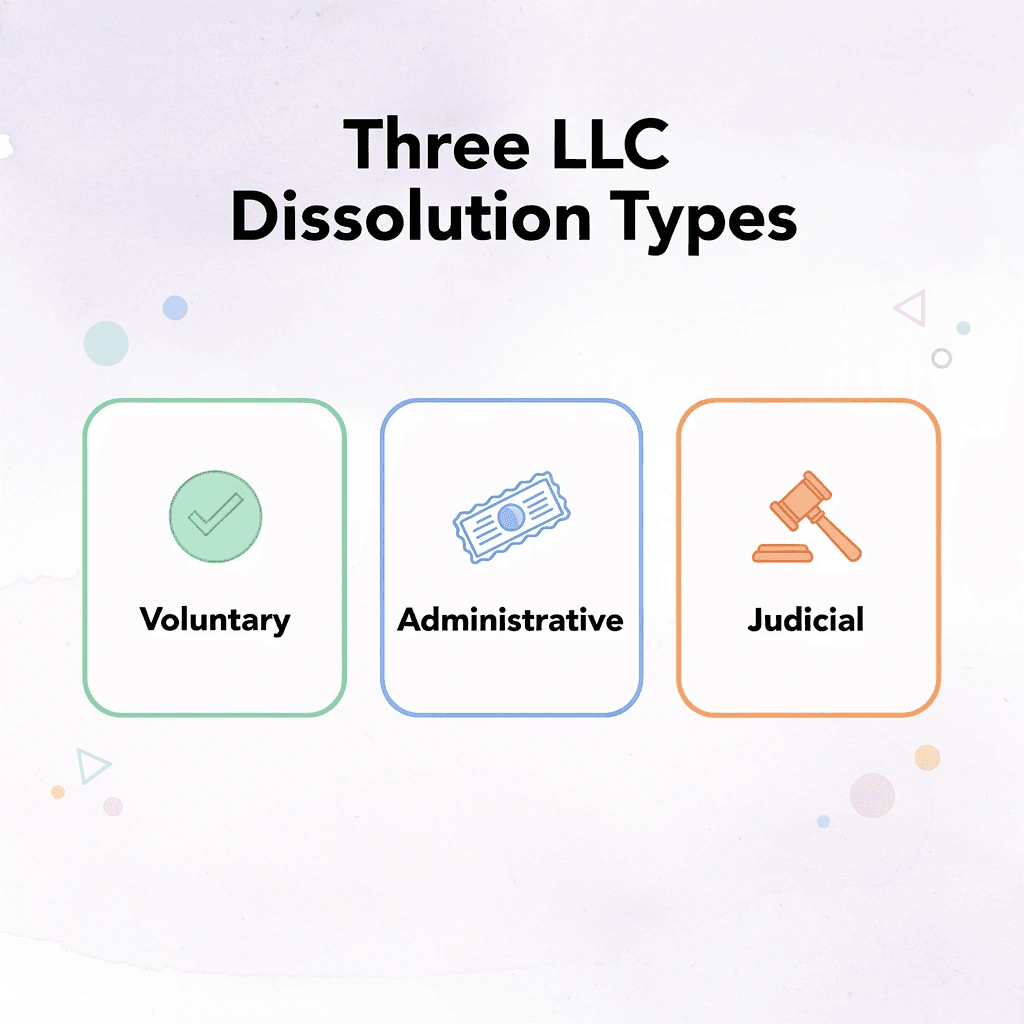
Voluntary dissolution lets founders control the exit sequence: settling debts, notifying creditors, distributing assets, and filing paperwork at their own pace. The Arkansas Secretary of State charges a $50 filing fee for Articles of Dissolution, keeping administrative costs low compared to the financial exposure of unresolved obligations. Manual winding-up via spreadsheets works until key dates slip or subscriptions keep billing after closure. Our Starcycle platform provides structured action plans, contract tracking, and key date management to prevent costly oversights during wind-down.
Administrative dissolution occurs when the Arkansas Secretary of State dissolves your LLC for failing to meet compliance requirements, typically due to unpaid annual franchise tax or failure to maintain a registered agent. Unlike voluntary dissolution, this forced exit creates compliance problems. An administratively dissolved LLC must complete formal reinstatement before resuming legal business operations, adding time, cost, and administrative burden.
Judicial dissolution occurs when a court orders an LLC to dissolve due to member disagreements, management deadlock, or serious wrongdoing that the operating agreement cannot resolve. It occurs more frequently in multi-member LLCs where negotiation has failed. Because court involvement is required, the process takes longer, costs more, and is less predictable than voluntary dissolution or administrative closure.
The type of dissolution you choose determines how much control you retain over the closing process. Voluntary dissolution keeps decision-making in your hands, while administrative and judicial dissolution transfer that control to the state or a judge. For founders seeking a structured, efficient exit, the goal is to achieve voluntary dissolution before circumstances force a different outcome. A clean business closure preserves your reputation, relationships, and financial standing. Once you understand the three types, the next questions founders ask reveal the underlying complexity.
Place after the final CTA
"Dissolving an LLC is not just about stopping operations — it's about properly closing your legal and financial obligations to protect yourself from future liability." — Business Formation Best Practices
FAQ Topic | Key Consideration |
|---|---|
Filing Requirements | Submit Articles of Dissolution to the Arkansas Secretary of State |
Tax Clearance | Must settle all outstanding state taxes before dissolution |
Creditor Notification | Legally required to notify known creditors |
Timeline | The process typically takes 4–6 weeks from filing to completion |
💡 Tip: Always consult a licensed attorney or CPA before beginning the dissolution process — missing a step can result in ongoing fees and penalties.
⚠️ Warning: Failing to properly dissolve your LLC in Arkansas means your business may still be subject to annual franchise taxes and reporting requirements — even if it's no longer operating.
🔑 Takeaway: A complete and compliant dissolution protects you from personal liability, closes your tax obligations, and ensures your business records are officially and permanently closed with the state.

Leaving an inactive Arkansas LLC in place carries ongoing obligations. The state requires annual franchise tax payments and compliance filings regardless of whether your LLC opened a bank account or signed a contract. According to the Arkansas Secretary of State, the $300 annual franchise tax fee is required before dissolution, so a dormant LLC can accumulate substantial financial obligations over time. Filing formal dissolution paperwork is the only way to stop that clock.
Dissolving the LLC itself does not touch your personal credit report. The risk lies in personal guarantees attached to business loans, leases, or vendor agreements. Those obligations follow you past dissolution because they were never the LLC's liability alone. If you guaranteed a line of credit, that debt does not disappear when the Articles of Dissolution are accepted. Most founders track dissolution tasks across email, calendar reminders, and PDFs, an approach that fails when deadlines slip or documents go missing. Our Starcycle platform offers tailored action plans, key date tracking, and document organization to move through winding up without losing critical details.
After paying off debts and obligations, any remaining money in your business bank account is distributed to LLC members according to the operating agreement and Arkansas law. This distribution must be recorded as part of the legal closing process. Keep all formation documents, tax filings, contracts, and dissolution paperwork. Questions from the IRS, former vendors, or state agencies can arise months or years after closure, and your records are your only protection.
Your EIN is permanently tied to the dissolved business and cannot be transferred to a new one. Any future LLC will need a new EIN from the IRS. Your website and domain name are separate assets; dissolving the business doesn't cancel your hosting or domain registration. You'll need to handle redirection or preservation independently. According to the Arkansas Secretary of State, the Articles of Dissolution carry a $45 filing fee. However, knowing what to file is only part of the process. The harder part, which most guides skip entirely, is what you do in the weeks before submitting that form.

Most founders think dissolving an LLC in Arkansas is a single administrative act: file dissolution paperwork, stop operating, and move on. That assumption creates more problems than it solves. Arkansas law treats dissolution as the beginning of a formal process, not the end of your obligations.
The confusion is understandable. When you formed your LLC, you filed articles of organization, received approval, and started doing business. Dissolution should work in reverse: file the paperwork, get confirmation, and walk away. But Arkansas Code Annotated Title 4, Subtitle 3, Chapter 38 (specifically §§ 4-38-701 through 4-38-709) makes clear that dissolution triggers a separate phase, called a wind-up, during which the LLC continues to exist for specific purposes.
Under §4-38-701, an LLC is dissolved when a triggering event occurs (a member vote, an event specified in the operating agreement, or administrative dissolution by the state). At that point, the LLC does not cease to exist. Instead, it enters wind-up.
During the wind-up, the LLC continues to exist for limited purposes: settling debts, fulfilling contractual obligations, handling tax obligations, and distributing any remaining assets. Filing dissolution paperwork does not bypass these responsibilities. It authorizes them.
The Uniform Limited Liability Company Act, which Arkansas adopted, is designed to protect creditors, members, and the public by requiring an orderly exit. The law assumes that businesses leave obligations behind, even when operations cease. Quiet exits are not the same as legal ones.
Another common misunderstanding is believing that filing Articles of Dissolution with the Arkansas Secretary of State automatically ends all obligations. State filing formally recognizes dissolution, but it does not eliminate unresolved liabilities.
If creditors, taxes, or contracts are not properly handled during the wind-up, issues can arise long after the founders believe the business is closed. I've seen founders receive tax notices two years after they thought their LLC was finished because they filed dissolution paperwork but never closed their employer identification number or submitted final tax returns. The state filing confirmed intent to dissolve, but it did not release them from obligations they never addressed.
Some founders stop operating, close the bank account, and assume the LLC will quietly expire. Arkansas law does not recognize inactivity as dissolution. Until the LLC is properly dissolved and wound up, it continues to exist legally.
This misunderstanding often shows up later through tax notices, franchise tax issues, or questions about prior entities when founders start something new. The Arkansas Secretary of State still lists the LLC as active. The state still expects annual franchise tax filings. Creditors can still pursue claims.
Founders who shut down operations without filing dissolution paperwork often discover years later that their "closed" business has accumulated penalties, fees, and compliance issues. The LLC never stopped existing. It just stopped being managed.
Most people handle this by piecing together state requirements, tax obligations, and compliance deadlines on their own, relying on scattered guidance from government websites and generic legal articles. As the checklist grows (final tax returns, creditor notifications, contract terminations, asset distributions, state filings), it becomes easy to miss steps or misunderstand their sequence. Platforms like Starcycle provide tailored action plans that organize these obligations into a clear roadmap, helping founders complete wind-up correctly without overlooking critical steps or triggering future liabilities.
Formation feels like a single step. Dissolution should feel like the reverse. But the Uniform LLC Act treats formation and dissolution asymmetrically because they serve different purposes. Formation creates a legal entity. Dissolution begins the unwinding process, which requires time, transparency, and attention to obligations.
The law does not assume good faith alone is sufficient. It requires documentation, notification, and completion of specific duties. Founders who expect dissolution to mirror formation often underestimate the administrative burden of a proper closing.
What "dissolving" actually means under Arkansas law is more involved than most founders expect.
Obligation tracking, document organization, and stakeholder coordination — in one platform, in the right order.
Get my shutdown plan
Dissolving an LLC is a legal declaration that the entity will cease to exist, but not immediately. It starts a clock. From the moment dissolution is filed, the LLC remains legally existent but operates under different rules. It can't take on new business, sign new contracts, or expand operations. It exists only to finish what it started.
This is where expectations diverge from reality. Shutting down operations feels final. You stop answering emails, close the storefront, and cancel subscriptions. However, the legal entity remains active until all obligations associated with its existence are satisfied. The state doesn't recognize "we're done" as a status. It recognizes dissolution, followed by the completion of the wind-up.
When you file Articles of Dissolution with the Arkansas Secretary of State, you're not erasing the LLC. You're changing its legal status from "active and operating" to "dissolved and winding up." That shift matters because it redefines what the LLC can and cannot do.
A dissolved LLC in Arkansas retains the power to settle debts, resolve disputes, distribute assets to members, and handle tax obligations. It cannot enter into new agreements, assume new liabilities, or continue operating as if nothing had changed. The entity is in a controlled descent, not in free fall.
This distinction protects everyone involved. Creditors get time to file claims. Members get time to handle distributions properly. Tax authorities get time to verify final filings. The law assumes that abrupt endings create more problems than orderly ones.
Wind-up is not symbolic. It's a checklist of concrete tasks that must be completed before the LLC can be terminated. Arkansas Code § 4-38-702 outlines the steps during this phase: the LLC must collect and dispose of its property, discharge or make provision for its liabilities, and distribute the remaining assets to its members.
That sounds straightforward until you realize how many threads need untangling. Outstanding invoices. Lease agreements. Vendor contracts. Tax obligations at the state and federal levels. Employee final wages. Intellectual property transfers. Each one requires documentation, communication, and often negotiation.
I've worked with founders who filed dissolution paperwork, expecting it would take a week to complete. Six months later, they were still chasing down final tax clearances and resolving contract terminations. The legal process doesn't care about your timeline. It cares about completion.
Some founders believe that if they cease operations, the LLC will eventually dissolve on its own. Arkansas law does not work that way. An inactive LLC remains a valid legal entity. It still owes franchise taxes. It still must file annual reports. It remains in the state's eyes until formal dissolution is complete.
According to the Arkansas Secretary of State's business database, thousands of LLCs remain listed as active despite having no operations, revenue, or activity. Their founders assumed inactivity equaled closure. Years later, they discover accumulated penalties, unresolved compliance issues, and a legal entity they thought had been dissolved.
The state has no mechanism to automatically dissolve inactive entities. Dissolution requires affirmative action. Filing paperwork. Completing wind-up. Submitting final documents. Until those steps are taken, the LLC continues to exist and accrues obligations, whether or not anyone is paying attention.
When operations end, most founders focus on what stops: revenue, expenses, and customer relationships. What they miss is what continues: legal obligations tied to the entity's existence. Tax filings don't stop because revenue stopped. Registered agent requirements don't pause because the office is closed. State fees don't disappear because the business is dormant.
This creates a gap between lived experience and legal reality. You feel done. The state sees an active entity with unmet obligations. That gap widens over time, leading to notices, penalties, and administrative headaches that arise when you least expect them.
Founders often handle this by piecing together state requirements, tax obligations, and compliance deadlines on their own, relying on scattered guidance from government websites and generic legal articles. As the checklist grows (final tax returns, creditor notifications, contract terminations, asset distributions, state filings), it becomes easy to miss steps or misunderstand their sequence. Platforms like Starcycle provide tailored action plans that organize these obligations into a clear roadmap, helping founders complete wind-up correctly without overlooking critical steps or triggering future liabilities.
Filing Articles of Dissolution with the Arkansas Secretary of State is necessary, but it's not sufficient. The state acknowledges your intent to dissolve. It does not certify that all obligations have been met. That certification comes only after the wind-up is complete and all required steps are documented.
Full closure means the LLC is removed from active status, tax accounts are closed, final returns are filed, creditors are notified, and assets are distributed. It means there are no loose ends that could resurface later. The state filing is the start of that process, not the finish line.
Founders who treat state filing as the end often discover, months or years later, that obligations remain unresolved. A tax account is still open. A registered agent is still listed. A creditor's claim was never addressed. The state accepted the dissolution filing, but the process was never completed.
The real work of dissolving an LLC happens between filing and finality. That's the phase most people underestimate, and where most mistakes occur.

Most Arkansas LLC dissolutions don't fail because founders fail to follow the process. They stall because closure happens in disconnected pieces across different systems, each operating on its own timeline. The state accepts your dissolution filing, but tax accounts remain open. Contracts auto-renew. Registered agents stay listed. What felt like completion turns out to be partial progress, and the gaps surface months later through unexpected notices or fees.
The breakdown isn't dramatic. It's quiet, gradual, and often invisible until something forces you to look back.
Filing Articles of Dissolution with the Arkansas Secretary of State updates your business status in one database. It does not communicate with the Arkansas Department of Finance and Administration, the IRS, or any local tax authority. Those systems continue to operate as if nothing has changed until you explicitly close them.
Founders often discover this when they receive franchise tax notices six months after filing dissolution paperwork. The state recognized your intent to dissolve, but your tax account remained active because no final return was filed. According to the Arkansas DFA's 2024 compliance data, approximately 22% of dissolved entities still had open tax accounts more than a year after filing for dissolution, resulting in penalties averaging $350 per entity.
The same pattern appears with federal obligations. Your EIN doesn't expire when the LLC dissolves. The IRS expects a final return marked as such, with specific boxes checked and dates documented. Without that signal, the agency assumes ongoing activity and continues expecting annual filings.
Software subscriptions, vendor agreements, and service contracts don't pause when operations stop. They renew automatically, often with annual billing cycles that make them easy to forget. A $50 monthly SaaS tool becomes a $600 annual charge that hits your business account long after you thought everything was closed.
The failure point is usually scattered recordkeeping. Contracts live in email threads, shared drives, and individual team members' inboxes. When the business winds down, no single person holds a complete list of what's still active. Cancellation windows pass unnoticed. Termination clauses require 30 or 60 days' notice, and by the time you remember, another billing cycle has started.
I've worked with founders who believed they'd cancelled everything, only to find charges appearing months later from services they'd forgotten they used. One client discovered a $1,200 annual domain registration fee that auto-renewed because the original purchase email was buried in an old inbox no one checked anymore.
Arkansas annual reports are due by May 1st every year, regardless of whether your LLC is still operating. If you stop doing business in June but don't file dissolution paperwork until the following March, you still owe that year's report and franchise tax. The state doesn't prorate obligations based on when you stopped operating. It measures them by when the LLC legally ceased to exist.
Missing that deadline triggers late fees. In Arkansas, the penalty starts at $25 and increases over time. More importantly, it creates administrative friction. You can't complete dissolution while compliance issues remain unresolved. That means reopening accounts, filing overdue reports, and paying penalties before you can finish the wind-up process you thought was already underway.
The same timing pressure applies to creditor notifications. Arkansas Code § 4-38-703 allows LLCs to publish notice to unknown creditors, giving them 120 days to file claims. If you skip this step or execute it incorrectly, the statute of limitations extends, leaving you exposed to claims for years. The clock starts when proper notice is given, not when you stop operating.
When documents are scattered across platforms, confirming what's been completed becomes guesswork. Did you file the final state tax return or just the federal one? Was the registered agent officially changed, or were they just notified? Did you cancel that contract or only intend to?
That uncertainty forces founders to retrace steps they believe they already took. You file duplicate paperwork because you can't confirm the original was submitted. You pay fees twice because the first payment confirmation email was lost. You contact the same agency multiple times because there is no central record of prior interactions.
The cost isn't just financial. It's cognitive load during a period when most founders are already managing the emotional weight of closing a business. Every unresolved question adds friction. Every missing document extends the timeline. What should take weeks stretches into months because the process lacks structure.
Most founders handle this by piecing together checklists from state websites, legal articles, and generic business advice, then tracking progress in spreadsheets or in their heads. As obligations multiply (final tax returns, creditor notices, contract terminations, asset distributions, compliance filings), it becomes difficult to maintain visibility across all threads. Platforms like Starcycle organize these tasks into sequenced action plans with document storage and progress tracking, compressing timelines by ensuring nothing is overlooked or duplicated.
The common thread isn't negligence. It's fragmentation. Dissolution requires coordinating actions across multiple systems that don't communicate with each other, each with its own requirements, deadlines, and confirmation processes. State filings. Tax closures. Contract terminations. Asset distributions. Creditor notifications. Each one is straightforward in isolation. Together, they create a coordination problem that most founders underestimate.
The breakdowns happen in the gaps between systems. You complete step three before realizing step two wasn't fully finished. You assume that one filing covers multiple obligations, even though they're separate. You treat silence from an agency as confirmation when it's just delayed processing.
Arkansas LLC dissolutions stall not because the steps are impossibly complex, but because they're interdependent and easy to execute out of sequence or incompletely. The process rewards structure over speed, documentation over assumption, and systematic completion over good intentions.
The legal steps themselves are clear, but knowing them and executing them in the right order are different challenges.

Dissolving an LLC in Arkansas requires completing four sequential steps, each dependent on the previous step. Member approval authorizes the process. Wind-up resolves obligations. State filing formalizes dissolution. Final tax compliance closes accounts. Skip one, and the others lose their legal foundation.
Every Arkansas LLC dissolution begins with internal authorization. Your operating agreement likely specifies how dissolution decisions are made: unanimous consent, majority vote, or some other threshold. If the agreement is silent, Arkansas Code § 4-38-701 defaults to majority approval by members.
Single-member LLCs face less procedural friction here, but the authorization still matters. Document the decision through written consent or meeting minutes. That record proves you had the authority to begin the wind-up and file the dissolution paperwork. Without it, later actions rest on shaky legal ground.
This step takes minutes to complete but protects you from member disputes later. If someone claims they never agreed to dissolve, your documentation answers that question before it becomes expensive.
Once dissolution is approved, the LLC enters wind-up. This is where liability gets resolved or left to fester. Arkansas Code § 4-38-702 permits the LLC to continue to exist during this phase for one purpose: to settle its affairs.
Wind-up means notifying known creditors in writing. It means resolving outstanding contracts, whether through performance, negotiation, or termination clauses. It means collecting receivables, liquidating assets, and settling debts. It means confirming that state and federal tax obligations are current and that final returns are prepared.
After obligations are settled, the remaining assets are distributed to members in proportion to their ownership interests. That distribution should be documented. If you transfer property, equipment, or intellectual property, create records showing what went where and when.
The wind-up phase is where most dissolved LLCs leave loose ends. A vendor invoice goes unpaid because no one tracked it. A lease auto-renews because a termination notice wasn't given 60 days in advance. A tax account stays open because the final return wasn't marked as final. These aren't dramatic failures. They're small administrative gaps that compound over time.
Founders often piece together wind-up tasks through spreadsheets, email reminders, and memory, which works until something falls through the cracks. Platforms like Starcycle organize wind-up into sequenced action plans with built-in tracking for creditor notifications, contract terminations, and asset distributions, reducing the risk that critical steps get overlooked during an already stressful transition.
After the wind-up is complete (or substantially underway), file Form LL-04, the Statement of Dissolution, with the Arkansas Secretary of State. This filing changes your LLC's status from active to dissolved in the state's records.
The form requires basic information: your LLC's name, the date of your original Certificate of Organization, any amendments, the reason for dissolution, the effective date, and an authorized signature. Errors here delay acceptance. If the LLC name doesn't exactly match state records, including punctuation, the filing is rejected.
Filing fees are $50 by mail, $45 online. Online filing generates a secure filing number immediately, which serves as proof of submission. Mailed filings take longer to process and do not provide instant confirmation.
Filing Articles of Dissolution tells the state you intend to close. It does not tell tax agencies, creditors, or contract counterparties. Those notifications occur separately, so a state filing alone does not constitute full closure.
Arkansas treats dissolution and tax compliance as separate obligations. Filing Articles of Dissolution does not close your tax accounts. The Arkansas Department of Finance and Administration and the IRS both require final filings to be submitted before they recognize your LLC as closed.
File your final Arkansas franchise tax return and mark it as final. File your final federal income tax return (Form 1065 for multi-member LLCs, Schedule C for single-member LLCs) and check the box indicating it's the final return. If you had employees, file final payroll tax returns and close your withholding account.
Each tax account operates independently. Closing one does not close the others. Your EIN remains active until you notify the IRS that the entity is dissolved and all obligations are met. The Arkansas DFA will continue to request annual reports until you file final returns and request account closure.
According to the Arkansas DFA's 2024 compliance data, approximately 18% of dissolved LLCs received penalty notices within 12 months of filing dissolution because final tax returns were never submitted. The state accepted the dissolution paperwork, but the tax system continued to operate.
Knowing these steps and executing them in the right sequence are different problems.
75% of closures leave unresolved obligations that create long-term exposure. A structured winddown saves 40–60 hours and cuts legal risk ~80%.
Get a quote
Most founders approach dissolution as a linear process: find the right forms, follow the steps, and close the business. The reality is that dissolving an LLC in Arkansas is a coordination problem. You're not executing a single action. You're managing overlapping timelines across agencies that don't communicate, tracking obligations that trigger other obligations, and documenting decisions that must happen in a specific sequence or they create new problems.
Instructions tell you what to do. Structure ensures you actually do it, in the right order, without missing dependencies that surface later as penalties or unresolved liabilities.
A checklist feels like progress. File Articles of Dissolution. Close the bank account. Submit final tax returns. Cancel subscriptions. Each item checked creates a sense of completion.
But dissolution doesn't work like a grocery list where order doesn't matter. Member approval must be obtained before the wind-up begins. Creditor notifications must go out before asset distributions. Final tax returns can't be filed until all financial activity stops. State dissolution can't be finalized while tax accounts remain open.
When founders treat these as independent tasks rather than dependent steps, they file paperwork prematurely, distribute assets before debts are settled, or close accounts that still have pending obligations. The checklist gets completed, but the process breaks down because sequence matters more than volume.
According to Founders Forum Group, 70% of startups fail between years 2 and 5. That means dissolution isn't an edge case. It's a common transition, yet most founders enter it with no roadmap beyond generic legal advice and scattered state guidance. The information exists. The structure to execute it cleanly does not.
During normal operations, founders track obligations through calendars, spreadsheets, email reminders, and memory. That system works when the business is stable, and someone is actively managing it. During dissolution, it fails.
You're shutting down operations while simultaneously managing the administrative closure process. You're emotionally exhausted from the decision to close. You're thinking about what comes next, not which agency still needs a final form. Mental bandwidth is low precisely when administrative precision is required.
Manual tracking creates gaps. You forget which contracts were cancelled and which are still auto-renewing. You lose track of which tax returns were filed and which are still pending. You can't remember if you notified that one creditor or just meant to. Each gap is small. Together, they extend timelines, trigger fees, and leave obligations unresolved.
The cost shows up later. A subscription charge six months after you thought everything was closed. A penalty notice from the Arkansas DFA for failing to file an annual report. A creditor claims that it surfaces because proper notice was never given. These aren't dramatic failures. They're the predictable result of managing complexity without structure during a high-stress transition.
The difference between knowing what needs to happen and ensuring it happens is visibility. Can you see, at any moment, what's been completed, what's in progress, and what's still pending? Can you confirm that a filing was submitted without searching through email? Can you identify which obligations are blocking others?
Most founders can't. They operate from memory and scattered confirmations, which works until something falls through the cracks. Then they spend time reconstructing what was done, refilling paperwork they believe may be missing, or contacting agencies multiple times because they have no record of prior interactions.
Centralized tracking solves this by making the status transparent. You know what's done because it's documented in one place. You know what's next because dependencies are visible. You know nothing is forgotten because the system holds the full list, not your memory.
That visibility reduces cognitive load. You're not constantly wondering if you missed something. You're not second-guessing whether a step was completed. You're following a clear path with confirmation at each stage.
Dissolution timelines stretch when founders discover missed steps after they thought the process was complete. You file Articles of Dissolution, then realize six weeks later that final tax returns were never submitted. You close your bank account, then discover a vendor invoice that can't be paid. You distribute assets, then learn that a creditor's claim was never resolved.
Each discovery restarts part of the process. You reopen accounts. You refile paperwork. You negotiate with creditors who should have been notified months earlier. What could have taken weeks now takes months because steps happened out of sequence.
Structure prevents this by surfacing dependencies before they become problems. It shows you that tax accounts must be closed before state dissolution is finalized. It reminds you that creditor notifications must be sent before asset distributions. It flags contracts that require a 60-day termination notice before you assume they have been cancelled.
When obligations are sequenced correctly, nothing needs to be redone. The timeline compresses because each step builds on the last without backtracking.
Founders can easily find information on Arkansas LLC dissolution. The Secretary of State website explains filing requirements. The DFA outlines tax obligations. Legal articles describe wind-up procedures. The information is accessible.
What's missing is a system that translates information into execution. Knowing you need to notify creditors is different from having a template, tracking who was notified, and confirming receipt. Knowing you need final tax returns is different from understanding which forms apply to your entity type, when they're due, and how to mark them as final.
Information answers what? Structure answers how, when, and in what order. It turns knowledge into action, and action into verified completion.
Most founders handle dissolution by assembling guidance from multiple sources and managing execution through spreadsheets and reminders. As the task list grows (member approvals, creditor notifications, contract cancellations, tax filings, state submissions, asset distributions), maintaining visibility across every thread becomes difficult. Platforms like Starcycle provide tailored action plans that sequence these obligations, track progress centrally, and surface dependencies before they create delays, compressing what often takes months into weeks by ensuring nothing is overlooked or executed out of order.
Founders dissolve LLCs not just to satisfy legal requirements, but to move forward without unresolved obligations shadowing what comes next. A clean closure means no surprise tax notices, no lingering liabilities, no administrative debris that resurfaces when you start something new.
The difference between a messy shutdown and a clean one isn't effort. Its structure. Founders who finish confidently don't work harder. They work within a system that ensures nothing is forgotten, nothing is done out of sequence, and nothing remains unresolved.
That confidence comes from knowing the process is complete, not just believing it is.
But knowing the steps and actually closing cleanly remain two distinct challenges.

Founders who close cleanly in Arkansas don't follow a different process. They follow the same process with a different mindset. They treat dissolution as deserving the same care they gave to formation, not as an administrative burden to rush through. That shift in approach changes outcomes.
The difference shows up months later. Clean closures don't generate surprise tax notices. They don't leave creditors unresolved. They don't create compliance gaps that surface during background checks for new ventures. Founders who close well protect their future by fully completing their past.
Stopping operations feels like the end. You turn off the lights, close the office, and stop answering customer emails. Emotionally, the business is done. Legally, it's still very much alive.
Founders who move forward confidently recognize this gap. They know that feeling finished and being finished are separate states. The emotional work of accepting closure happens on one timeline. The administrative work to complete it is scheduled for another day. Trying to compress both into the same moment leads to errors.
When you're emotionally exhausted from deciding to close, you're least equipped to handle detailed compliance work. Founders who do this well create space between decision-making and execution. They let themselves process the emotional weight without rushing the administrative steps that require precision.
That separation protects both. You can grieve, feel relief, or whatever emotion surfaces, without the pressure of perfect paperwork. And you handle the paperwork when you have the mental bandwidth to do it right.
Clean closures generate paper trails. Member approval in writing. Creditor notifications with delivery confirmation. Contract termination emails saved and filed. Asset distribution records signed by all parties. Tax return copies stored with dissolution paperwork.
This isn't bureaucracy for its own sake. It's insurance against future questions. When someone asks three years later whether a creditor was notified, you don't rely on memory. You produce the certified mail receipt. When the IRS questions whether your final return was actually marked final, you show them the filed copy with the box checked.
According to the Small Business Administration's 2023 closure data, businesses that maintained organized records during dissolution resolved post-closure issues 64% faster than those relying on scattered documentation. The time spent organizing during the wind-up saves multiple times that time later.
Documentation also protects against internal disputes. If a member claims they never agreed to the asset distribution terms, your signed record settles the matter. If a vendor insists they were never notified of the closure, your delivery confirmation will confirm that. Records convert disputes into facts.
The temptation during dissolution is to do everything at once. File state paperwork while closing bank accounts, cancelling contracts, and distributing assets. It feels efficient. It creates problems.
Some obligations must happen before others. You can't distribute assets until debts are settled. You can't close tax accounts until final returns are filed. You can't finalize state dissolution while compliance issues remain open. Doing things out of order forces you to undo and redo steps, extending timelines and creating gaps.
Founders who close cleanly resist the urge to rush. They complete member approval before starting wind-up. They resolve liabilities before distributing assets. They file final tax returns before closing accounts. They wait for state confirmation before assuming dissolution is complete.
That patience compresses overall timelines because nothing needs to be repeated. Each step builds on verified completion of the previous one. The process takes time, but only once.
You are aware of the vendor invoices and the lease agreement. Those are easy to track. What about the software subscription you signed up for two years ago and forgot about? Is the domain registration set to auto-renew? The business credit card with a small recurring charge you stopped noticing?
Founders who close cleanly assume there are obligations they've forgotten. They audit bank statements for the past 12 months, looking for recurring charges. They search the email for contract confirmations. They review credit card statements for subscriptions. They contact service providers proactively rather than waiting for renewal notices.
This audit catches the obligations that would otherwise surface months later as unexpected charges or unresolved contracts. It's tedious work. It's also the difference between thinking you're done and actually being done.
Some founders treat dissolution as a test of self-sufficiency. They research statutes, interpret requirements, and file paperwork themselves because asking for help feels like admitting defeat. That pride extends timelines and increases error rates.
Founders who close confidently recognize that dissolution involves specialized knowledge they don't use regularly. Tax compliance rules change. State filing requirements have nuances. Creditor notification procedures carry legal weight. Getting these wrong creates liabilities that cost more to fix than guidance would have prevented.
Choosing support isn't about capability. It's about efficiency and risk management. You can learn Arkansas dissolution law, or you can work with someone who already knows it. One path takes weeks of research and carries execution risk. The other compresses timelines and reduces errors.
Platforms like Starcycle exist for this reason. Founders often manage dissolution through self-research, scattered checklists, and manual tracking across multiple systems. As obligations multiply (creditor notifications, contract cancellations, tax closures, state filings, asset distributions), maintaining visibility and sequence becomes difficult. Starcycle provides structured action plans that organize tasks by dependencies, track completion centrally, and surface next steps, compressing what typically takes months into weeks while ensuring nothing critical is overlooked. With transparent pricing starting at $399 and no hidden costs, founders gain clarity without adding financial stress during an already difficult transition.
How you exit a business affects how people remember you. Vendors, customers, partners, and employees all form lasting impressions based on how closure was handled. Did you notify people properly? Did you honor commitments? Did you settle debts fairly?
Founders who move forward confidently understand that their professional reputation outlasts any single business. They notify customers with enough lead time to find alternatives. They pay vendors in full even when they could negotiate a discount. They provide employees with proper notice and final paychecks on time.
This costs more in the short term. It pays dividends long term. The vendor you treated fairly becomes a reference for your next venture. The customer you notified properly recommends you when someone needs expertise in your field. The employee you handled well speaks positively when your name comes up.
Responsible closure isn't just legal compliance. Relationship management extends beyond the business itself.
Filing paperwork creates a sense of finality. You submitted the form, paid the fee, and received confirmation. It feels done. But confirmation of filing isn't confirmation of completion.
Founders who close cleanly verify every step. They don't just file final tax returns. They confirm with the Arkansas DFA and IRS that accounts are closed. They don't just submit Articles of Dissolution. They check the Secretary of State database to verify that the status changed to dissolved. They don't just cancel contracts. They get written confirmation that termination was processed.
This verification catches processing errors, missed requirements, and administrative gaps before they become problems. Sometimes filings get lost. Sometimes forms are rejected for minor errors. Sometimes agencies require additional documentation. Identifying issues immediately lets you fix them while you're still focused on closure. Discovering this six months later means reopening a process you thought was complete.
The extra week spent verifying completion prevents months of cleanup later.
Once dissolution is complete, the instinct is to delete everything. Close email accounts. Shred documents. Clear out digital files. You're done, so why keep reminders?
Because tax audits can go back three years. Creditor claims can surface within statute-of-limitations periods. Because future ventures sometimes require proof of how previous businesses were closed. Because lenders and investors conducting due diligence want to see clean histories.
Founders who move forward confidently keep dissolution records for at least five years. Final tax returns. State filing confirmations. Creditor notification receipts. Asset distribution agreements. Bank account closure letters. Member approval documents.
These records take minimal storage space. They provide maximum protection if questions arise. The cost of keeping them is negligible. The cost of not having them when needed can be high.
But the real shift happens when founders stop treating closure as something to escape from and start seeing it as something worth finishing properly.
Dissolution doesn't have to drag on for months while you wonder what you've missed. If you're ready to close your Arkansas LLC without second-guessing every step or discovering obligations six months after you thought you were finished, Starcycle helps founders complete the process faster with less stress. You get a tailored action plan that sequences every requirement, tracks what's done, and surfaces what's next. No hidden fees. No vague timelines. Just transparent pricing starting at $399 and a clear path from decision to completion.
The difference between closing and closing cleanly is structure. Sign up to get a quote and see how organized guidance changes the dissolution experience. You've already made the hard decision. Administrative work shouldn't be more difficult than necessary.