 Starcycle
State Guide
Closing an LLC in Ohio involves more than submitting a single form. Founders must file Articles of Dissolution with the Ohio Secretary of State, settle outstanding debts, notify creditors, and fulfill tax obligations with the Ohio Department of Taxation. Each step follows a specific order, and missing one can leave the business legally exposed long after the doors close.
Knowing how to dissolve an LLC in Ohio correctly saves time, money, and future liability. Starcycle works with founders through every stage of business closure, from winding down operations to canceling registrations and clearing final tax requirements.
Most Ohio LLC owners get confused about stopping operations versus legally closing down. Under Ohio law, your LLC continues to exist as a legal entity until you formally dissolve it through the Ohio Secretary of State — no matter if you've stopped trading, closed your bank account, or let your website expire.
"Your LLC continues to exist as a legal entity until you formally dissolve it through the Ohio Secretary of State — regardless of whether you've stopped trading or closed your bank account." — Ohio LLC Dissolution Law
⚠️ Warning: Simply stopping operations is not the same as legally dissolving your LLC. Until you file the proper paperwork, your business remains open in the eyes of the law — and all associated obligations remain active.
💡 Tip: If you've stopped trading, closed your bank account, or let your website expire, don't assume your LLC is closed. You must file a formal dissolution with the Ohio Secretary of State to truly end your legal obligations.
Action Taken | LLC Still Active? |
|---|---|
Stopped trading | ✅ Yes — still legally open |
Closed bank account | ✅ Yes — still legally open |
Let website expire | ✅ Yes — still legally open |
Filed dissolution with Ohio Secretary of State | ❌ No — officially closed |

The gap between "we stopped operating" and "we are legally closed" creates hidden problems. Your LLC remains active in Ohio's public records, visible to creditors, state agencies, and potential partners. You may continue receiving notices from the Ohio Department of Taxation, face ongoing statutory agent requirements, or carry liability for unresolved debts and obligations. Walking away without filing articles of dissolution doesn't end these responsibilities; it delays them.
Voluntary dissolution is the most common way to close a business. Members vote to wind up the business, settle outstanding debts, distribute remaining assets, and file required paperwork with the state. Administrative dissolution occurs when the Ohio Secretary of State intervenes because the business failed to maintain a statutory agent or meet compliance requirements. Judicial dissolution is ordered by a court, typically after member disputes or findings of illegal conduct under Ohio Revised Code Section 1702.52. All three types require the proper winding up of the company's affairs before closure.
Most founders navigate this process alone, searching state websites and risking missed steps. The critical issue is sequencing: filing the wrong document at the wrong time or skipping creditor notifications can delay closure or create personal liability. Our Starcycle platform provides step-by-step action plans built around Ohio's specific requirements, tracking key dates and organizing necessary documents.
Most Ohio LLCs stay open longer than necessary not from carelessness, but because the process lacks clarity. There is no automatic closure trigger or state reminder that dormant LLCs continue accumulating obligations. Responsibility rests entirely with members, and without clear structure, inaction becomes the default. Knowing the three dissolution types is only the beginning of what you need to understand before filing.
Obligation tracking, document organization, and stakeholder coordination — in one platform, in the right order.
Get my shutdown planFiling the Articles of Dissolution is one of the final steps in closing your Ohio LLC. Every document you submit to the Ohio Secretary of State should show that the business has already completed its internal wind-up. Getting this sequence right makes the difference between a clean closure and one that creates liability months after you thought you were done.
"The Articles of Dissolution should reflect a business that has already completed its wind-up — not one that is still in the process of wrapping up." — Ohio LLC Dissolution Best Practices
⚠️ Warning: Submitting your Articles of Dissolution before completing your internal wind-up is one of the most common mistakes Ohio LLC owners make — and it can leave you exposed to unexpected liability long after you believed the business was closed.
🎯 Key Point: The Ohio Secretary of State does not verify whether your LLC has completed its wind-up before accepting your filing — that responsibility falls entirely on you and your members.
Pre-Filing Step | Why It Matters |
|---|---|
Settle all outstanding debts | Prevents creditor claims after dissolution |
Distribute remaining assets | Ensures members receive proper allocation |
Cancel licenses and permits | Avoids ongoing fees and obligations |
Close business bank accounts | Eliminates financial loose ends |
File final tax returns | Required before the state accepts dissolution |
💡 Tip: Work through every pre-filing step in order before you touch the Articles of Dissolution — a clean sequence now protects you from costly surprises later.

Your Operating Agreement is the first document to pull out, not the last. Most well-drafted agreements include specific voting thresholds, required notice periods, and instructions for distributing remaining assets. If your agreement requires a supermajority vote to dissolve, that requirement is binding regardless of what the state form asks for. Ignoring those provisions creates grounds for dispute among members.
When your LLC has more than one member, document the dissolution decision in formal meeting minutes or written consent signed by the required members. This protects you if a creditor or former member later questions whether dissolution was properly approved; the written record serves as your proof. Keep it with your business records even after the LLC is formally closed.
The failure point is usually not the paperwork; it's the incomplete inventory of what the business owes. Build a complete list of outstanding debts, active contracts, recurring subscriptions, permits, licenses, and employee obligations, including final payroll and benefits. A forgotten auto-renewing contract or unresolved vendor balance can surface as a personal liability claim long after the LLC dissolves.
Platforms built for business closure solve this problem by tracking contracts, subscriptions, and important dates in one place. Our Starcycle platform transforms a stressful inventory exercise into a clear checklist with a defined endpoint.
Once the decision to dissolve is made, the LLC should stop entering into new contracts, accepting new clients, or incurring new financial commitments. Ohio law treats the wind-up period as a distinct phase with its own rules; obligations created after dissolution can complicate the prioritization and settlement of debts. According to the Ohio State Bar Association's Law Facts on Divorce, Dissolution and Separation, a hearing must be held no sooner than 30 days and no later than 90 days after the petition is filed, reflecting Ohio's structured closure timelines to ensure obligations are properly resolved before finalization. The wind-up period exists to close things out, not to keep the engine running. Once you have completed these steps, the next steps follow a sequence that most guides overlook.
Dissolving an Ohio LLC follows a defined sequence. Each step builds on the last, and skipping ahead can create compliance gaps that outlast the business itself.
"Skipping steps in the LLC dissolution process can leave legal and financial liabilities open long after the business has stopped operating." — Legal Compliance Best Practices
⚠️ Warning: Never skip steps in the dissolution sequence — compliance gaps created by rushing the process can outlast the business itself, leaving you personally exposed to ongoing liabilities.
💡 Pro Tip: Treat the dissolution process as a checklist, not a suggestion — every step is a mandatory building block toward a clean, legally complete closure.
Dissolution Phase | What Happens If Skipped | Risk Level |
|---|---|---|
Notify Members & Vote | No legal authority to dissolve | 🔴 High |
Settle Debts & Liabilities | Personal liability exposure | 🔴 High |
Cancel Licenses & Permits | Ongoing fees and penalties | 🟡 Medium |
File Articles of Dissolution | LLC remains legally active | 🔴 High |
Close Tax Accounts | Continued tax obligations | 🟡 Medium |

Write down the vote in meeting minutes or a written consent resolution, note when it becomes effective, and file it with your business records. This written record protects you if disagreements arise later about who approved the closure and when.
The winding-up phase determines whether closures succeed or fail. Collect outstanding receivables, pay creditors in the order Ohio law requires, resolve pending disputes, and liquidate or distribute remaining assets according to your Operating Agreement. Close financial accounts only after all transactions clear, and retain final bank statements. Most founders track obligations in spreadsheets, which fail when forgotten auto-renewing contracts or overlooked vendor invoices surface months later. Platforms like Starcycle address this gap with contract and subscription management, key date tracking, and document organization to prevent oversights during wind-up.
File Form 616, the Certificate of Dissolution, with the Ohio Secretary of State once winding up is complete. You'll need the LLC's exact legal name, Ohio entity number, a statement of compliance with Ohio law, and an authorized signature. According to Northwest Registered Agent, the filing fee is $50. Tailor Brands reports the Secretary of State typically processes dissolution paperwork in 3 to 7 business days. Filing online through Ohio Business Central is faster and provides timestamped confirmation.
Filing the Certificate of Dissolution does not close your tax accounts. Depending on how your LLC was taxed, file a final federal return marked as final and settle remaining Ohio state tax obligations. If you collected sales tax or ran payroll, close those accounts separately and issue final W-2s or 1099s. Cancel every license, permit, and DBA registration individually; the state will not do this for you. The part nobody warns you about is what comes after you think you are done.
Most Ohio LLC dissolutions fall apart in the quiet weeks before and after filing, when founders assume administrative details will resolve themselves. They won't.

⚠️ Warning: Never assume the post-filing period is just a formality. The smallest overlooked administrative detail — a missed notice, an unfiled form, an unclosed account — can unravel an otherwise clean dissolution and expose founders to ongoing liability.
"The period before and after filing is where most LLC dissolutions quietly fail — not in the courtroom, but in the details no one thought to manage." — Dissolution Planning Best Practices
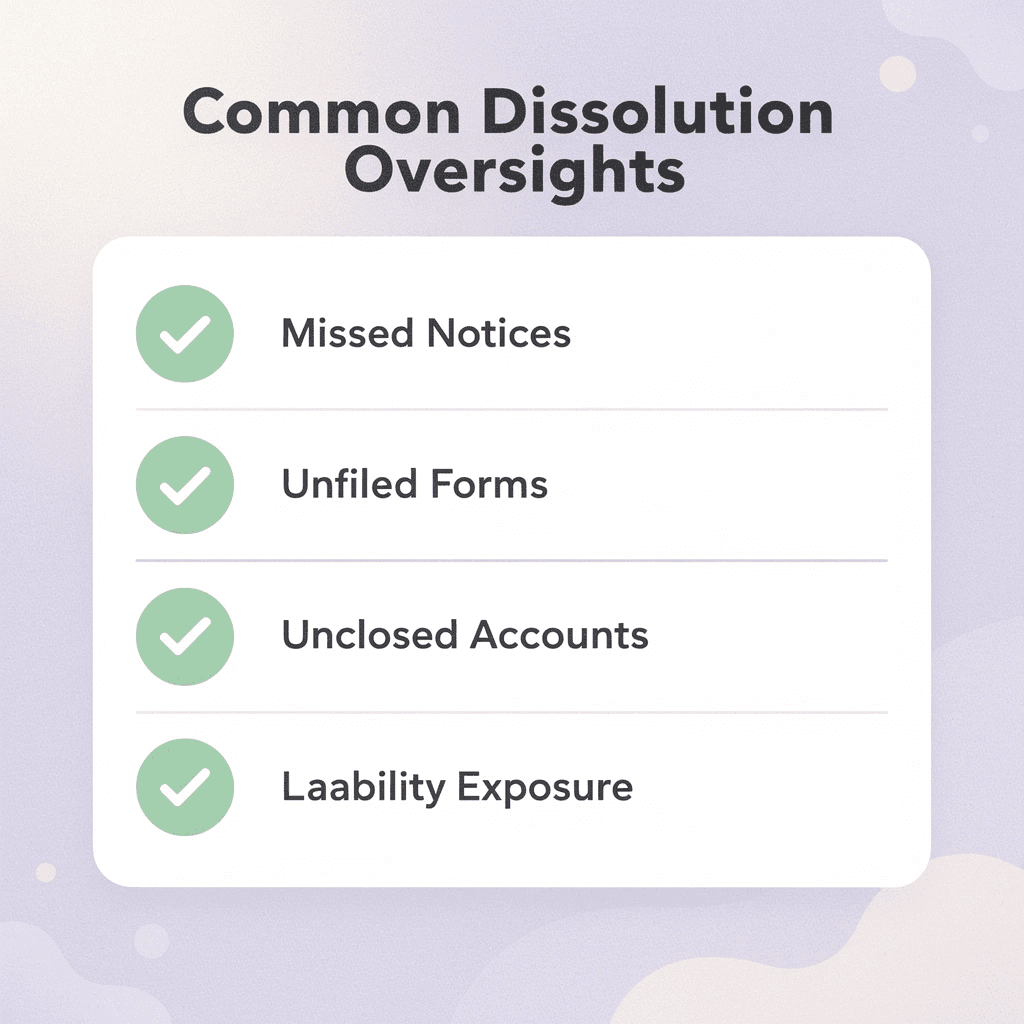
💡 Tip: Build a pre- and post-filing checklist before you begin the dissolution process. Treating administrative tasks as an afterthought is the single most common mistake founders make — and the one most likely to cause lasting legal and financial consequences.
Open business bank accounts are a common source of problems after a business closes. Automatic payments continue, monthly maintenance fees accumulate, and vendors keep charging a business that no longer legally exists. Close every business financial account once all transactions have cleared and final distributions are confirmed, and obtain written confirmation from the bank. The same applies to software subscriptions and equipment leases: many automatically renew on 30- or 60-day cycles, and vendors have no obligation to verify that your LLC still exists before charging your card.
Most founders manage this with a spreadsheet, which breaks down when deadlines overlap and one missed notice period locks you into another billing cycle. Our Starcycle platform tracks contracts and subscriptions, along with key dates, so nothing renews without your attention.
The Ohio Secretary of State's records show nearly 190,000 new business filings in 2025 alone. According to the Art of Data Engineering, only 3% of companies' data meets basic quality standards. This gap between official records and reality creates exposure for dissolved entities whose accounts, permits, or tax registrations weren't properly closed. If your Ohio vendor's license or trade name registration remains active months after dissolution, you may receive compliance notices, renewal demands, or penalties tied to a business you believe no longer exists.
Written proof that members approved the decision is important and often overlooked. Even if all members agreed in person, that agreement must be documented—either as a signed document or notes from a formal meeting kept with your company records. Ohio's process for closing a business doesn't require you to send this documentation to the state, but if a creditor, former partner, or taxing authority questions whether the dissolution is legitimate, your written records protect you.
Filing the Certificate of Dissolution closes your entity record with the Ohio Secretary of State but does not close your federal EIN account with the IRS, your Ohio commercial activity tax account, your sales tax permit with the Ohio Department of Taxation, or any employer withholding accounts.
Each requires a separate final filing, a final return marked as such, and sometimes a written request to close the account. According to IBM and Gartner research cited by the Art of Data Engineering, poor data quality costs the US economy $3.1 trillion per year, burdening businesses and government agencies reconciling improperly closed records. Leaving a tax account open generates automated penalty notices on returns that were never filed because you assumed the account had closed.
Finishing a dissolution correctly takes the same discipline as starting a business. Small details that seem unimportant can create notices, fees, and problems months after you thought everything was finished. Getting this right the first time is the fastest way to be done.
75% of closures leave unresolved obligations that create long-term exposure. A structured winddown saves 40–60 hours and cuts legal risk ~80%.
Get a quoteOhio outlines the legal steps to dissolve an LLC, but founders often struggle with timing, paperwork, tax obligations, creditor notification, and state filings. Missing any step can create problems.
"The dissolution process involves far more than a single filing: timing, taxes, and creditor notices must all align to achieve a clean and legally sound closure." — Starcycle Business Guidance
💡 Tip: Don't underestimate LLC dissolution complexity. Missing even one step can expose you to lingering liabilities or state penalties.

Starcycle guides you from the decision to close through the final filing, helping you understand exactly what needs to happen before, during, and after filing dissolution documents.
Phase | Key Actions |
|---|---|
Before Filing | Settle debts, notify creditors, resolve tax obligations |
During Filing | Submit Articles of Dissolution to the Ohio Secretary of State |
After Filing | Cancel licenses, close accounts, distribute remaining assets |
✅ Best Practice: Work with a guided dissolution service like Starcycle to ensure every phase is completed in the correct order — protecting you from costly oversights.
🎯 Key Point: Starcycle's end-to-end support means you're never left guessing what comes next — from the first decision to the last document.
A first session review with Starcycle identifies your remaining Ohio dissolution requirements, flags missing closure steps like open tax accounts or unresolved registered agent obligations, and provides a clear filing roadmap before you submit your Articles of Dissolution.
"Closing a business correctly requires addressing every outstanding obligation — from tax accounts to registered agent duties — before filing a dissolution document." — Starcycle Platform Insight
💡 Tip: Don't submit your Articles of Dissolution without a complete filing roadmap. Skipping steps like opening tax accounts can delay or invalidate your closure.
⚠️ Warning: Unresolved registered agent obligations are among the most commonly overlooked closure steps and most costly to fix after the fact.

Ready to finish this correctly? Get a personalized quote from Starcycle today. The platform was built by founders who understand that closing a business is not a failure: it is the final act of running one well.
✅ Best Practice: Work with a platform built by founders who've been there. Proper business closure is as important as a strong launch.
The timeline depends on how quickly you complete the winding up process and submit your paperwork. Once you've settled your business affairs, you can file the Certificate of Dissolution with the Ohio Secretary of State. Online filings are generally processed faster than mailed submissions, and expedited processing is available for an additional fee.
The filing fee to submit an Ohio LLC Certificate of Dissolution is $50. If you choose expedited processing, additional fees apply. Keep in mind that you may also incur costs to pay outstanding taxes, creditors, or professional advisors before your LLC can be fully closed.
Yes. Before closing your LLC, you should file all required federal, state, and, if applicable, local tax returns and pay any taxes owed. If your LLC had employees or collected sales tax, you'll also need to file your final payroll and sales tax returns and close those tax accounts.
Yes. The Ohio Secretary of State allows LLCs to file a Certificate of Dissolution online through Ohio Business Central. If you prefer, you can also submit the completed form by mail with the required filing fee.
Not necessarily. The voting requirement depends on your LLC's Operating Agreement. If it specifies how members must approve a dissolution, you should follow those provisions. If it does not, Ohio law provides the default rules for member approval. Document the decision in writing and keep it with your company records.
Your LLC does not automatically cease to exist simply because you stop doing business. It remains a legal entity until it is properly dissolved with the Ohio Secretary of State. As a result, you may continue receiving state correspondence, remain responsible for certain compliance requirements, and need to address unresolved tax or legal obligations.
Yes. Dissolving an LLC does not eliminate valid debts or legal claims. That's why it's important to notify creditors, pay outstanding obligations, and properly wind up the business before completing the dissolution. Failure to do so can lead to disputes even after the LLC has been dissolved.
Yes. Filing a Certificate of Dissolution does not automatically cancel your business licenses, permits, tax registrations, or other government accounts. You'll need to contact the appropriate state or local agencies to close each one separately.