 Starcycle
Guide
Closing your business? Starcycle runs the shutdown with you.
Get startedYou've decided to close the company, and now it has to close on paper as well. Shutting down a company means you approve the closure in writing, settle what the business owes, file final tax returns, dissolve the entity with your state, and close every account that still carries its name. Stopping operations does none of that by itself. Several states won't accept a dissolution filing until the tax side is settled, so the order you work in matters too.
Shutting down a company is harder than starting one because the work is spread across offices that don't coordinate with each other. You deal with your state's business registry, the IRS, your state tax and labor departments, and every bank, landlord and vendor you signed with, and each one has its own form and its own definition of closed.
Founders spend years learning how to build companies and almost no time learning how to dismantle one, so you learn the process while you're doing it. The closing comes during a stretch when money is tight and the decisions keep coming. If the list feels heavier than it looks, that's a fair reading of it.
The parts get smaller once you can see all of them on one page. A written list is how you keep from missing one. The IRS publishes its own checklist for closing a business, and the Small Business Administration lists the steps on the state and licensing side.

The company closure process is the set of steps that legally ends a business. The owners approve the closure in writing, the company pays or settles its debts, files final federal and state tax returns, files dissolution paperwork with the state where it was formed, and closes its tax accounts, licenses and bank accounts.
In practice it's the opposite of starting a company, except without the excitement that carried you through the tedious parts the first time. Every registration, account and contract you opened gets unwound. You'll also see the process called a company closing procedure, a wind-down, a dissolution or shuttering the business. Whichever name you searched for, ending a business properly covers the four areas below. If you're winding down a startup with investors, our startup wind-down checklist covers who to tell and when.
Before any paperwork gets filed, someone has to decide that the company is closing. That decision goes in writing. For a single owner the decision is straightforward: the SBA's guidance is that a sole owner can decide alone. Co-owners have to agree under the same guidance, following their articles of organization, and record the decision in a written agreement.
In a corporation, that record is a board resolution and a stockholder vote. In a multi-member LLC (limited liability company), your operating agreement says who has to approve and by what margin. Date the document, because one federal deadline runs from it. A corporation files IRS Form 966, Corporate Dissolution or Liquidation, within 30 days after the resolution or plan to dissolve is adopted.

Once the decision is made, you face everything the business still owes. The next job is a full list of it, with who each amount goes to. The list usually includes:
The obligations people forget tend to be the automated ones, or the ones buried in old email threads. So search your bank and card statements for the last 12 months as well as your inbox. With the list in front of you, you can sort what gets paid, what gets negotiated and what needs formal notice to creditors. Each state sets its own rules for that notice, and our guide to what a notice of dissolution is and who receives one covers how it works. If you have debt, talk to your lawyer.
Your employees need three things from you: their final pay, clear dates, and their tax forms. Telling your team is often the hardest conversation in a closure, and it goes better when you can give them all three at once. The Department of Labor notes that federal law doesn't require a final paycheck immediately, but some states do. Check your state labor department's rule before you set the last day.
Larger employers have a federal notice rule on top of that. The WARN Act requires employers with 100 or more employees to give at least 60 calendar days' written notice of a plant closing or mass layoff. Every employer sends each employee a Form W-2 for the final year. The IRS sets the deadline as the due date of your final Form 941 or Form 944.
Dissolution is the state filing that ends a company's legal existence, and tax closure is the separate work of filing final returns and closing each tax account. Filing articles of dissolution tells your state the company is closing, and most owners expect that news to reach the tax offices as well. Neither filing triggers the other. The company is dissolved once the state accepts its filing. A company that has stopped trading still owes annual reports, franchise taxes and tax returns until both are done.
The state filing goes to the business registry where the company was formed, usually the Secretary of State. Tax closure goes to the IRS and to your state's tax agency, and it covers your income tax return, payroll accounts and any sales tax permit. A company registered to do business in other states files a withdrawal in each of those states too.
Obligation tracking, document organization, and stakeholder coordination — in one platform, in the right order.
Get my shutdown planTo shut down a company, work through the steps below in order, from the owners' vote to the last record you file away. Your state decides one part of the sequence: whether the dissolution filing goes in before or after your final tax returns.

Steps 5 and 6 trade places in some states, which is why the table further down lists what four states ask for before they accept a filing.
Once the decision is on paper, recurring charges are the first thing to stop, because they keep billing until someone cancels them. This is one of the quicker steps, which makes it a good place to start. Go through software, cloud hosting, payment processors, insurance policies and phone lines. Check each contract for a notice period before you pick an end date.
Save every cancellation confirmation with its date. You'll want that proof when you close the bank account and need to show that nothing is still set to debit it.
Pay or settle what the business owes before any money goes to the owners. Dissolution paperwork doesn't erase an invoice, a loan balance or a customer refund, and a debt you signed for personally stays with you after the company is gone.
End leases and contracts the way each agreement says to, in writing. Return leased equipment. Where the company can't pay everything, get any settlement confirmed in writing, and bring your lawyer in before you agree to terms.
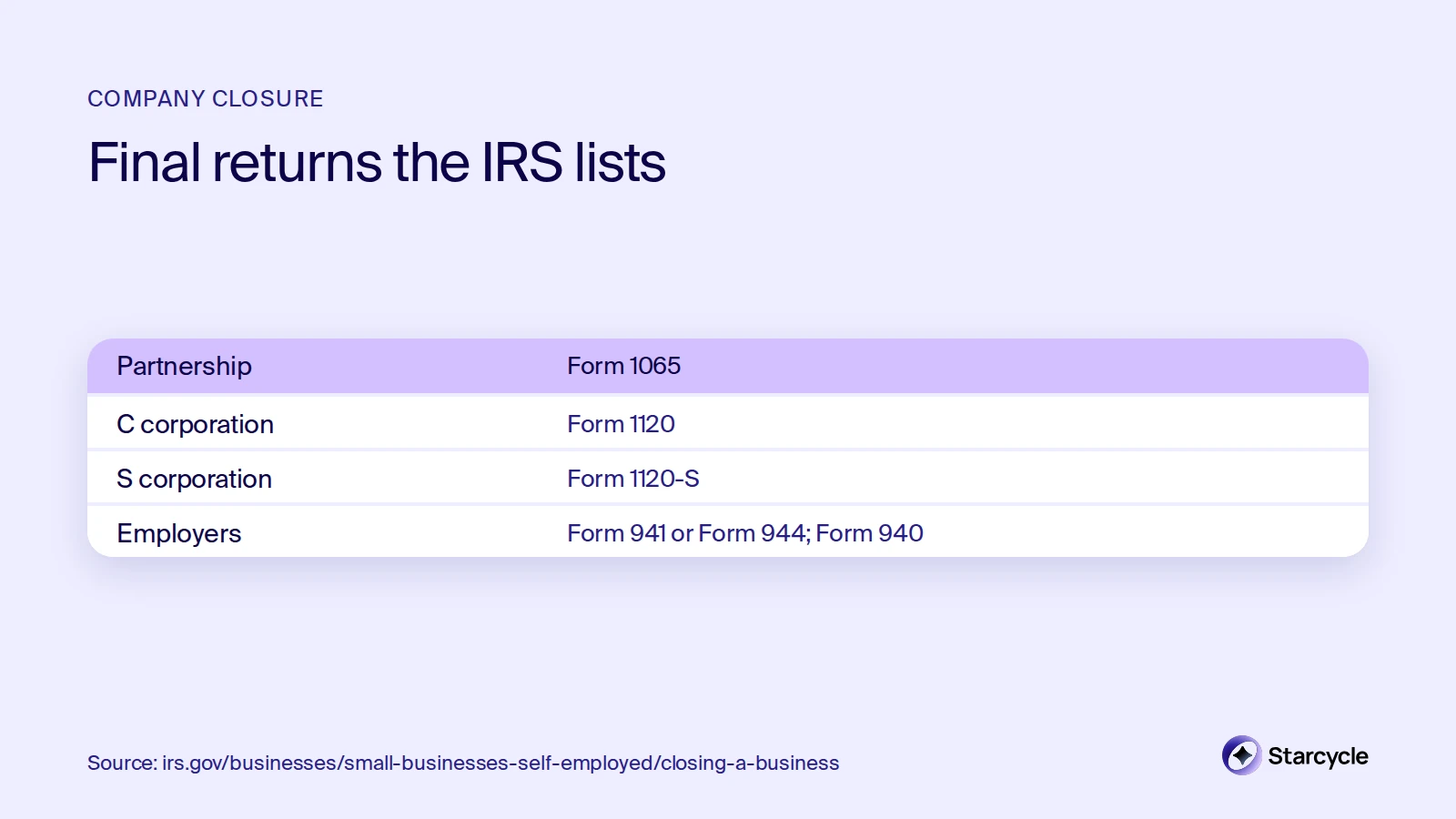
Final returns come first. The IRS closes your business account only after every return is filed and every tax is paid. This is the step with the most forms in it, and you'll only file the ones that match your business. The IRS closing checklist lists these filings for the year you close:
Your state has its own versions: a final income or franchise tax return, a final sales tax return, and closure of your withholding and unemployment insurance accounts. Confirm the full filing list with your CPA. It changes with your entity type and the states you operated in. We've covered the federal side in more depth in how to close a business with the IRS.
The EIN is the last federal item. The IRS says it can't cancel an EIN, but it can deactivate one when you write to it with the company's legal name, EIN, address and your reason for closing the account. Our guide to canceling an EIN with the IRS walks through the letter.
Keeping these filings in order across several agencies is the hardest part to do from memory. It's the part Starcycle takes off your plate. We prepare and file your state dissolution paperwork, track your key dates and your contract and subscription cancellation timelines, and keep your documents in one place.
Articles of dissolution are the document you file with your state's business registry to end the company's legal existence. When you file depends on the state, because some registries want proof that taxes are settled before they'll accept the filing. Timing the filing correctly matters more than rushing to submit it.
The name of the document changes by state and by entity type. It may be a certificate of dissolution, a certificate of termination, or a certificate of cancellation for many LLCs. Four states show how much the fee and the precondition vary.
State | Filing | State filing fee | What the state asks for |
|---|---|---|---|
Delaware | Certificate of Dissolution, stock corporation | All franchise taxes paid and annual franchise tax reports filed through the dissolution date | |
California | Certificate of Dissolution and other termination documents | Filing with the Secretary of State within 12 months of your final tax return | |
New York | Certificate of Dissolution, business corporation | Consent of the New York State Department of Taxation and Finance | |
Texas | $40 | A certificate from the Comptroller of Public Accounts showing that taxes have been paid |
These are the states' own filing fees, before any taxes owed. The cost of shutting down a business covers the rest of what you'll pay for. An LLC follows the same outline with different forms, and how to dissolve an LLC covers those steps. For a corporation, the votes and filings are set out in how to dissolve a corporation.
75% of closures leave unresolved obligations that create long-term exposure. A structured winddown saves 40–60 hours and cuts legal risk ~80%.
Get a quoteThe biggest winddown mistakes, the ones that cause problems later, are leaving the entity registered after operations stop, leaving tax accounts open, and discarding records too early. Founders assume that closing the website, stopping customer intake and emptying the bank account means the company no longer exists. Without dissolution paperwork filed with the state, the legal entity stays active. Legal existence and operational existence are separate, and each one has to be closed on its own.
You can shut down the website and move on to the next thing, and still receive annual report notices and franchise tax bills, because the business still exists in the state's records. A company that has ceased operations but never dissolves keeps every obligation that comes with being registered. Annual reports stay due, franchise taxes keep accruing, and your registered agent keeps billing, with or without revenue.
Delaware is a clear example of what happens if you stop paying for compliance before you dissolve. A Delaware corporation's annual report and franchise tax are due by March 1, and the Division of Corporations charges a $200 penalty for a late report plus 1.5% interest per month on unpaid tax. Filing the certificate of dissolution is what stops the cycle. Delaware collects the taxes owed through the dissolution date when you file.
Tax agencies keep expecting returns from an account that's still open, however long ago the business stopped making money. Payroll, sales tax and state unemployment accounts are each closed on their own, usually by filing a final return marked as final.
This one is mostly a search job. List every tax registration your company ever opened, including the ones you forgot about in states where you had one remote employee or collected sales tax for a single season. Your payroll provider's filing history is a fast way to find them.
Your records have to outlast the company. The IRS says to keep all records of employment taxes for at least four years, and the SBA's common guideline for tax and business records is three to seven years.
Before you close the last account, decide where these will live and who can reach them:
Export them from any software you're about to cancel, since access usually ends with the subscription.
A structured winddown ends with every filing confirmed and every account closed, which gives you an end date you can prove. You have documents to show a lender, an investor or a state agency if a question comes up later.

Relationships suffer less from the decision to shut down than from poor communication, unresolved obligations or disappearing without following through. The business community is smaller than it appears. The investor who backed this company might evaluate your next one, and the employee you let go might interview at a company considering you for a leadership role. Vendors who hear from you before an invoice goes overdue remember that too.
A written list with dates also turns an open-ended job into tasks you can finish and cross off.
Starcycle handles the state dissolution paperwork and the tracking for U.S. companies. The list above becomes something you review and approve, with far less left for you to chase. The question that slows a closure down is less "what do I file?" than "in what order, with whom, and what's still open?" You get one plan built around your entity type, your state and what your business still has open.
In practice, that covers four kinds of work:
Final returns are coordinated with a partner CPA or your own, and where a step needs one, we can also make intros to lawyers and accountants. If you're evaluating a business dissolution company or wind-down tooling, we set the options side by side in business shutdown services compared. If you'd like to see what your own closure list looks like, sign up for a quote and we'll take it from there.
How long it takes to shut down a company depends on how quickly your state processes the filing, whether it wants tax clearance first, and how long your debts and contracts take to settle. We've laid out typical timelines for closing a business, with the steps that tend to set the pace.
A voluntary dissolution assumes the company can pay or settle what it owes. A failing business that can't has other routes, and liquidation and bankruptcy work differently from each other. If you have debt, talk to your lawyer before you file anything with the state.
Winding down is the practical work of closing: paying debts, canceling contracts, selling assets and filing final returns. Dissolving is the legal step, the filing that tells the state the entity is ending. Some states use termination or cancellation for the final filing, and termination and dissolution mean different things for an LLC.