 Starcycle
Guide

Closing your business? Starcycle runs the shutdown with you.
Get startedYou've decided to close your company, and the state's forms have started using a phrase you hadn't needed until now. A notice of dissolution is the formal announcement that your company has decided to close and is winding up its affairs. It goes to the people and offices with a stake in that decision: your creditors, the state where the company is registered and, in some states, the public through a filed or published notice. What it asks of you depends on your state and on how the business is set up.
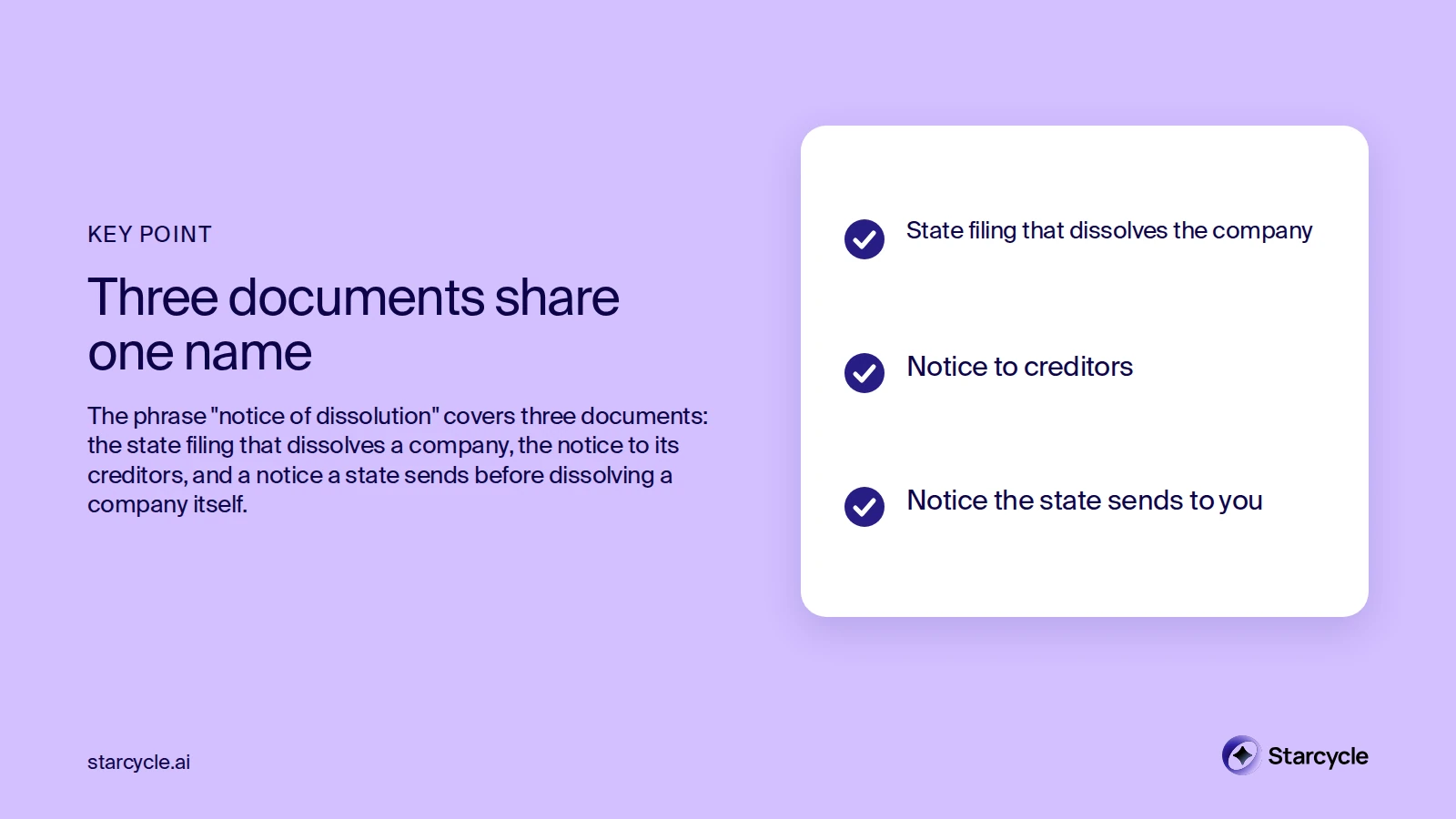
The phrase gets used for three different documents, and most of the confusion comes from mixing them up:
This page covers the first two. If the notice you're holding came from the state, our post on involuntary dissolution explains what that status means and how reinstatement works.
Many founders think a closure becomes official when operations stop: the website comes down, client work ends and subscriptions get canceled. Operationally, the company feels finished. Closing is that visible part. Dissolving is the legal step, and it happens only when the owners approve it and the state has a filing on record. Until someone files, a company that has gone quiet stays on the state's register.
Colorado's Secretary of State reads silence as a missed report rather than a closure. Its guidance on dissolving a business says that if you file nothing, the record becomes delinquent for failing to file a periodic report. That status doesn't show that the business has stopped operating. Some owners leave the company open "just in case" they restart later. Annual reports and state taxes can keep coming due for a company that still exists on paper. The fix is the dissolution filing itself. For the full sequence, start with the core steps in how to dissolve an LLC.
A notice of dissolution is a written statement that a business entity has dissolved and is winding up. It tells creditors and other claimants that the company is closing, where to send a claim and what the claim should include. Depending on the state, the notice is mailed to creditors, filed with the state, published, or some combination of these.
The notice is also the record that your company is entering a formal closure rather than going inactive on its own. It gives everyone the company owes one place to write.
Each state decides what the notice has to say, and the states that publish a form show you the pattern. Missouri's Notice of Winding Up for a limited liability company (Form LLC-13), listed on the Secretary of State's fees and forms page, asks for:
The first two come from your company's formation records, so have those open when you sit down to fill it in. Florida's notice for a corporation covers the same ground, with the date the dissolution takes effect in place of the formation date.
Articles of dissolution are the filing that tells the state your company is dissolved, and the notice tells everyone else. States name the filing differently. In Colorado a corporation files Articles of Dissolution and an LLC files a Statement of Dissolution, while a Missouri LLC files a Notice of Winding Up followed by Articles of Termination. Our comparison of LLC termination and dissolution explains the meaning of each of those words.
A notice of dissolution of partnership tells the people a partnership does business with that the partners have dissolved it and are winding up. It typically goes to creditors, suppliers, customers and anyone holding a contract with the partnership. Your partnership agreement may say how notice has to be given. Check it before you write the letter.
Some states also offer a public filing. In California, a general partnership that has a Statement of Partnership Authority on file can file a Statement of Dissolution (Form GP-4) with the Secretary of State. The form's instructions list no filing fee. The federal side is separate: the IRS expects a final Form 1065 for the year you close, and our guide to dissolving a partnership with the IRS lists the forms.
Filing or sending the notice is one milestone in a longer wind-down. Several steps still follow it. Creditors send in claims, your company pays what it owes, you file final tax returns and the state accepts the filing that ends the company. The notice also leaves your subscriptions, insurance policies and vendor contracts that renew on their own exactly where they were. Each of those goes on your list as its own cancellation.

Obligation tracking, document organization, and stakeholder coordination — in one platform, in the right order.
Get my shutdown planCreditors are the main audience, and the state and the tax agencies each get their own form of notice. Who has to be told, and how, comes from your state's law and from your own contracts:
Making the list helps in its own right. As you contact each creditor, you build a record of who the company owes, how much and on what terms. A debt you'd forgotten then turns up while you're still settling accounts.
A closure notification to your customers and investors usually goes out by choice or because a contract says so. If any of your contracts name a notice period for ending them, that period is separate from the state's rules. It's worth reading them before you set your dates.
A statutory notice to creditors is the notice a state's own law prescribes. Every state sets its own rules on what the notice says, how it is delivered or published, and how long creditors have to bring a claim.
State and entity | What the state's form says |
|---|---|
Florida corporation | The Articles of Dissolution form carries an optional Notice of Corporate Dissolution addressed to unknown claims. It costs nothing when filed with the articles ($35) and $35 when filed separately. The notice states that a claim is barred unless a proceeding to enforce it starts within 4 years after the notice is filed. |
Missouri LLC | A Notice of Winding Up (Form LLC-13), filed with a $25 fee, has to be on record before the state accepts Articles of Termination (Form LLC-5, also $25). The notice states that a claim is barred unless a proceeding to enforce it starts within three years after the notice is published. |
California general partnership | A Statement of Dissolution (Form GP-4) can be filed with the Secretary of State once a Statement of Partnership Authority (Form GP-1) is on file. The instructions list no filing fee. |

These are the forms' own words, and how a claim period applies to a particular creditor is a question for your lawyer. If your company has debt, talk to your lawyer before the notice goes out.
Working out which notice your state expects, and listing everyone who should get one, is the slow part of this stage. Starcycle prepares and files your state dissolution paperwork and tracks the key dates each filing sets.
A notice of dissolution is submitted after the owners have formally approved the dissolution and, in most states, before the company is finally terminated. The exact order is your state's call. Missouri won't accept an LLC's Articles of Termination until the Notice of Winding Up is on record. Florida lets a corporation include its notice with the Articles of Dissolution or file it later.
The state counts your company as active until its filing is on record, whatever date you stopped trading. If you stopped making money in March and the filing reaches the state in September, the state's record shows an active company all summer. That makes two dates worth writing down as you go: the day the owners approved the dissolution and the day the state filed it.
For an LLC, the starting point is the dissolution itself: a vote of the members under the operating agreement (the contract that sets out how your LLC is run), or an event the agreement names. Voluntary dissolution starts with the vote or the named event, and an LLC that simply goes quiet hasn't started one. Once the LLC is dissolved, your state's LLC law decides whether a notice is required, optional or folded into the dissolution filing.
A corporation's dissolution is tied to governance milestones rather than operational ones, which usually means a board resolution followed by shareholder approval. Florida's Articles of Dissolution, for example, ask for the date the dissolution was authorized and a statement that the shareholders approved it. That approval also starts a federal clock, because Form 966 is due within 30 days after the resolution or plan is adopted.
Nonprofits follow a different route. The Form 966 instructions tell exempt organizations to skip that form, and the votes, filings and asset rules that apply instead are in how to dissolve a nonprofit.
75% of closures leave unresolved obligations that create long-term exposure. A structured winddown saves 40–60 hours and cuts legal risk ~80%.
Get a quoteThe notice sits in the middle of the closing process, after your decision and before your final filings. The usual order looks like this, with steps 2 and 3 trading places in some states:

Shutting down a company walks through the whole closure in order, and how to close a business with the IRS covers the federal forms.
Most problems come from a step that was skipped or done out of order. Each one has a plain fix.

Sending a notice of dissolution is often the first time the closing is said out loud to people outside your company. That can be the hardest part of the paperwork. A filing sits quietly on a state website, while a letter to a lender or a supplier you've worked with for years makes the ending real.
Closing formally means facing what the business represented: the years of effort, the relationships and the ambition that went into it. Plenty of owners put the notice off for that reason. It can read like a public admission of failure. What the notice shows the people who receive it is a company being closed in order, with a clear place to send a claim. It helps to treat it as a list of names and one short letter, written once and sent to each of them. Keep the dates in view while you do.
A notice of dissolution is a short document that tells your creditors and your state that your company is closing and gives them a way to respond. The work around it is what takes the time. Getting the order right matters more than speed, because each state names its forms differently and sequences them its own way.
Starcycle can take on the state side of that work. Tell us which state your company is registered in, and we'll prepare and file the dissolution paperwork, track your key dates and your contract and subscription cancellation timelines, and keep the documents in one place. Where a question belongs with a professional, we can also make intros to lawyers and accountants.
The date of dissolution is the date the dissolution takes legal effect on the state's record. It is usually the day the state files your document, though some states let you name a later date. Florida's Articles of Dissolution and Missouri's Articles of Termination both allow an effective date up to 90 days after filing.
A dissolution letter is the everyday name for the written notice a company mails to its creditors, customers or partners to say it is closing. A notice of dissolution can be that same letter, or it can be a form filed with the state or a published notice where the state calls for one.
The office that approved the dissolution is one of several that keep a record of your company. The IRS keeps its own business account open until you've filed all necessary returns, paid the tax owed and written to ask it to deactivate the EIN. State tax and payroll accounts are closed separately too. Read the notice to see which agency sent it and which account it refers to, then ask your CPA what that account still needs.