 Starcycle
Guide
Closing your business? Starcycle runs the shutdown with you.
Get startedYou looked up your LLC in the state's business search and the status says dissolved, though you never filed to close it. That status is an involuntary dissolution: the state, or in some cases a court, has ended or frozen the company's legal standing, typically after a missed annual report or tax payment. In the states covered below you can reverse it by reinstating the company, and each state sets its own grounds, forms and fees. Finding that on a search page is a jolt, and the way back is paperwork.
Involuntary dissolution is the ending of an LLC's legal existence by someone other than its owners. A state's business filing office can dissolve a company administratively after it misses a required report, fee or tax payment, and a court can order a dissolution in a lawsuit. Either way, the owners did not vote for it or file for it.
States use different names for the same event, so the wording on your state's record may not match this page, though the meaning is the same. Wisconsin calls it administrative dissolution. Texas calls it involuntary termination, or forfeiture when the cause is unpaid franchise tax, a state tax on the privilege of doing business there. California suspends a company's rights, powers and privileges instead of dissolving it, and uses the word forfeited as well.
If your record says involuntarily dissolved, administratively dissolved, forfeited or suspended, the state has taken your company out of good standing without you asking for it. Dissolution and termination aren't always the same step, and our post on how LLC termination differs from dissolution explains the difference.
A voluntary dissolution starts with you and your co-owners, when you decide to close and file the dissolution paperwork with the state. An involuntary dissolution starts with a state agency or a court, and it doesn't need your consent.
It's natural to think of closing an LLC as a deliberate choice: the business isn't working, so you file paperwork, pay what you owe and move on. An involuntary dissolution is the other way an LLC ends, when the business stops operating and nobody files to close it. When the state does the dissolving, its own schedule sets the timing, through notices and a status change it makes itself.
Voluntary dissolution | Administrative dissolution | Court-ordered dissolution | |
|---|---|---|---|
Who starts it | The LLC's owners | The state filing office or tax agency | A court, when someone applies to it |
Typical reason | A decision to close the business | A missed report, fee, tax filing or registered agent | A situation the court is asked to resolve |
What goes on the record | A dissolution filing from the company, such as Wisconsin's Articles of Dissolution or Texas's Certificate of Termination | A notice from the state, then a status change the state makes itself | A court decree |
Court-ordered dissolution, also called judicial dissolution, runs through a lawsuit instead of a filing office. In Delaware, for example, a member or manager can ask the Court of Chancery to dissolve an LLC. The ground is that it is no longer reasonably practicable to carry on the business under the LLC agreement. That kind of dispute belongs with your lawyer. The rest of this post covers the administrative kind.
If you're closing by choice, the steps are in our guide on how to dissolve an LLC.
A state administratively dissolves your LLC when the company stops meeting the filing and payment requirements that keep it in good standing. Each state writes its own list of grounds, and here is what three of them publish:
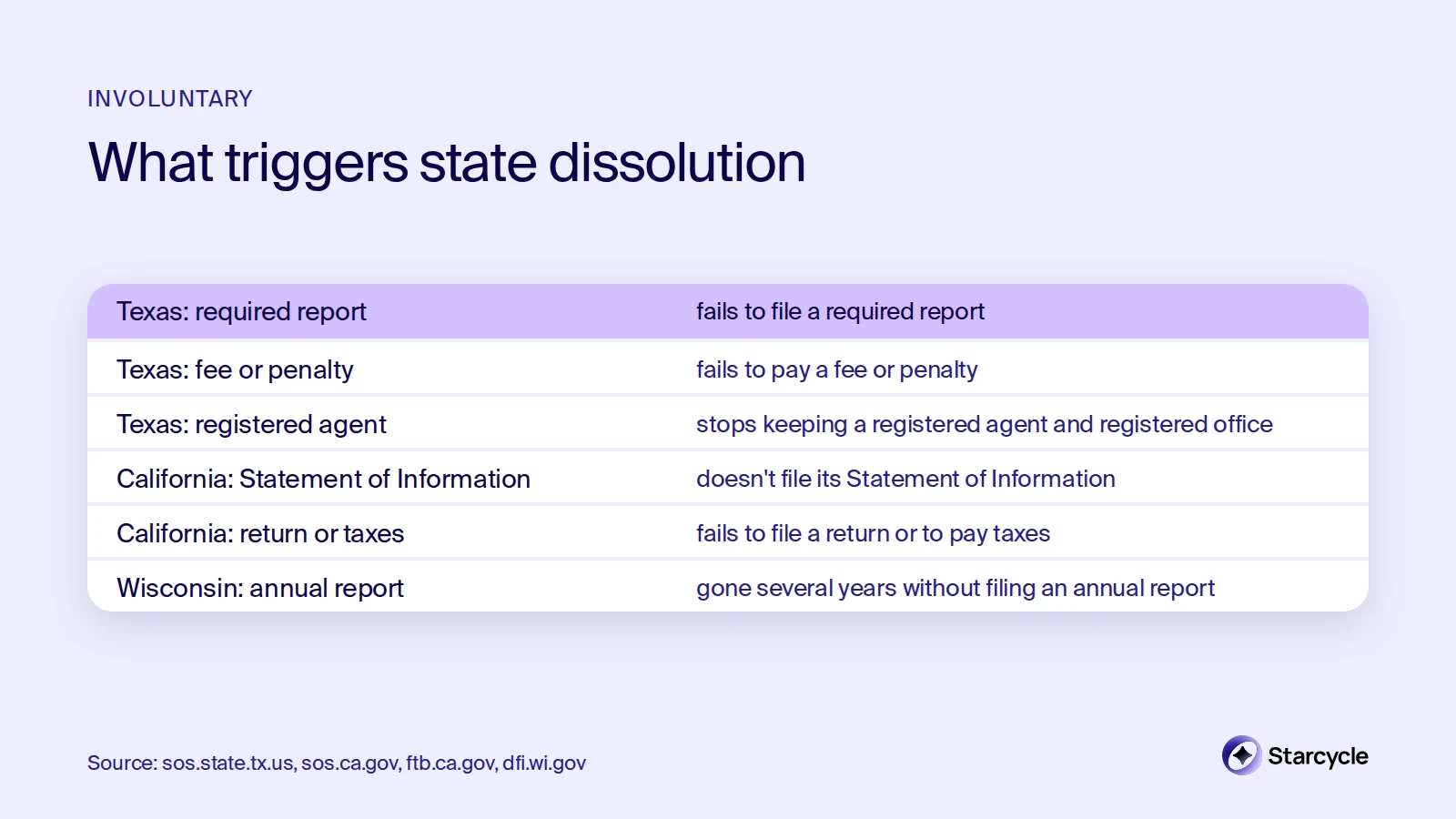
The business stops operating, but the legal entity carries on. That gap is where these lists come in: the reports, fees, franchise taxes and registered agent on them keep coming due after the revenue stops. The three lists differ on details, such as how long a company can be behind before the state acts. Your own state's filing office publishes its version, and that's the page to keep open.
Obligation tracking, document organization, and stakeholder coordination — in one platform, in the right order.
Get my shutdown planA state mails its warning to your registered agent or the address in its records and then updates your company's public status, so those are the two places to look. A missed annual report doesn't feel urgent, and a notice from the state looks like something to handle later. By the time the status changes, the state has already sent its notices.
In Wisconsin, the Department of Financial Institutions works through these steps:
California's Secretary of State sends a reminder about three months before a Statement of Information is due. A company that misses the filing gets a notice of delinquency and another 60 days to file before its powers are suspended. The same page says the filing is the company's responsibility even when the reminder never arrived.
Your registered agent may have received those notices. If you changed addresses, switched agents without updating the state's records or let the agent's service lapse, the notices never reached you. The state has still done its part by sending them to the address on file. The state's online business search shows your company's current status.

For you as an owner, an involuntary dissolution means your company is out of good standing and can't use some of its legal powers until it's reinstated. What it loses depends on your state, and California's Franchise Tax Board publishes one of the clearer lists.
According to the board's page on what a suspended business cannot do, a suspended California company cannot:
If a vendor breaks a contract or a customer files a claim, look at the second item on that list. A suspended company can't take the dispute to court or answer it there until it's revived. The suspension takes away the company's powers and leaves its unpaid balances where they were. The same page lists what restores good standing: file all past-due tax returns, pay all past-due balances and file a revivor request, which is California's name for a reinstatement application.
Texas has a timing rule. Its reinstatement form says a Texas company reinstated before the third anniversary of its involuntary termination is treated as having existed without interruption. The Secretary of State will still accept a reinstatement after that date.
State pages say less about personal liability. What they do say is specific. The Franchise Tax Board's page covers a business that cannot pay its taxes. In that case the board may make someone personally responsible if they took assets out of the business, have unpaid loans to shareholders or paid excessive salaries to officers. How any rule like that applies to you depends on your state and your facts, so bring that question to your lawyer.
75% of closures leave unresolved obligations that create long-term exposure. A structured winddown saves 40–60 hours and cuts legal risk ~80%.
Get a quoteReinstatement is the filing that returns your involuntarily dissolved LLC to good standing. In the three states below it comes down to fixing what you missed, paying what you owe and sending the state its reinstatement form.
State and cause | What the state asks for | Form |
|---|---|---|
Texas, terminated for a non-tax reason | Correct the cause and pay any fees, interest or penalties. Attach a tax clearance letter from the Comptroller (Form 05-377), which confirms the company's franchise tax is up to date. | Form 811, Certificate of Reinstatement. The filing fee after an involuntary termination is $75. |
Texas, forfeited for franchise tax | File each delinquent franchise tax report with the Comptroller and pay the tax, penalties and interest. Attach the same tax clearance letter. | Form 801, Application for Reinstatement and Request to Set Aside Tax Forfeiture. The filing fee is $75. |
California | File all past-due tax returns and pay all past-due balances. A company the Secretary of State suspended also files a current Statement of Information. | Application for Certificate of Revivor, Limited Liability Company (FTB 3557 LLC), sent to the Franchise Tax Board. |
Wisconsin | Email the Department of Financial Institutions with the company's name and entity ID. | The department emails the reinstatement forms back. |
In Texas and California the back filings and payments come first, and the reinstatement form goes in last. Wisconsin starts with an email. In Texas, the Comptroller explains how to request the tax clearance letter through its Webfile system or on Form 05-391. Texas sets no deadline for either reinstatement filing, as long as the company would otherwise still exist. Form 811 can't be used for a company terminated by court order.

Both Texas and California check that your company's name is still available before they reinstate it. If it isn't, each has you adopt a new name.
What applies in Texas differs from what applies in California, and your state will have its own form, fee and deadline. Confirm them with its filing office before you send anything.
Your state decides if a dissolved LLC still needs a closing filing from you, and Wisconsin and California give opposite answers. Wisconsin says a company that's no longer operating doesn't need to do anything, and the department dissolves it at no cost with no late fees or penalties. California lists "legally close or dissolve your business" among the things a suspended company cannot do, and its revivor steps are the ones in the table above.
Your state and tax records are also separate. Wisconsin's page notes that telling its Department of Revenue or the IRS that a company has dissolved does not dissolve it with the filing office. Federal tax runs on its own track as well, and the IRS doesn't assume you're done because you've stopped making money. The IRS asks for a final return for the year your business closes. It won't close your business account until you've filed every required return and paid all tax owed.
For the forms on the federal side, see our posts on closing a business with the IRS and canceling an EIN, your company's federal tax ID number. Confirm your own filing list with your CPA. State closing steps are in our guides to dissolving a California LLC and dissolving an LLC in Texas.
Working out which state office and which tax agency still expects something from a company that went quiet years ago is the slow part of this. Starcycle keeps the documents and key dates for your shutdown in one place, so you can see what's still open.
An involuntary dissolution leaves you with a decision that the state's status change didn't settle: bring the company back, or finish closing it. Both routes begin in the same place. Start with the status and the reason shown on your state's record. Reinstatement is the route when you plan to keep operating. When you're finished with the business, your state closing filing and your final federal returns are still ahead. Either way, the timing is back with you, and you decide how this chapter of the company ends.

If you'd like the closing paperwork off your plate, Starcycle prepares and files the state dissolution paperwork for U.S. companies and tracks your key dates. Your final returns are coordinated with a partner CPA or your own, and we can also make intros to lawyers and accountants for the questions that need one.
If you don't dissolve an LLC you've stopped using or never used, it stays registered until you or the state dissolves it. An LLC doesn't die when the business does, and Wisconsin's filing office says the only way to dissolve a company there is to file Articles of Dissolution with it. California's Franchise Tax Board, for one, says registered entities owe at least the $800 franchise or annual tax from their registration date onward "regardless of business activity." Closing by choice means a voluntary dissolution, and our guide on how to dissolve an LLC covers the steps.
Yes, a corporation can be involuntarily dissolved too, and the state pages cited above cover corporations as well as LLCs. Texas's Form 811 applies to any domestic filing entity the Secretary of State has involuntarily terminated. California's Franchise Tax Board has a separate revivor application for corporations, FTB 3557 BC.