 Starcycle
Guide

Closing your business? Starcycle runs the shutdown with you.
Get startedStopping operations closes the business for your customers, and the IRS needs paperwork of its own. You close a business with the IRS by filing a final return, filing final employment tax returns if you had employees, paying the tax you owe, reporting contractor payments, asking the IRS by letter to close your business account, and keeping your records.
The IRS sets out those six steps on its Closing a business page, and most of the forms sit in the first two.
Closing a business with the IRS means ending the business's federal tax filing obligations. You file a final income tax return for the year you close, file final employment tax returns, pay any tax owed, report contractor payments, and ask the IRS in writing to close the account tied to your EIN (Employer Identification Number, the business's federal tax ID).
You can't stop filing and assume the IRS will figure it out once you've locked the door. The IRS's instructions for a return such as Form 941 keep it due every quarter until you file one marked final.
The IRS treats business structures differently, so what works for one founder won't work for another. It groups the forms under sole proprietors, partnerships and corporations, with S corporations counted among the corporations, and the forms you file depend on which of those you are.
Nobody looks forward to the IRS part of a shutdown. The full list makes it look longer than yours will be, because it covers every kind of business. Your state handles the legal dissolution separately. Before you start, confirm your own filing list with your CPA.

The IRS publishes six steps for closing a business, and you work through them in this order. Closure is easy to treat as a single event, filing one form and moving on, and the IRS's list is a sequence instead. It puts a letter you write yourself in fifth place and a box of records you keep in sixth.
The letter in step five waits for the rest. The IRS can close the business account only after you have filed all necessary returns and paid all taxes owed.
Obligation tracking, document organization, and stakeholder coordination — in one platform, in the right order.
Get my shutdown planThis checklist covers every form the IRS names on its official Closing a business page, grouped under the IRS's own six steps. Expect to cross lines out as you go. Your CPA can help you strike the ones that don't belong to your business.
The IRS asks for a final return for the year you close the business. The return and the forms that travel with it depend on the business type. You need only the row that matches yours:
Business type | Final income tax return | How the IRS says to mark it final | Other forms the IRS lists |
|---|---|---|---|
Sole proprietor | Schedule C (Form 1040 or Form 1040-SR), filed with your individual return for the year you close | The IRS's page names no final-return box for Schedule C | Schedule SE (Form 1040) if net earnings from the business are $400 or more |
Partnership | Form 1065 | Check the "final return" box and the "final K-1" box on Schedule K-1 | Schedule D (Form 1065) for capital gains and losses |
C corporation | Form 1120 | Check the "final return" box | Form 966; Schedule D (Form 1120) for capital gains and losses |
S corporation | Form 1120-S | Check the "final return" box and the "final K-1" box on Schedule K-1 | Form 966; Schedule D (Form 1120-S) for capital gains and losses |
The "final return" box sits near the top of the front page of each return, below the name and address. For every business type, the IRS also lists these two forms as ones you may need:
A corporation files Form 966, Corporate Dissolution or Liquidation, when it adopts a resolution or plan to dissolve or to liquidate any of its stock. That includes S corporations. The form's instructions give the deadline as within 30 days after the date the resolution or plan is adopted. The fuller walk-throughs sit in our guides to dissolving a partnership with the IRS and dissolving a corporation.

If you have one or more employees, you pay them any final wages and compensation owed, make final federal tax deposits and report employment taxes. Income tax is one part. It's easy to assume the "final return" box on your income tax return covers payroll too. Form 941 and Form 944 each carry their own closed-business box, and a Form 941 stays due even if you haven't run payroll in months. The IRS lists these forms:
The IRS notes that the Trust Fund Recovery Penalty may apply when withheld income, Social Security and Medicare taxes aren't deposited, and the fix sits in the same step: make the final federal tax deposits in full. If you run a pension or benefit plan, the IRS points you to its page on terminating a retirement plan.

This is the slow step, with the most forms and the most dates. It arrives while you're settling vendor payments, canceling contracts and carrying the emotional weight of the shutdown. The IRS list then asks you to cross-reference form numbers, track down payroll records and work out which boxes to check. Starcycle keeps the documents and key dates for a shutdown in one place and prepares and files the state dissolution paperwork. That way, your accountant can work from a complete file.
Pay what you owe using one of the methods on the IRS's payments page. Closing the business leaves its tax bill where it was. The IRS's closing page gives this step a single line. How much you owe is a question for your CPA.
You report what you paid contractors for services during the calendar year in which you close the business. The IRS lists two forms:
The reporting threshold is set in the IRS's current instructions for Forms 1099-MISC and 1099-NEC. It changed for tax years beginning after 2025. Ask your CPA which figure applies to the year you close.
An EIN is the permanent federal taxpayer ID for the business, so the IRS deactivates the number instead of erasing it. What you can close is the account tied to it. Filing your final return leaves that account open until you ask in writing. To have the number deactivated and the business account closed, you send the IRS a letter of a few lines that includes:
The IRS lists the mailing address for the letter on its EIN deactivation page. Our guide to canceling an EIN with the IRS has a sample letter and explains what happens to the number afterward.
How long you keep a record depends on what it documents. This last step is mostly about knowing where the box is. The IRS's closing page gives two rules and links to How long should I keep records? for the rest:
75% of closures leave unresolved obligations that create long-term exposure. A structured winddown saves 40–60 hours and cuts legal risk ~80%.
Get a quoteAn LLC closes with the IRS on the forms for its federal tax classification. The IRS treats an LLC as a partnership, a corporation, or an entity disregarded as separate from its owner, and your CPA can confirm which classification your LLC has.
The IRS describes the classifications this way:
It's natural to expect the IRS to dissolve an LLC along with its tax account. Dissolving the LLC itself happens with the state where you formed it, because an LLC is organized under state law. The IRS's closing page reminds you to check your state responsibilities as well. Our guide on how to dissolve an LLC covers the state side in order.
You notify the IRS that your business is closed on the final returns themselves and then formally in a letter. Each form on the IRS's list has its own box or line for saying the business has closed, so most of the notice happens while you're filling in forms you'd file anyway.
The gap is between what you meant to file and what the forms say. The IRS works from explicit signals. A closure you intended but never marked looks like a business that has gone quiet. A final Form 941 sent without its closed-business box reads as one more quarter's return.
Where you say it | What you mark or send |
|---|---|
Form 1065, Form 1120 or Form 1120-S | The "final return" box near the top of the front page |
Schedule K-1 (partnerships and S corporations) | The "final K-1" box |
Form 941 or Form 944 | The closed-business box and the date final wages were paid (line 17 of Form 941, line 14 of Form 944) |
Form 940 | Box "d" in the Type of Return section |
Form 966 (corporations) | The form itself reports the resolution or plan to dissolve |
Letter to the IRS | Legal name, EIN, address and the reason for closing the account |
A proper IRS business closure leaves no federal return still expected from the business and no balance owed. Closure happens when the IRS agrees you're finished, which comes later than the day you stop operating. In the IRS's words, it cannot close your business account until you have filed all necessary returns and paid all taxes owed.
By the end, you should be able to put your hand on each of these:

The federal forms above close the tax side of a business. The rest of the work to shut down a business runs alongside them: the state dissolution, state tax accounts, licenses, leases, vendors and bank accounts. Our closing down a business checklist sets out those steps in order.
If you're three forms deep and want help with the rest, Starcycle prepares and files the state dissolution paperwork for a U.S. shutdown, tracks the key dates and keeps your documents in one place. Your final returns are coordinated with a partner CPA or your own. We can also make intros to lawyers and accountants. Tell us what kind of company you're closing and we'll show you the rest of the process.
Yes, Form 941 stays due each quarter after you stop paying wages, until you file a final one. The Form 941 instructions say that after your first Form 941 you must file a return for each quarter, even with no taxes to report, unless you have filed a final return or an exception such as the one for seasonal employers applies.
Each return's instructions set its own due date, and each one starts the clock on a different day:
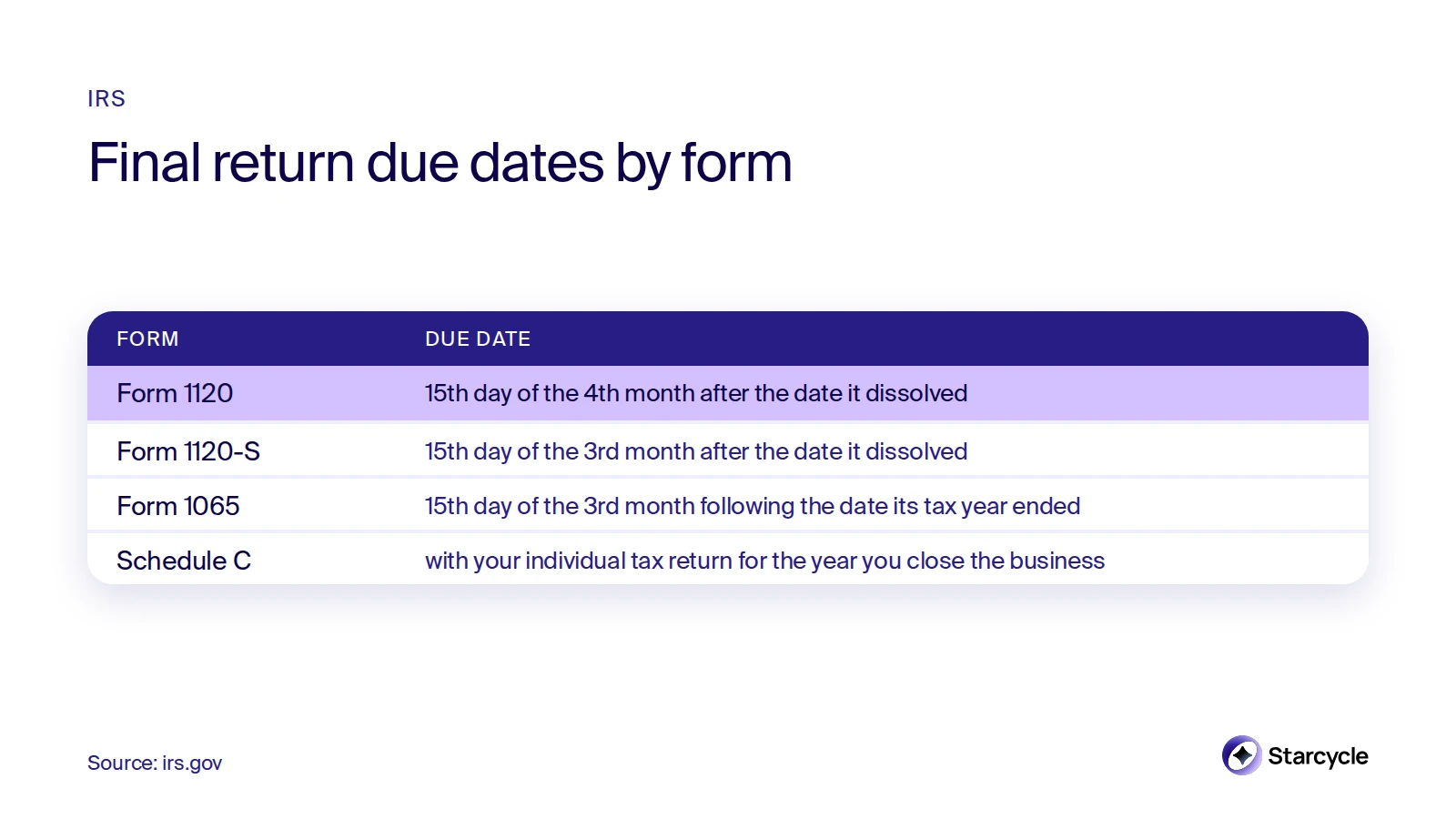
Your CPA can confirm the date for your return.