 Starcycle
State Guide
Running a business that's no longer serving its purpose feels like dragging a weight behind you. When you've decided it's time to close your Alabama limited liability company, understanding how to dissolve an LLC properly becomes essential to avoid lingering tax obligations, potential legal issues, and unexpected fees that could follow you for years. This guide walks you through the complete process of dissolving an LLC in Alabama, from filing articles of dissolution to settling debts and notifying the right parties, so you can close this chapter cleanly and move forward with confidence.
If the thought of handling state filings, creditor notifications, and tax clearances feels overwhelming, you're not alone in wanting expert support. Starcycle specializes in business closure services that handle the administrative burden of winding down your Alabama LLC, ensuring all requirements are met without the stress of managing paperwork, deadlines, and compliance details. Their team guides you through each step, from canceling your business licenses to filing final tax returns, so nothing falls through the cracks during this transition.
Starcycle addresses business-closure complexity by creating tailored action plans that coordinate legal filings, tax closures, and contract cancellations in sequence, ensuring founders can track exactly what's been completed and what still requires attention, rather than relying on memory during an already difficult transition.

Most founders think dissolving an LLC in Alabama means filing one form and walking away. Stop operating, submit the paperwork, close the chapter. The assumption makes sense because forming an LLC feels straightforward (file articles of organization, pay the fee, receive confirmation), so ending one should follow the same logic.
That assumption creates real problems.
Alabama law treats LLC dissolution as a structured legal process rather than an administrative checkbox. Under the Alabama Limited Liability Company Law of 2014 (Code of Alabama Title 10A, Chapter 5A), you must formally wind up the company's affairs before the state terminates the entity.
Shutting down operations doesn't equal legal closure. Your LLC remains active on the Secretary of State's registry until you file dissolution documents and the state accepts them. During that time, the entity still carries obligations:
The failure point is usually this: founders confuse operational shutdown with legal termination. You close the office, cancel the website hosting, and stop taking clients. The business feels finished. Yet the state still considers your LLC an active legal entity capable of incurring liabilities, entering into contracts, and facing regulatory consequences. According to research from the Kauffman Foundation, approximately 30% of small business owners who shut down operations never file formal dissolution paperwork, leaving entities in legal limbo for years.
Debts and liabilities don't vanish when you stop working. Alabama law requires you to settle known claims and make reasonable provisions for outstanding obligations before distributing remaining assets to members. If you skip this step and distribute money prematurely, creditors can pursue members directly. The winding-up process exists to protect everyone involved: the business owners, creditors, vendors, and anyone else with a financial stake in the outcome.
State business registries exist to verify whether a company is active and who's responsible for it. Customers checking references, lenders evaluating credit applications, and vendors deciding whether to extend terms all rely on these records. When you don't file dissolution documents, the registry still shows your LLC as operational. That creates confusion and potential liability. Someone might assume they can do business with your company, sign a contract, or pursue a claim, only to discover later that the entity was effectively abandoned without proper closure.
Platforms like Starcycle handle the administrative burden of filing dissolution paperwork, updating state records, and ensuring every regulatory requirement gets addressed so your business closure appears complete and professional in public registries, not abandoned or legally ambiguous.
Multi-member LLCs face another layer of complexity. Operating agreements typically define how dissolution must be approved (by member vote, written consent, or specific percentage thresholds). If you ignore those procedures, disputes can emerge over whether the dissolution was valid, who authorized it, and whether members followed the company's own governance rules.
Treating dissolution casually leaves founders facing unexpected obligations, creditor claims, or internal disputes long after they thought the business ended. But understanding what dissolution actually requires under Alabama law changes how you approach the entire process.

Dissolving an LLC is the formal legal process that ends the company's existence in the eyes of the state, not just the moment you stop answering customer calls or close your bank account. When you file dissolution documents with the Alabama Secretary of State and the state accepts them, you're triggering a sequence of legal events that wind up the business, settle obligations, and remove the entity from active status.
Until that process completes, your LLC remains legally alive, capable of incurring liabilities, and subject to ongoing compliance requirements, regardless of whether you've generated revenue in any given month.
The gap between operational shutdown and legal termination is the source of most of the confusion. You can stop selling products, cancel your lease, and tell employees the company is finished. Those actions feel like closure. But Alabama law doesn't recognize your business as dissolved until you've completed the winding-up process:
The state's business registry will continue listing your LLC as active until those steps are documented and accepted.
Dissolution doesn't mean debts disappear or contracts void themselves. Alabama's LLC statute requires you to make reasonable provisions for claims against the company, whether those claims are known or reasonably estimated.
If you distribute assets to members before addressing creditor obligations, those creditors can pursue members directly for amounts they would have received had the distribution followed the proper legal sequence. The winding-up phase exists to create an orderly process:
Tax obligations follow a similar pattern. Stopping business activity doesn't close your tax accounts. You still need to file final federal and state tax returns, mark them as final, and ensure all employment taxes are settled if you had employees. The IRS and Alabama Department of Revenue expect formal notification that the business has ended. Without those filings, the agencies assume you're still operating and expect continued compliance.
Multi-member LLCs face an additional layer of procedural requirements. Your operating agreement likely specifies how dissolution must be approved (e.g., member vote, written consent, or specific percentage thresholds). If you bypass those internal governance rules, you risk disputes over whether the dissolution was valid, who had authority to initiate it, and whether remaining members can challenge the process.
Platforms like Starcycle help founders navigate these procedural requirements by creating tailored action plans that ensure every governance rule, creditor notification, and filing deadline gets addressed in the correct sequence, reducing the risk of disputes or regulatory gaps that leave the business in legal limbo.
The core distinction to remember is this: dissolution is a legal status change, not a business decision. You're not just choosing to stop operating. You're formally requesting that the state recognize your company as terminated, and that request comes with specific procedural obligations to protect creditors, members, and the integrity of the public record.
But knowing what dissolution means legally doesn't tell you where the process typically falls apart for Alabama founders.
Obligation tracking, document organization, and stakeholder coordination — in one platform, in the right order.
Get my shutdown plan
Most Alabama LLC dissolutions don't fail outright. They stall quietly, often months after founders believe the business is closed. The breakdown occurs in the gap between filing the dissolution paperwork and actually completing the administrative work that surrounds it.
One of the most frequent failure points occurs when state dissolution filings are completed, but tax obligations remain unresolved. Founders file the certificate of dissolution with the Secretary of State and assume the process is finished, only to receive tax notices or filing reminders six months later.
The Alabama Department of Revenue and the IRS don't automatically close your accounts when the LLC's legal status changes. You must file final tax returns, mark them as final, and separately notify each agency that the business has ended. Without those explicit steps, the agencies assume you're still operating and expect continued compliance.
Platforms like Starcycle help founders avoid this gap by creating action plans that include final tax filings, agency notifications, and confirmation tracking, ensuring that tax closure happens in parallel with legal dissolution rather than surfacing as a surprise months later.
Another common breakdown involves auto-renewing contracts and subscriptions. Software tools, service providers, domain registrations, and vendor agreements often continue billing after operations stop. Without a structured review and cancellation process, these costs accumulate quietly and surface later as unexpected expenses on personal credit cards or bank accounts that founders thought were closed.
The problem isn't that founders forget these obligations exist. It's that they're scattered across platforms, emails, and shared logins, making it difficult to create a complete inventory before shutdown begins.
Deadlines don't pause just because the business has stopped operating. Annual report filings, final tax submissions, and contract cancellation windows continue on their original schedules. When deadlines slip, founders may face late fees, penalties, or the need to reopen accounts just to close them correctly.
According to research from the National Federation of Independent Business, approximately 40% of small business owners reported receiving unexpected fees or penalties after they believed their business was fully closed, often due to missed filing deadlines or unresolved compliance obligations.
Scattered documentation is another weak point. When formation documents, operating agreements, tax filings, and vendor contracts are spread across emails, cloud storage platforms, and shared folders, it becomes difficult to confirm what's been filed, cancelled, or paid. That uncertainty creates delays and often forces founders to retrace steps they thought were complete.
The failure modes tend to look the same:
Alabama LLC dissolutions usually break down not because founders ignore the process, but because the closure happens in pieces rather than as a coordinated whole. Without structure, loose ends tend to linger longer than expected.
But understanding where things break down doesn't tell you how to execute the process correctly from the start.

Dissolving an LLC in Alabama follows a defined sequence:
Each step builds on the previous one, and skipping any creates gaps that surface later as compliance problems or unresolved liabilities.
Before you can legally dissolve the LLC, you need documented authorization. Multi-member LLCs typically require member approval according to the procedures outlined in the operating agreement, whether that's a majority vote, unanimous consent, or a specific percentage threshold. Single-member LLCs can authorize dissolution directly, but documenting that decision still matters because it establishes the legal timeline for the winding-up process to begin.
If your operating agreement doesn't specify dissolution procedures, Alabama's default LLC law applies, usually requiring member consent. This step isn't ceremonial. It creates the legal record that dissolution was properly initiated and prevents disputes later over who had authority to shut down the company.
Once dissolution is approved, the LLC enters the winding-up phase. You're no longer operating normally. Instead:
Alabama law allows the LLC to continue operating only to the extent necessary to complete these tasks.
The winding-up phase exists to create an orderly process where creditors get paid, obligations get resolved, and assets get distributed according to the operating agreement. Rushing through this stage or skipping creditor notifications creates liability exposure that follows members long after they thought the business was finished.
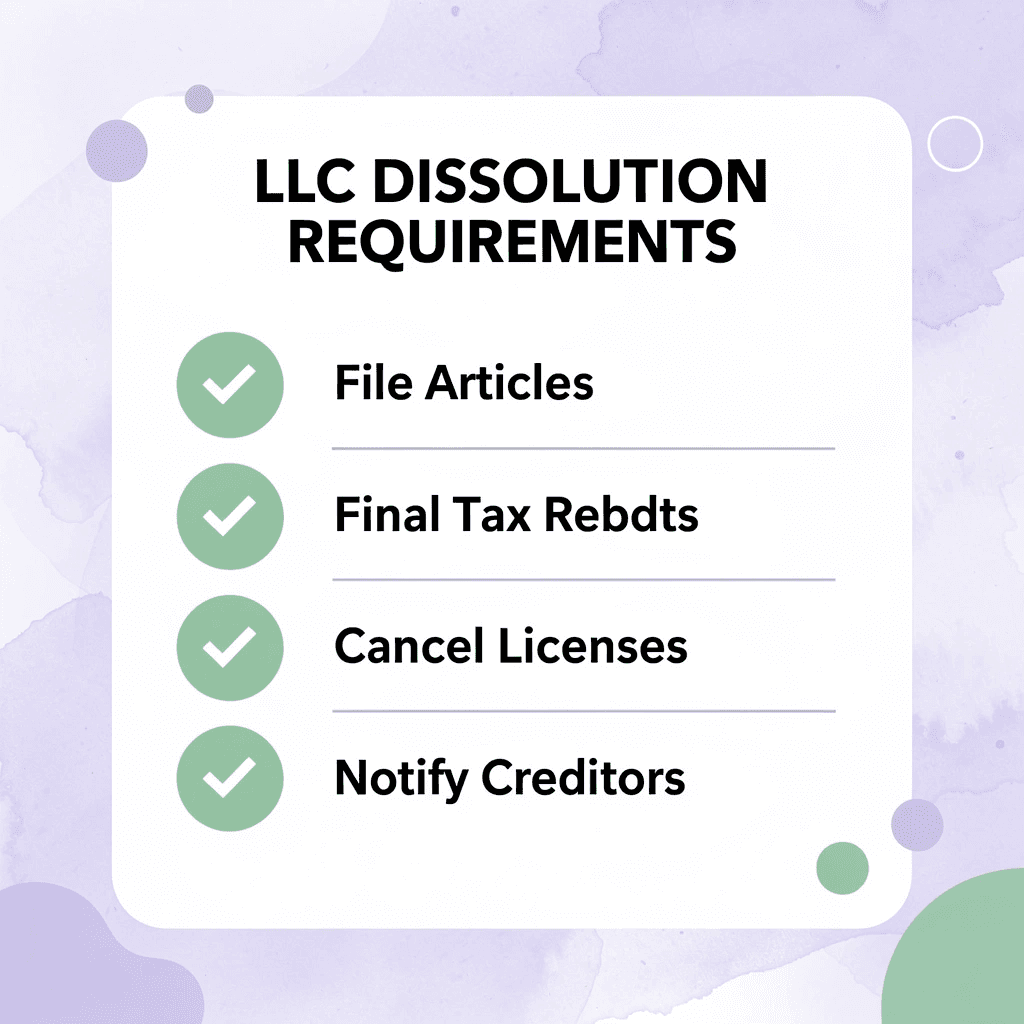
Filing Articles of Dissolution doesn't close your tax accounts. You must file final federal tax returns with the IRS, submit final Alabama state tax filings, pay outstanding liabilities, and close employer payroll tax accounts if you had employees. If the LLC collected sales tax, those accounts must be formally closed with the Alabama Department of Revenue. According to FormLLC, Alabama charges a state filing fee to process LLC dissolution documents, but that fee only covers the legal termination, not the closure of the tax account. Tax agencies don't monitor filings with the Secretary of State.
Without explicit final returns or account-closure requests, they assume you're still operating and expect continued compliance. Starcycle helps founders avoid this gap by creating action plans that coordinate legal dissolution and tax closure in parallel, ensuring final filings happen on schedule and agency notifications get tracked, rather than surfacing months later as unexpected penalties or notices.
The legal step that officially ends your LLC is filing Articles of Dissolution with the Alabama Secretary of State. Alabama's process differs from many states:
Email submissions aren't accepted. You can also complete and submit the form online through the Alabama Secretary of State Online Services portal.
The filing requires the LLC's legal name, formation date, confirmation of dissolution, and an authorized signature by a member or manager. The state filing fee is typically $100, though probate offices may charge additional recording fees. Until the state accepts this filing, your LLC remains legally active.
After all debts and obligations are satisfied, the remaining assets are distributed to members. If your operating agreement specifies how distributions should happen, follow those terms. If it doesn't, Alabama law provides default rules for allocating assets among members based on their ownership percentages. Distributing assets before settling creditor claims creates personal liability risk.
Creditors can pursue members directly for amounts they would have received had the distribution followed the proper legal sequence. Documenting asset distributions clearly reduces the risk of disputes among members and provides evidence that the winding-up process was completed correctly.
But knowing the steps doesn't explain why so many founders still end up with unresolved obligations months after filing dissolution paperwork.

Many founders approach dissolution with the assumption that it's a matter of following a few online steps. A quick search, a checklist, a form or two, and the rest will fall into place. In practice, dissolving an LLC is less about knowing individual steps and more about managing timelines, dependencies, and documentation that span multiple agencies and deadlines.
Each action triggers the next. Member approval enables winding up. Winding up affects creditor handling. Creditor handling influences tax filings. Tax filings must align before state dissolution can truly close the loop. According to Small Business Trends, 70% of startups fail between years 2-5, meaning thousands of founders face this process during periods of high stress and transition fatigue. Under normal circumstances, tracking these dependencies is manageable. During a business closure, it's not.
Stress and transition fatigue make manual tracking unreliable. Founders forget what's been filed, which accounts are closed, or what still needs attention. Small gaps turn into lingering obligations. Subscriptions renew. Deadlines are missed. Fees appear after closure. Without structure, money leaks quietly, and the mental burden of "did I handle everything?" persists for months.
What actually helps founders close cleanly is structure, not more instructions. A clear, specific action plan that reflects state requirements. Centralized tracking for filings, deadlines, and confirmations. Visibility into what's done, what's pending, and what comes next.
Platforms like Starcycle provide this structure by creating tailored action plans that coordinate legal filings, tax closures, and contract cancellations in sequence, ensuring founders can see exactly what's been completed and what still requires attention rather than relying on memory or scattered spreadsheets during an already difficult transition.
Instructions explain dissolution. Structure ensures it's completed, fully and confidently. The difference between knowing the steps and having a system to execute them is what separates a confusing shutdown from a clean transition forward. For founders, that difference is what turns months of uncertainty into weeks of focused action.
But structure alone doesn't guarantee success if founders don't know what clean closure actually looks like in practice.
75% of closures leave unresolved obligations that create long-term exposure. A structured winddown saves 40–60 hours and cuts legal risk ~80%.
Get a quote
Clean closure happens when founders treat dissolution as a complete process rather than a single filing event. You finish what you started by systematically resolving obligations, documenting each step, and ensuring nothing remains unresolved when you walk away. That clarity protects you legally and creates the mental space needed to move forward without wondering if something will surface later.
If your LLC has multiple members, start by documenting the dissolution approval in accordance with your operating agreement's terms. Written consent signed by all members (or the required percentage) establishes the legal authority to proceed and prevents disputes about whether dissolution was properly initiated.
Single-member LLCs still benefit from written documentation showing when winding up began, creating a clear timeline if questions arise later about obligations or liabilities. This isn't bureaucracy. It's proof that you followed your own governance rules and initiated closure deliberately rather than abandoning the business informally.
A clean closure requires knowing what you owe before distributing the remaining assets. Review vendor contracts, service agreements, outstanding invoices, loan obligations, and any pending claims against the company. Notify creditors that the LLC is dissolving and settle debts according to priority (secured creditors first, then general creditors, then member distributions).
According to Governor Kay Ivey, Alabama's economy saw $14.6 billion in new capital investment in recent years, reflecting a business environment where financial relationships matter and proper closure protects your ability to participate in future opportunities. Rushing asset distribution before addressing creditor claims creates personal liability exposure that follows members long after they thought the business ended.
Filing Articles of Dissolution doesn't notify tax agencies that your business has ended. You must submit final federal tax returns marked as final, file Alabama state tax returns for the dissolution year, close employer payroll accounts if you had employees, and formally close sales tax permits if applicable. Each agency operates independently. Without explicit final filings and closure requests, they assume you're still operating and expect continued compliance.
Platforms like Starcycle coordinate these parallel processes by creating action plans that ensure tax closures happen alongside legal filings, rather than surfacing months later as unexpected notices or penalties, as founders assumed everything was finished.
Auto-renewing contracts continue billing after operations stop unless you actively cancel them. Software subscriptions, domain registrations, registered agent services, insurance policies, payment processing platforms, and vendor agreements often renew automatically based on original terms. Without a structured review, these costs accumulate silently.
Clean closure means creating a complete inventory of recurring obligations, canceling each according to contract terms, and confirming cancellation rather than assuming nonpayment will end the relationship. According to Governor Kay Ivey, Alabama announced 17,000+ new jobs in recent economic development activity, illustrating a business landscape where maintaining professional relationships (including clean exits from contractual obligations) matters for future opportunities.
Proper records protect you if questions arise later about how the business was closed. Maintain organized files containing:
Articles of Dissolution, filing receipts, contract cancellation confirmations, and final asset distribution records. If the IRS, a former vendor, a creditor, or a regulatory agency requests clarification years later, you should be able to produce clear evidence showing the LLC was properly wound up. Scattered documentation creates uncertainty. Organized records create confidence that nothing was missed and everything can be verified.
Alabama recognizes three distinct paths to LLC dissolution: voluntary, administrative, and judicial. According to William H. Burress, Attorney at Law, each carries different triggers, timelines, and levels of founder control.
"Each of the three dissolution paths — voluntary, administrative, and judicial — carries different triggers, timelines, and levels of founder control." — William H. Burress, Attorney at Law
Dissolution Type | Who Initiates | Founder Control |
|---|---|---|
Voluntary | The LLC members themselves | Highest — fully member-driven |
Administrative | The State of Alabama | Limited — triggered by compliance failures |
Judicial | A court of law | Lowest — court-ordered outcome |
🎯 Key Point: Not all dissolutions are created equal — voluntary dissolution gives founders the most control, while judicial dissolution can be imposed against the founders' wishes.
⚠️ Warning: Choosing the wrong dissolution path — or failing to act before the state does — can result in loss of control over your LLC's wind-down process and expose members to unexpected liability.
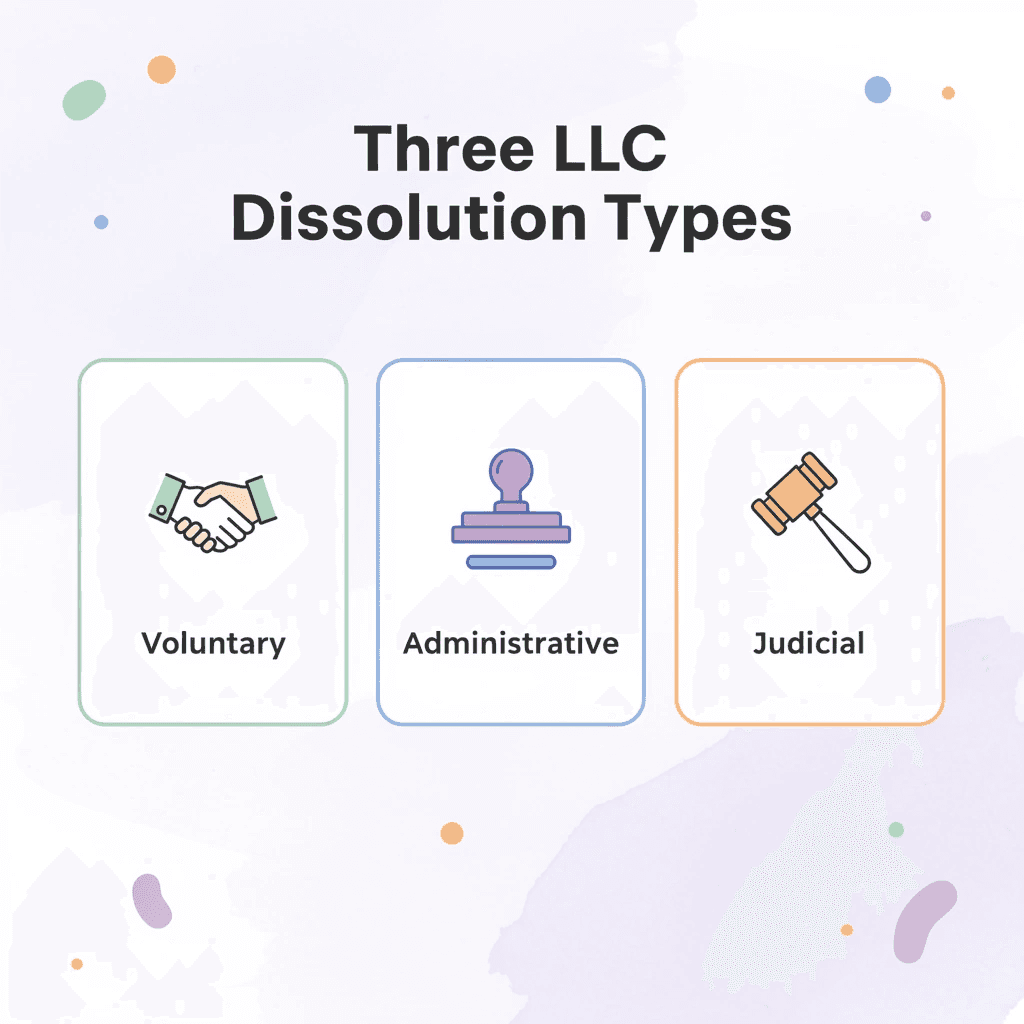
Voluntary dissolution allows founders to wrap up the business, meet obligations, distribute remaining assets, and file paperwork with the Alabama Secretary of State, all while controlling timing and outcomes. The common failure point is paperwork pile-up. Without clear organization, founders miss contracts, fail to notify creditors, and slip key filing deadlines. Our business closure platform streamlines this process through tailored action plans, document organization, and deadline tracking.
Administrative dissolution occurs when the state takes action due to missed filings, compliance problems, or loss of registered agent status. Many assume it automatically closes the business, but reinstatement is often required before the LLC can legally operate again or be formally dissolved. Founders frequently discover that inaction costs more than a clean, voluntary closure.
Judicial dissolution occurs when a court orders a business to close due to member disagreements, management deadlock, or breach of fiduciary duty. It typically affects multi-member LLCs where disputes exceed the operating agreement's scope. According to Tailor Brands, Alabama's dissolution process takes anywhere from a few weeks to several months, with litigation extending the timeline further.
The type of dissolution you face determines how long it takes, how much it costs, and how legally complicated your exit will be. Voluntary dissolution keeps this time window as short as possible, while administrative and judicial paths extend it through reinstatement requirements, court proceedings, or unresolved compliance issues.
Frequently Asked Questions about dissolving an LLC in Alabama are addressed below to help you navigate the dissolution process with confidence. Whether you're unsure about filing requirements, outstanding debts, or final tax obligations, these answers cover the most critical details you need to complete your LLC closure properly.
"Failing to formally dissolve an LLC can leave business owners personally exposed to ongoing fees, penalties, and legal liability — even after operations have ceased." — Alabama Secretary of State Business Division
💡 Tip: Bookmark this FAQ section and refer back to it at each stage of your dissolution process — many business owners miss key steps by rushing through without a checklist.
⚠️ Warning: Simply stopping operations does not legally dissolve your LLC in Alabama. You must file the proper Articles of Dissolution with the Alabama Secretary of State to officially terminate your business entity and avoid ongoing annual fees.
Common FAQ Topic | Key Takeaway |
|---|---|
How long does dissolution take? | Typically 3–5 business days for standard filing |
Are there filing fees? | Yes — a $100 filing fee applies in most cases |
Do I need to notify creditors? | Yes — notifying creditors is a critical legal step |
What about final taxes? | You must file a final state tax return before closing |
Can I reinstate after dissolving? | Possibly — reinstatement options vary by circumstance |
🔑 Takeaway: The dissolution process involves more than just paperwork — it requires settling debts, closing accounts, notifying creditors, and filing final taxes to ensure you have no lingering legal or financial obligations.
Closing one LLC before launching a new venture is allowed and often the cleaner path forward. Unresolved obligations from a prior entity—tax filings, member disputes, or outstanding contracts—can follow you into your next business if not addressed properly. A clean dissolution keeps your next start fresh.
The funds in your LLC's account pay outstanding obligations at closure, including unpaid vendor payments, final payroll, any remaining lease terms, and state fees. After settling these obligations, any remaining funds are distributed to members in accordance with your operating agreement.
Alabama does not tie dissolution eligibility to the calendar year, so you can dissolve your LLC mid-year. However, mid-year closures trigger partial-year tax filings; coordinate with your accountant before submitting your Articles of Dissolution to the Alabama Secretary of State. According to Northwest Registered Agent, the filing fee for Articles of Dissolution in Alabama is $100, with standard processing taking 3-5 business days. These details help you plan your wind-down timeline and budget.
Business assets don't disappear when you close. During the winding-up period, physical property, equipment, remaining inventory, and intellectual assets must be accounted for. They can be sold to pay off debts, transferred to members, or distributed in accordance with your operating agreement.
Most founders underestimate how long this step takes. Selling equipment, canceling vendor accounts, and documenting asset transfers each involve substantial paperwork. Rushing through it creates gaps that can surface later as disputes or compliance questions.
The common approach is to handle these tasks one at a time, tracking assets in spreadsheets and reviewing contracts individually. As the list grows, things get missed: a subscription keeps charging, a vendor agreement stays open, a key date passes unnoticed. Starcycle addresses this directly with tools for contract and subscription management, asset tracking, and deadline visibility, ensuring nothing gets left behind.
Yes. Keep your Articles of Dissolution, final tax returns, member distribution records, and signed contracts. If a former vendor, creditor, or tax authority questions you after the LLC closes, your documentation is your only defense. Alabama's statute of limitations on certain business claims means these records may matter years after closure.
The answer depends on why and how the LLC was dissolved. Voluntary dissolution through proper filing differs from administrative dissolution triggered by missed annual reports or compliance failures. UpCounsel notes that a $10 annual report fee is required before dissolving an LLC in Alabama, and compliance gaps affect reinstatement eligibility. A dissolved LLC cannot simply be reopened. Alabama has specific reinstatement procedures that vary based on how long the entity has been inactive and what triggered the dissolution. Consult a business attorney before assuming reinstatement is possible.
Closing your Alabama LLC does not automatically close your obligations elsewhere. If your LLC has a foreign registration in another state, that registration remains active until you formally withdraw it with that state's filing authority. The same applies to property ownership: holding real estate or significant assets in another jurisdiction may trigger separate legal or tax requirements that the Alabama closure process does not address.
Each state where your LLC has a legal presence or registered agent operates independently. Founders who skip the foreign withdrawal step often discover months later that they are still accruing annual report fees or registered agent costs in states they thought they had exited. Getting through it cleanly and completely frees you to start the next thing without looking over your shoulder.
Closing your Alabama LLC correctly doesn't require expensive attorneys or months of uncertainty. What it requires is a system that ensures nothing gets missed, every deadline gets tracked, and every obligation gets resolved in the right sequence. If you're ready to dissolve your Alabama LLC without confusion or loose ends, Starcycle helps make the process clearer, faster, and more human.
Sign up to get a quote and see how we can simplify your business closure starting at $399, with no hidden fees You'll get a tailored action plan that coordinates legal filings, tax closures, and contract cancellations so you can finish strong and move forward with confidence. The business didn't work out as planned. That's okay. How you close it still matters.