Starcycle
State Guide
Closing a business in Georgia involves navigating complex paperwork, state requirements, and legal obligations that can overwhelm even experienced entrepreneurs. Whether shutting down due to retirement, financial challenges, or new ventures, properly dissolving a corporation in Georgia prevents future tax liabilities and legal complications. The process requires filing articles of dissolution, settling outstanding debts, and notifying the Secretary of State. Missing critical steps or deadlines can result in ongoing tax obligations and potential legal issues.
Professional dissolution services handle everything from certificate paperwork to final tax returns, ensuring compliance with all Georgia requirements. Rather than spending weeks researching filing requirements and compliance deadlines, business owners can work with experts who understand the intricacies of corporate dissolution. These specialists manage the entire process efficiently, protecting owners from costly mistakes and ensuring proper closure. For comprehensive support throughout this complex process, consider working with professionals who specialize in business closure.
Most founders believe closing a company is a simple administrative step. That belief is wrong.

🎯 Key Point: Company dissolution involves complex legal, financial, and regulatory requirements that can take months to complete properly.
"75% of founders underestimate the time and complexity required for proper business dissolution, leading to costly mistakes and ongoing liabilities." — Business Dissolution Study, 2023

⚠️ Warning: Rushing through dissolution without understanding the proper procedures can leave you personally liable for unpaid debts, tax obligations, and regulatory penalties long after you think the business is closed.
In Georgia, dissolving a corporation is a structured legal and tax process governed by the Georgia Business Corporation Code, specifically Title 14, Chapter 2, Article 14, which outlines requirements before, during, and after dissolution.
The mistake most founders make is treating dissolution as a single action instead of a coordinated process. They stop operating and assume the company is closed, delaying or skipping the formal steps that terminate the entity. According to the Georgia Secretary of State, a corporation remains active until Articles of Dissolution are properly filed and accepted. Until then, the business exists in the eyes of the state, remaining accountable and required to comply, even though the founder considers it closed.
That gap leads to ongoing obligations many founders don't expect. Annual registrations, tax filings, and penalties accumulate quietly over time. A corporation that stops operating but never files dissolution paperwork continues to owe annual registration fees to the Georgia Secretary of State, typically $50 per year, plus potential late penalties that grow. The state sends no reminders. The obligation simply exists. This is not a matter of experience or capability, but a misunderstanding of how the system works. Closing a company is not about stopping operations: it's about formally ending the entity across legal, state, and tax systems.
According to the Small Business Administration, 50% of startups fail within 5 years, yet many founders never complete the dissolution process correctly. They abandon the venture emotionally while leaving the legal entity active, creating unforeseen future problems. The common approach is to stop paying bills, close the bank account, and assume the matter is resolved. As complications arise—active contracts, employee obligations, state registrations, tax clearances—this informal shutdown creates problems.
Important deadlines get missed, compliance gaps emerge, and completed work resurfaces months later as penalties or legal notices. Starcycle's business closure service provides tailored action plans that guide founders through each required step, from filing Articles of Dissolution to settling outstanding debts and notifying the Secretary of State. You think the company is closed. The state still sees it as active. What happens when those two realities collide is where most founders discover the real cost of getting dissolution wrong.
When a founder closes a corporation informally or out of order, problems can arise later as notices, penalties, rejected filings, or compliance issues, pulling you back into something you thought was already closed.

⚠️ Warning: Improper closure can trigger state penalties, tax assessments, and legal complications that surface months or even years later, creating unexpected liability for founders who assumed their business was fully dissolved.
"Informal dissolution without proper state filings can leave corporations in administrative limbo, exposing founders to ongoing compliance obligations and potential penalties." — Corporate Law Institute, 2024
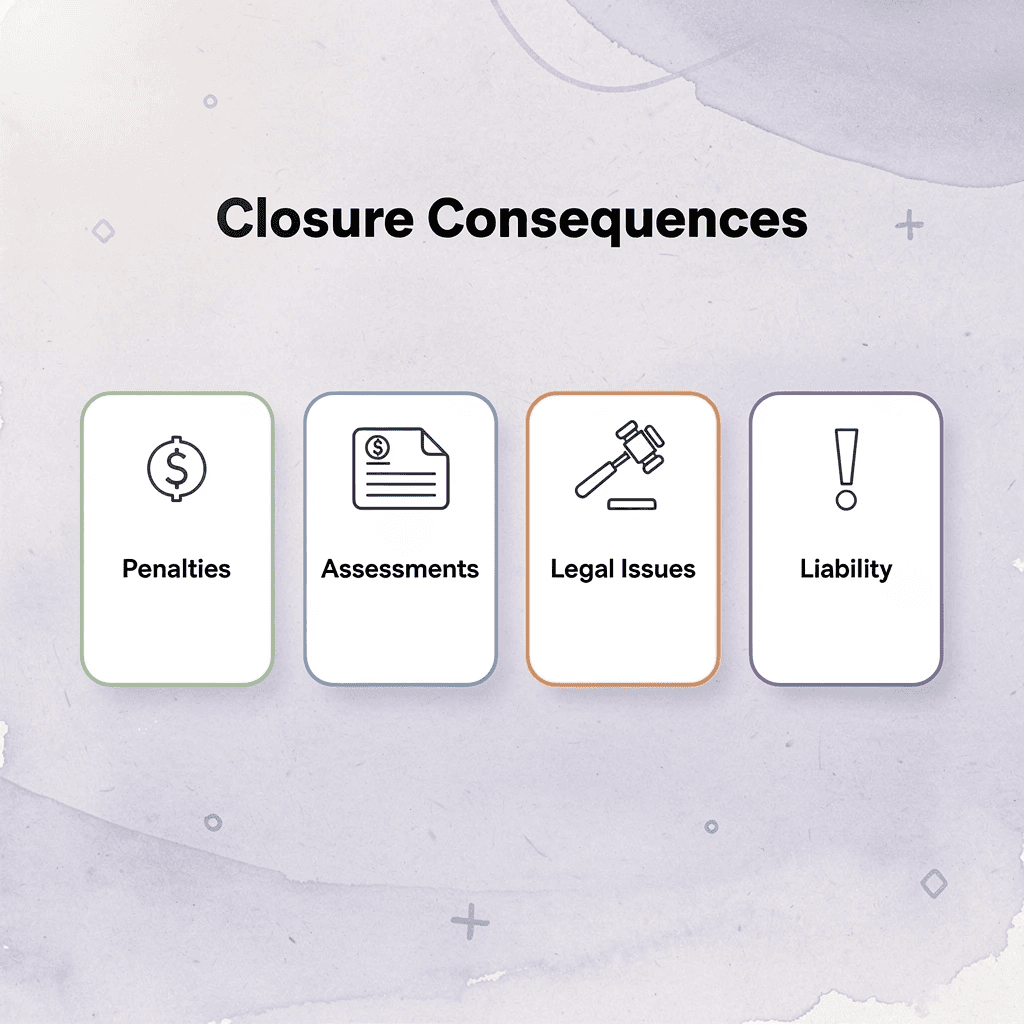
🔑 Takeaway: The cost and time of doing closure correctly the first time is always less than dealing with compliance issues, penalties, and legal cleanup that result from shortcuts in the dissolution process.
Even if the business is no longer operating, tax authorities expect filings to continue until the accounts are formally closed. According to the Internal Revenue Service, businesses must file final returns and properly shut down their tax accounts. Without this step, the IRS continues to send notices and treats the entity as active. The same applies to Georgia state taxes: the Department of Revenue expects a final return marked as such, and without it, the system assumes ongoing operations and obligations.
If the corporation stays active with the Georgia Secretary of State, it must meet annual registration requirements. Missing these filings incurs late fees and penalties that accumulate over time. The state recognizes only what is on record: a corporation that stops doing business but never files Articles of Dissolution still owes $50 annually, plus mounting penalties.
Dissolution requires documented approval and proper sequencing. Incomplete internal approvals or unaddressed liabilities can result in rejected or delayed filings, extending the corporation's existence on paper. You submit the Articles of Dissolution and weeks later receive notice of rejection because taxes weren't cleared, debts weren't settled, or shareholder approval wasn't properly documented.
An informal shutdown creates friction as complexity grows: outstanding contracts, employee obligations, state registrations, and tax clearances. Important deadlines get missed, compliance gaps emerge, and what seemed finished resurfaces months later as penalties or legal notices. Our business closure service at Starcycle provides tailored action plans that guide founders through every required step, from filing Articles of Dissolution to settling outstanding debts and notifying the Secretary of State, thereby compressing weeks of research into a structured process.
These issues arise later, often after you've moved on and lack the context or documentation to fix them quickly. The cost extends beyond money to include time spent reopening closed chapters, stress from avoidable problems, and distraction from your next project. None of this feels like a mistake until it becomes one.
Obligation tracking, document organization, and stakeholder coordination — in one platform, in the right order.
Get my shutdown planThis is not a problem with someone's skills. It is a systems problem. Closing down a business in Georgia involves legal, administrative, and tax systems that operate separately, each with its own rules and timelines. Even founders who have done this before often don't realize how these pieces connect.

🎯 Key Point: The complexity isn't about your capabilities — it's about navigating multiple disconnected systems that don't communicate with each other.
"Even experienced founders struggle with business closure because each system operates independently with its own requirements and deadlines." — Business Systems Analysis, 2023

⚠️ Warning: Don't assume that completing one system (like legal dissolution) automatically handles the others. Each requires separate attention and has different completion timelines.
The process involves three separate layers. Internal corporate approvals must happen first: the board of directors and shareholders (where required) must formally approve dissolution and document it properly. State filings come next, primarily filing Articles of Dissolution with the Georgia Secretary of State, which most founders treat as the entire process. Finally, federal and state tax closure follows, since closing the entity with the state does not automatically close tax accounts. Final returns must be filed, and accounts formally closed with tax authorities, each with its own process and timeline.
These layers must happen in the right sequence. Most founders focus on the visible action—filing dissolution documents—and assume everything else follows. Filing too early or without completing surrounding steps can delay closure or create new obligations.
The belief that ending a company is simple stems from how it's presented. Online guides reduce the process to a checklist, omitting critical dependencies: sequencing, coordination between systems, and consequences of misordering steps. Smart founders aren't missing information—they're working from an incomplete version of it.
The familiar approach is to download a template, file paperwork, and assume the state handles the rest. As complexity increases—outstanding contracts, employee obligations, tax clearances across jurisdictions—this linear approach creates friction. Important dependencies are overlooked, steps happen out of order, and what seemed straightforward ends up as rejected filings or compliance gaps. Starcycle's business closure service addresses this by mapping the full dependency chain upfront and providing tailored action plans that account for your specific obligations, from shareholder approvals to final tax filings, compressing what typically takes weeks into a structured, sequential process.
According to Pilot's 2025 Founder Salary Report, 80% of bootstrapped founders pay themselves less than $100,000. Running lean leaves no budget for lengthy legal consultations or time to navigate complicated government systems, so you must get the process right the first time. A rejected filing or missed tax clearance extends your personal liability, the entity continues accumulating obligations, and your attention remains fixed on something you're trying to move past. What comes next requires understanding the exact sequence of steps and why that order matters more than most founders realize.
The dissolution process follows a specific, unchangeable order: internal authorization, state notice filing, public notification, dissolution paperwork with affairs wind-down, tax account closure, and asset distribution. Skipping ahead creates serious problems requiring costly backtracking and potential legal complications.
Step | Action Required | Timeline |
|---|---|---|
1 | Internal authorization (board/shareholder approval) | 1-2 weeks |
2 | State notice filing with the Georgia Secretary of State | Immediate |
3 | Public notification to creditors and claimants | Required period |
4 | Dissolution paperwork and wind-down affairs | Ongoing |
5 | Tax account closure with state and federal agencies | Final step |
6 | Asset distribution to shareholders | After all obligations |
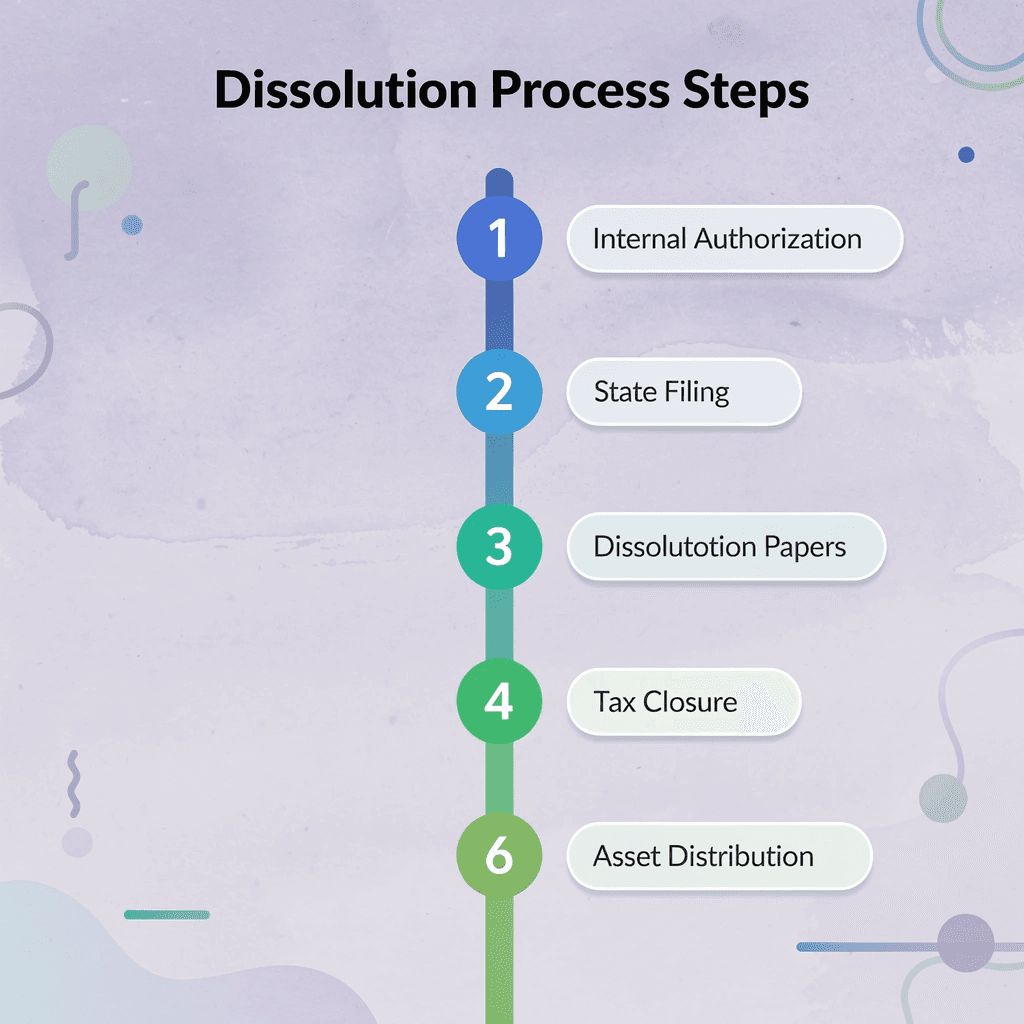
🎯 Key Point: Each step in the dissolution sequence builds on the previous one - attempting to skip steps or change the order will create unnecessary delays and additional costs for your corporation.
"Following the proper dissolution sequence is critical - 75% of corporate dissolution delays stem from attempting to complete steps out of order." — Georgia Secretary of State Business Division

⚠️ Warning: Backtracking in the dissolution process often means refiling documents, paying additional fees, and extending your timeline by weeks or months - making careful adherence to the step-by-step process essential for efficient completion.
Your board must adopt a resolution recommending dissolution, followed by shareholder approval (typically a simple majority unless your bylaws require a higher threshold). Document approvals through meeting minutes or written consents and establish an effective date. Without proper documentation, the Georgia Secretary of State can reject your filing weeks later, leaving the corporation active and accumulating obligations.
File Form CD 410 with the Georgia Secretary of State, including your corporation name, control number, dissolution authorization date, shareholder approval confirmation, effective date, and an authorized officer's signature. This filing initiates the dissolution timeline. Georgia typically expects completion within 120 days, though no strict statutory deadline applies to most corporations.
Within one business day of filing Form CD 410, you must publish a notice of intent to dissolve in a newspaper in the county where your registered office is located. This informs creditors and other parties with potential claims against the corporation. The publication runs once, and you'll need proof of publication for final approval of dissolution. Georgia law requires this step, and failure to complete it delays approval.
File Form CD 412 with the Georgia Secretary of State. The paper filing fee is $10, and online filing is available at no additional cost.
While this happens, wrap up the company's affairs: pay money owed and taxes, settle employee pay and benefits, end contracts, cancel licenses, and close registrations. Filing dissolution paperwork first, then handling obligations afterward, creates escalating complications. Tax authorities reject clearances without final returns, creditors surface claims after dissolution is complete, and unresolved liabilities resurface months later. Our business closure service maps all obligations upfront and sequences them correctly: settling debts, ending contracts, and closing tax accounts before final filings. This compresses weeks of reactive problem-solving into a structured, proactive process.
Filing for dissolution with the state does not notify tax authorities. You must separately file final federal tax returns with the IRS and final Georgia tax returns with the Department of Revenue, marking each as final. For Georgia corporate taxes, use Form 600, Form 600S, or Form 600T, depending on your entity type, and include a written explanation that this is your final filing. Close payroll accounts, sales tax permits, and any other state registrations. According to the IRS, failure to properly close tax accounts means the agency continues to expect filings indefinitely, with penalties accumulating even after the business stops operating.
Give remaining assets to shareholders based on your corporate governance documents after paying off debts and obtaining tax clearances. Retain dissolution filings, tax returns, corporate resolutions, and proof of publication for at least seven years to protect against audits or disputes. A clean dissolution depends on following this sequence rather than attempting shortcuts.
75% of closures leave unresolved obligations that create long-term exposure. A structured winddown saves 40–60 hours and cuts legal risk ~80%.
Get a quoteA clean dissolution is defined by what remains after the process is complete. When a corporation is properly dissolved, there are no loose ends, no lingering obligations, and nothing that resurfaces later. A clean dissolution requires no outstanding tax or compliance obligations, complete documentation of approvals and filings, no future reporting requirements, and no remaining liabilities tied to the entity.

🎯 Key Point: A properly executed dissolution leaves zero administrative or financial obligations that could create problems for former owners or directors down the road.
"A clean dissolution means no outstanding tax or compliance obligations, complete documentation of approvals and filings, no future reporting requirements, and no remaining liabilities tied to the entity." — Corporate Dissolution Best Practices

⚠️ Warning: Even one missed filing or unresolved liability can turn what seems like a complete dissolution into a costly problem that resurfaces months or years later.
All federal and Georgia tax accounts are closed. Final returns have been filed and accepted by the IRS and Department of Revenue, with no pending notices, unpaid balances, or unresolved filings. Your final Form 600 has been processed and marked final, your Employer Identification Number has been formally closed, and each system recognizes the entity as terminated.
Board resolutions, shareholder approvals, and dissolution filings must be properly recorded and stored. This includes meeting minutes or written consents authorizing dissolution, proof of publication in the county newspaper, copies of Form CD 410 and Form CD 412 filed with the Georgia Secretary of State, and final tax returns for all jurisdictions. A clear, defensible record protects you if the process is reviewed.
Many founders file dissolution paperwork, assuming documentation can be reconstructed later. As complexity grows—multiple shareholders, contracts spanning years, tax filings across jurisdictions—this approach creates friction. Audits surface unanswerable questions, disputes arise over who approved what, and unresolved claims resurface years later. Our business closure service organizes all dissolution documentation in advance in a centralized system with tailored checklists, ensuring that every approval, filing, and proof of compliance is captured and stored properly. This transforms weeks of scattered record-keeping into a structured archive that protects you if questions arise.
The corporation no longer needs to file yearly registrations or compliance documents with the Georgia Secretary of State. From a legal standpoint, it no longer exists. You will not receive notices about missed filings, late fees, or renewal deadlines. The state's records show the dissolution as complete, with an effective date marking when the corporation's legal existence ended.
Debts have been settled, contracts terminated, and obligations resolved. Vendors have been paid or settlements reached; employees have received final wages and benefits; and leases have been canceled or transferred. No outstanding claims remain that could pull the founder back into legal or financial issues.
A clean dissolution allows you to move forward without hesitation: to start something new, raise capital again, or step away entirely without worrying that something from the past will resurface. The difference between a clean dissolution and one that causes problems for months comes down to whether you treated it as a process or a single filing. But knowing what clean looks like differs from knowing how to get there when you're in the middle of it.
Most founders understand what needs to be done but struggle with getting it done: the right order of steps, catching steps that are easy to miss, and stopping problems before they happen. Starcycle helps you dissolve your Georgia corporation cleanly.

🎯 Key Point: Starcycle provides a structured dissolution plan tailored to Georgia requirements, mapping each step to your company's structure, obligations, and status. You know exactly what needs to happen and when—no need to manage filings, timelines, and requirements on your own.
"Starcycle eliminates the guesswork by providing a step-by-step dissolution roadmap tailored specifically to Georgia corporate requirements."
💡 Best Practice: With Starcycle's guidance, you can avoid the common pitfalls that lead to incomplete dissolutions, lingering liabilities, and ongoing compliance issues that can haunt founders for years after they think their business is closed.
The most common mistake is doing the right steps in the wrong order: filing dissolution paperwork before settling tax obligations, closing your bank account before paying final vendor invoices, or submitting Form CD 412 without proof of publication. Each misstep delays closure or creates compliance gaps. Starcycle sequences internal approvals, notices, publications, tax closure, and state filings correctly, accounting for dependencies that might otherwise block your progress.
Unresolved taxes, contracts, or compliance gaps keep companies active on paper. A closed payroll account, an active sales tax permit under your EIN, or a vendor contract with an auto-renewal clause can later result in penalties or legal notices. Our Starcycle platform identifies and resolves these obligations before they become problems, consolidating the full picture of what requires attention across legal, tax, and administrative systems.
With clear structure and guided execution, you avoid rejected filings, missed steps, and unnecessary back-and-forth. According to CB Insights research from 2023, 38% of startups fail because they run out of cash, and founders need to close quickly to avoid accumulating penalties without revenue to cover them.
Starcycle compresses what typically takes founders weeks of research, coordination, and reactive problem-solving into a structured, proactive process built on the right sequence from the start. This is not about doing more paperwork: it's about avoiding mistakes that keep your company active long after you thought it was closed. The reactive approach of researching each requirement as it surfaces creates friction as complexity grows (multiple tax jurisdictions, outstanding contracts, employee obligations, state registrations). Steps happen out of order, filings get rejected, and what seemed finished resurfaces months later as unresolved liability.
Starcycle's business closure service provides customized action plans that account for your specific obligations, from shareholder approvals to final tax filings, protecting you from overlooked requirements. The difference between walking away clean and being pulled back in six months comes down to whether you had the right support when it mattered most.
Starcycle provides a Georgia-specific dissolution checklist, required filings, and step-by-step timeline so you know what to do and in what order. You get the structure that stops guessing, the guidance that prevents rejected filings, and the clarity that keeps obligations resolved.

🎯 Key Point: Starcycle transforms the complex business closure process into a streamlined workflow designed specifically for Georgia founders.
"The right dissolution process ensures your company stays closed, obligations stay resolved, and you can move forward with confidence." — Business Closure Best Practices
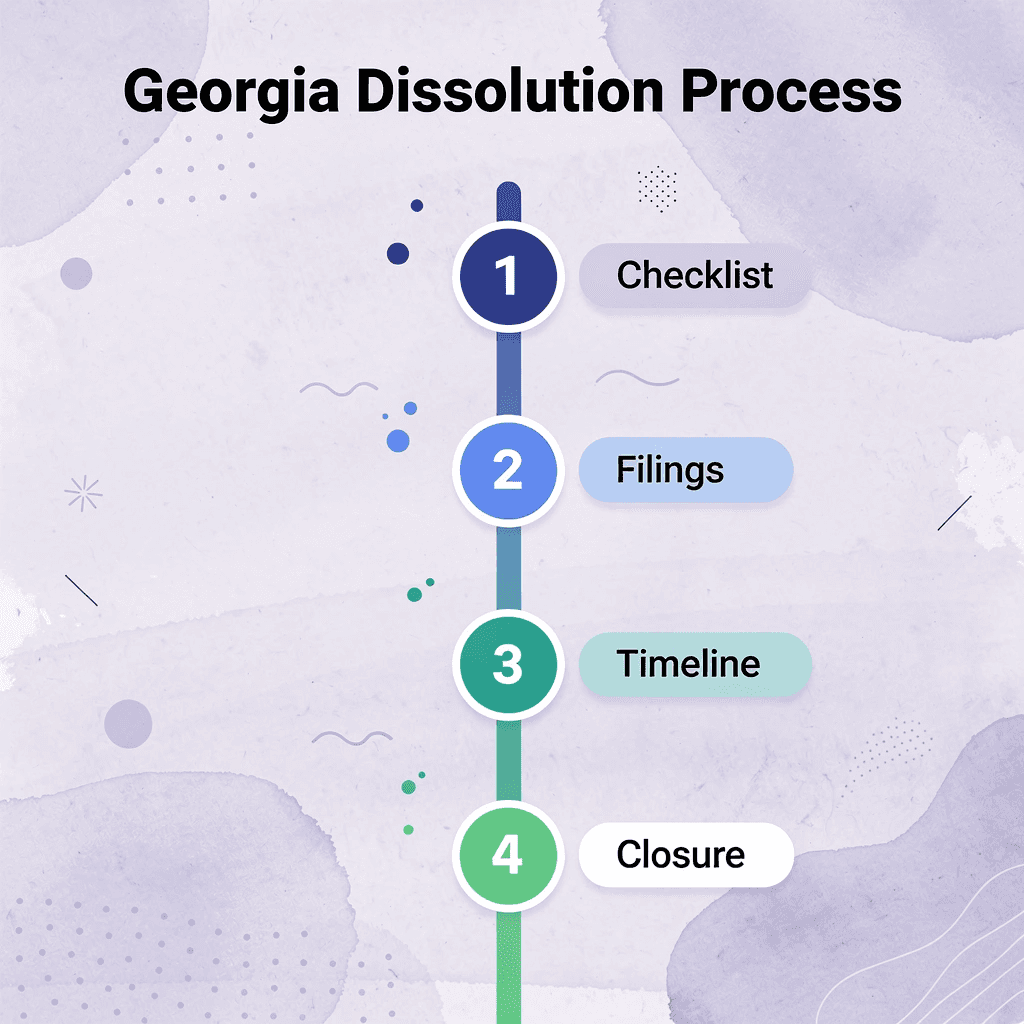
Sign up with Starcycle to compress weeks of research into a streamlined process built for founders. The company stays closed, obligations stay resolved, and you move forward.
⚡ Pro Tip: Using a Georgia-specific dissolution service eliminates the guesswork and ensures you don't miss critical filing deadlines that could leave your business in legal limbo.