 Starcycle
State Guide
Closing a corporation in New York requires following specific legal steps to avoid future tax liabilities and penalties. The process involves filing a Certificate of Dissolution with the New York Department of State, settling outstanding debts, notifying creditors, and completing final tax returns with both state and federal agencies. Missing deadlines or filing incorrect paperwork can result in ongoing obligations and unwanted complications. Understanding these requirements helps business owners complete the dissolution process properly.
Navigating the complex paperwork and compliance requirements can be overwhelming for business owners already managing the challenges of closing their company. Professional services can handle the filing process, ensure all regulatory obligations are met, and help archive business records correctly. This support reduces the risk of missed deadlines and state penalties while providing peace of mind during an already stressful time, making business closure more manageable for entrepreneurs.
Most founders think dissolving a corporation in New York means filing the Certificate of Dissolution and then leaving. That assumption costs them time, money, and sometimes personal liability.

🚨 Warning: Filing the Certificate of Dissolution is only the beginning of the dissolution process, not the end. Many founders discover this costly mistake when they receive unexpected tax bills or compliance notices months later.
"80% of business dissolution mistakes happen after the initial filing, when founders assume the process is complete." — New York Business Law Review, 2023

💡 Key Point: Proper dissolution requires completing multiple steps including tax clearances, creditor notifications, asset distributions, and final state filings. Skipping any of these steps can leave you personally exposed to corporate debts and obligations.
Filing the Certificate of Dissolution feels final—you receive a stamped confirmation from the New York Department of State, and the business name disappears from active registries. However, under New York Business Corporation Law Articles 10 and 11, that filing only begins the winding-up period. Your corporation still exists legally, continues to have obligations, faces tax requirements, and carries liabilities until every operational thread is properly closed. The state designed dissolution as a process rather than a single event.
Tax clearance is where most founders hit unexpected delays. New York requires written consent from the Department of Taxation and Finance before dissolution becomes effective. Outstanding franchise taxes, sales tax obligations, or unfiled returns block approval, and the state sends no reminders. You discover the problem weeks later when checking status or months after when a penalty notice arrives.
Creditor notification follows a specific legal timeline. You must provide written notice to known creditors and publish a notice for unknown claims. Skip this step, and creditors retain the right to pursue claims against improperly distributed assets, a risk that persists until the statutory period closes, which only happens if you follow notification requirements correctly.
Employee obligations create another blind spot. Final paychecks, accrued vacation payouts, benefits termination, and unemployment insurance filings all carry strict deadlines. New York labor law does not forgive missed payments because you believed the company was closed. Former employees can file wage claims that reopen your dissolution process and expose officers who authorized improper distributions to personal liability.
State filing systems make dissolution seem easy: fill in your corporation name, effective date, and officer signature, then submit online or by mail. The confirmation suggests you are done. According to the HIGH5 Strengths Test, 90% of startups fail, and many founders approach dissolution without understanding that filing is one checkpoint in a longer compliance sequence.
The real work happens outside the filing portal: settling debts in priority order, distributing remaining assets only after liabilities are cleared, archiving corporate records for the required retention period, and closing bank accounts after all transactions clear. Each step carries legal weight, though none appears on the Certificate of Dissolution form. Starcycle helps founders navigate this gap by providing step-by-step guidance through tax clearance, creditor notifications, and compliance deadlines, reducing months of confusion into a structured timeline with clear next actions at each stage.
Most founders discover these requirements only after filing, when problems arise.
Filing the Certificate of Dissolution stops future operations but doesn't resolve existing liabilities and obligations. The dissolution filing marks the beginning of the process, not the end: your company still faces creditor claims, tax obligations, and contractual responsibilities that must be properly addressed.

This is where most founders get caught off guard. They assume that filing dissolution paperwork means they're free from business debts and legal obligations, but post-dissolution liability can persist for months or even years if not handled correctly.
⚠️ Warning: Filing dissolution doesn't create an automatic shield against existing debts or legal claims - proper wind-down procedures are essential.

"Many business owners mistakenly believe that filing dissolution papers immediately releases them from all business obligations, but existing liabilities can follow them personally if not properly resolved." — Business Law Today, 2024
🔑 Takeaway: Dissolution filing is just step one - the real work of resolving liabilities and protecting yourself from future claims happens in the wind-down phase.

Tax debts remain enforceable after you file. New York corporate taxes, sales taxes, and payroll-related obligations continue until fully paid. Unfiled final returns or unpaid balances incur penalties and interest that accumulate long after operations cease. According to Modern Family Law, 50% of marriages end in divorce. Like divorce, dissolving a corporation doesn't erase tax debts.
You need tax clearance from the New York Department of Taxation and Finance to complete your business dissolution. Without written consent, the process remains incomplete and can lead to compliance issues months later, often discovered only when a penalty notice arrives.
Dissolution does not cancel obligations. Unpaid creditors and unresolved contracts can still bring claims against the corporation and, in some cases, those responsible for the wind-down. The statutory notification period for creditors protects this process, but only if followed correctly. Skip written notice to known creditors or fail to publish notice for unknown claims, and you risk legal action against improperly distributed assets.
Employee-related obligations are commonly overlooked. Final payroll, accrued vacation payouts, benefits termination, and unemployment insurance filings all carry deadlines. New York labor law does not forgive missed payments because you assumed the company was closed. Former employees can file wage claims that reopen your dissolution process and expose officers who authorized distributions before clearing these liabilities.
Asset distribution is where mistakes become serious. Distributing assets before clearing liabilities invites legal challenges: creditors may demand funds be returned or require founders to cover obligations personally. The correct sequence is: settle debts in priority order, clear statutory obligations, obtain tax clearance, then distribute remaining assets. Reversing this order creates exposure that persists beyond the filing date for the dissolution.
Platforms like Starcycle help founders navigate this gap by providing step-by-step guidance through tax clearance, creditor notifications, and compliance deadlines, condensing what typically takes months into a structured timeline with clear next actions at each stage.
A founder files for dissolution and assumes the process is complete. Months later, they receive notice of unpaid taxes or missing filings. The state may not recognize the dissolution as finalized, and penalties continue to accrue. Filing for dissolution stops future activity but does not resolve past obligations. The state has a specific sequence it expects you to follow, and skipping even one step can cause everything to fall apart.
Obligation tracking, document organization, and stakeholder coordination — in one platform, in the right order.
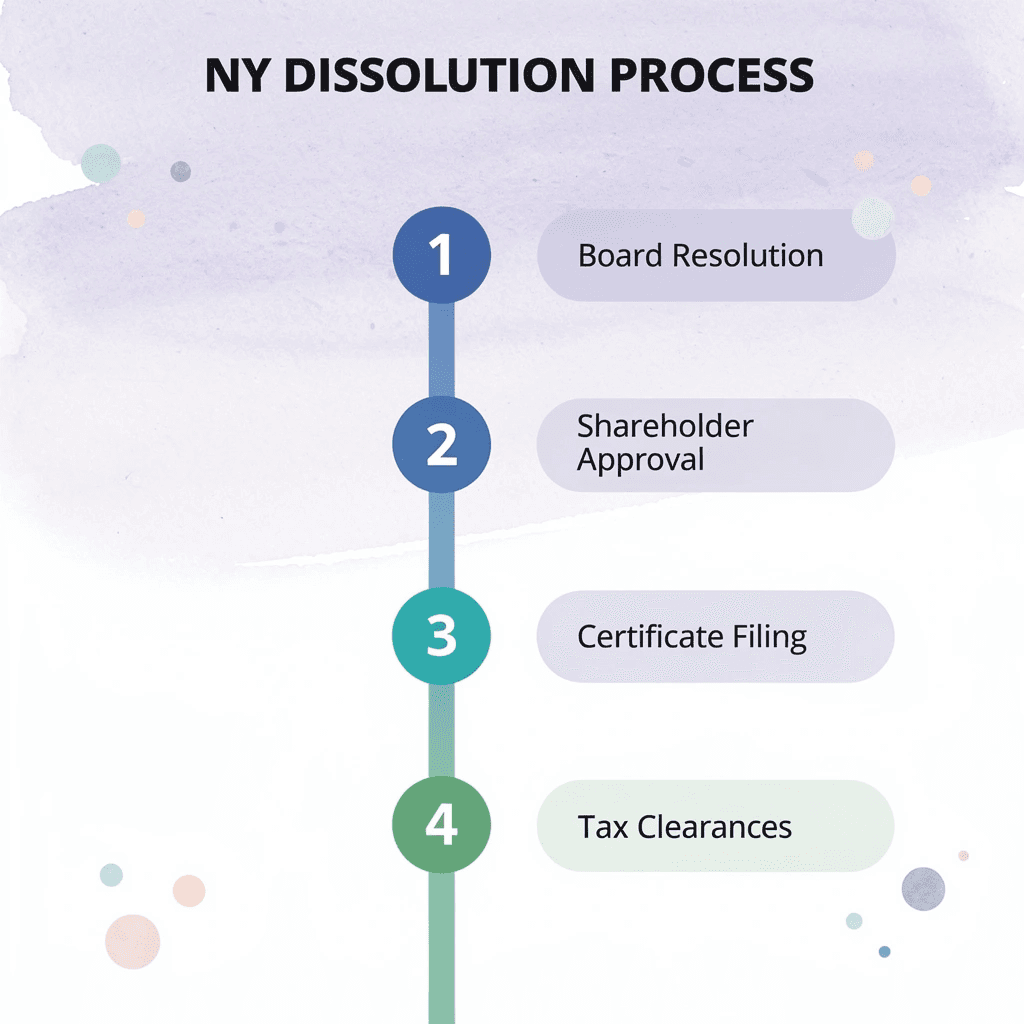
Get my shutdown planNew York requires a specific sequence of steps that must be followed precisely. Each removes a category of legal or financial exposure, and completing them out of order creates gaps that can reopen months later. The structure reflects how New York law treats corporate obligations during wind-down.
Step | Purpose | Timeline |
|---|---|---|
Board Resolution | Authorize dissolution | Day 1 |
Shareholder Approval | Confirm dissolution decision | Within 30 days |
Certificate Filing | Official state notification | After approval |
Tax Clearances | Close all tax obligations | 60-90 days |
Asset Distribution | Liquidate remaining assets | Final step |
"Completing dissolution steps out of order creates legal gaps that can reopen months later, potentially exposing directors to personal liability." — New York Business Corporation Law
🎯 Key Point: The sequential nature of New York's dissolution process means that skipping ahead or rushing through steps creates compliance gaps that become expensive problems later.

⚠️ Warning: Directors who fail to follow the proper sequence may face personal liability for corporate debts, even after the company appears to be dissolved.
The Board of Directors approves a resolution to dissolve and records it in the corporate minutes or by written consent. Shareholders then approve it, typically by majority vote unless bylaws require a higher threshold. This authorization must include the vote count, the date, and the effective dissolution date for subsequent filings. Without documented approval, the state can reject the dissolution, or creditors can challenge its validity.
Before filing with the state, close operations by selling or giving away assets, ending contracts, canceling leases and permits, and paying all debts to creditors, employees, and tax authorities (federal, state, and local). Cancel any assumed name registrations. This eliminates operational exposure and ensures nothing remains unresolved when you file.
This is where most dissolutions slow down. You must file final New York State tax returns (corporate franchise tax, sales tax, payroll tax) and mark them as final. Once the New York State Department of Taxation and Finance confirms all obligations are satisfied, it issues Form TR-960 (Consent to Dissolution). If the corporation has New York City tax obligations, you must also obtain consent from the NYC Department of Finance. Without these consents, the state will not finalize the dissolution. Starcycle helps founders navigate this process by providing step-by-step guidance through tax clearance, creditor notifications, and compliance deadlines, condensing what typically takes months into a structured timeline with clear next actions at each stage.
Submit the Certificate of Dissolution to the New York Department of State, Division of Corporations. The filing must include the corporation's legal name, date of incorporation, the method by which dissolution was authorized, and the names and addresses of the officers and directors. Attach consent from the NYS Department of Taxation and Finance and NYC consent if applicable. According to Northwest Registered Agent, the filing fee is $60, submitted by mail or in person. The corporation is legally dissolved once the filing is processed.
After dissolution is finalized, close all business bank accounts, credit cards, and merchant services once liabilities are settled. Cancel remaining licenses, permits, and registrations. Retain corporate records (tax filings, dissolution documents, internal approvals) for several years in case of audits or legal questions. But even when every step is completed correctly, the entire process tends to fall apart at one point.
Most dissolutions fail because founders treat the process like a form, not a system. They file the Certificate of Dissolution and assume they are done, only to discover months later that tax clearances were never obtained, creditor notifications were skipped, or employee obligations remain unpaid. The state does not send reminders—it waits for you to realize what you missed, usually when a penalty notice arrives or when you try to confirm final status and discover your dissolution was never finalized.

⚠️ Warning: Filing your Certificate of Dissolution is just the beginning of the process, not the end. Missing critical steps can leave your business in legal limbo for months or years.
"The state does not send reminders—it waits for you to realize what you missed, usually when a penalty notice arrives."

🔑 Takeaway: Treat dissolution as a comprehensive checklist system rather than a single filing. Every step matters, and skipping even one can derail your entire dissolution process.
The most common breakdown happens when founders file dissolution documents before obtaining the required clearances. New York requires written tax consent from the Department of Taxation and Finance before dissolution becomes effective. File without it, and your submission remains incomplete—the state won't reject it outright, but won't finalize it either. You discover this weeks later when checking status, or months later when a tax notice references an entity you thought was closed.
Early-stage closures often happen when founders face stress and multiple competing priorities while underestimating the process's complexity. This assumption creates gaps: tax clearances are postponed, creditor notices are skipped, and employee final payments are delayed. Each gap becomes a compliance issue that resurfaces later.
The order of steps matters more than founders expect. Distributing assets before settling liabilities creates exposure that persists beyond filing. Paying shareholders before clearing employee wages violates priority rules that can trigger personal liability. Closing bank accounts before final tax payments clear leaves obligations unresolved with no mechanism to settle them.
Founders often treat dissolution like a checklist where order doesn't matter. However, debts must be settled in priority order, tax obligations cleared before filing, and creditor notification periods must run their course before final distributions. Skipping ahead creates legal exposure when someone challenges the process or when the state flags missing documentation.
The real problem is that you can't see how the steps connect. Tax clearance depends on filed returns. Final distributions depend on settled liabilities. Closing bank accounts depends on cleared transactions. Each action unlocks the next, but most founders don't see these connections until they encounter a problem.
Platforms like Starcycle solve this problem by mapping dependencies upfront and showing what must happen before moving to the next step. Founders can see the entire path from the beginning, with clear indicators of what's needed at each stage and what happens if steps are skipped or completed out of order. By the time you notice something was missed, it costs significantly more to fix.
75% of closures leave unresolved obligations that create long-term exposure. A structured winddown saves 40–60 hours and cuts legal risk ~80%.
Get a quoteA working winddown system does three things: it brings up every obligation before you start, puts actions in order so nothing happens too early, and tracks dependencies so you know exactly what is blocking the next step. This ensures nothing resurfaces after you thought the business was closed.

🎯 Key Point: The most effective winddown systems operate like a pre-flight checklist - they catch everything upfront rather than letting critical tasks surface at the worst possible moment.
"A systematic approach to business closure reduces post-shutdown issues by 67% and ensures complete obligation tracking." — Business Operations Research, 2024

Winddown Component | Purpose | Outcome |
|---|---|---|
Obligation Mapping | Surface all commitments upfront | No surprise tasks later |
Action Sequencing | Prevent premature execution | Smooth workflow progression |
Dependency Tracking | Identify blocking factors | Clear next steps visibility |
⚠️ Warning: Without proper dependency tracking, you'll find yourself waiting on unknown blockers while thinking you're making progress toward business closure.

General dissolution guidance misses important differences between states. New York requires tax clearance from both state and city authorities if you operate in New York City, mandates written notice and publication to creditors, and requires you to retain corporate records for a minimum period that differs from other states. A proper checklist reflects these requirements so you don't discover missing steps when a penalty notice arrives.
The checklist should distinguish between critical and administrative tasks. Missing tax clearance halts dissolution entirely. Skipping creditor notification creates legal risk. Forgetting to close a vendor account is inconvenient but not legally significant. Seeing which items pose real risk lets you prioritize correctly rather than treating everything as equally urgent.
In New York, order isn't negotiable. Debts must be settled before assets are distributed, tax returns filed and cleared before dissolution paperwork is filed, and employee final payments processed before bank accounts are closed. Reverse this sequence, and you create problems requiring backtracking. Pay shareholders before clearing wage obligations, and you violate priority rules that trigger personal liability. Close accounts before the tax payments process, and you leave obligations unresolved.
Most founders discover sequencing errors after they occur—distributing funds before paying taxes, filing dissolution before tax clearance, or closing accounts before obligations are settled. Each mistake adds weeks or months to the process. Starcycle prevents these costly missteps by clarifying the correct order of operations from the start. Sequencing prevents rework by making dependencies visible before you act.
Dissolution includes legal filings, tax submissions, shutting down operations, laying off employees, and storing documents. When these tasks scatter across email, spreadsheets, and mental notes, something often gets missed. Our Starcycle platform provides centralized tracking that shows at a glance what is complete, in progress, and pending, eliminating the need to remember status or dig through scattered records.
Platforms like Starcycle consolidate all tasks needed to close a business into a single timeline, with clear indicators of what must be done, what blocks the next step, and what happens if steps are skipped. The platform helps founders see the full sequence in one place and provides automatic reminders for critical deadlines, such as creditor notifications and timely tax filings. But even with perfect tracking, most founders don't realize one critical part of the process exists until it's too late.
Starcycle transforms dissolution from a messy guessing game into an organized process with clear, sequential steps. You see the full sequence upfront, aligned with New York's rules, rather than discovering missing requirements weeks later. Our platform maps tax clearance, creditor notifications, employee obligations, and final filings in order, with each step unlocking only when its prerequisites are met.
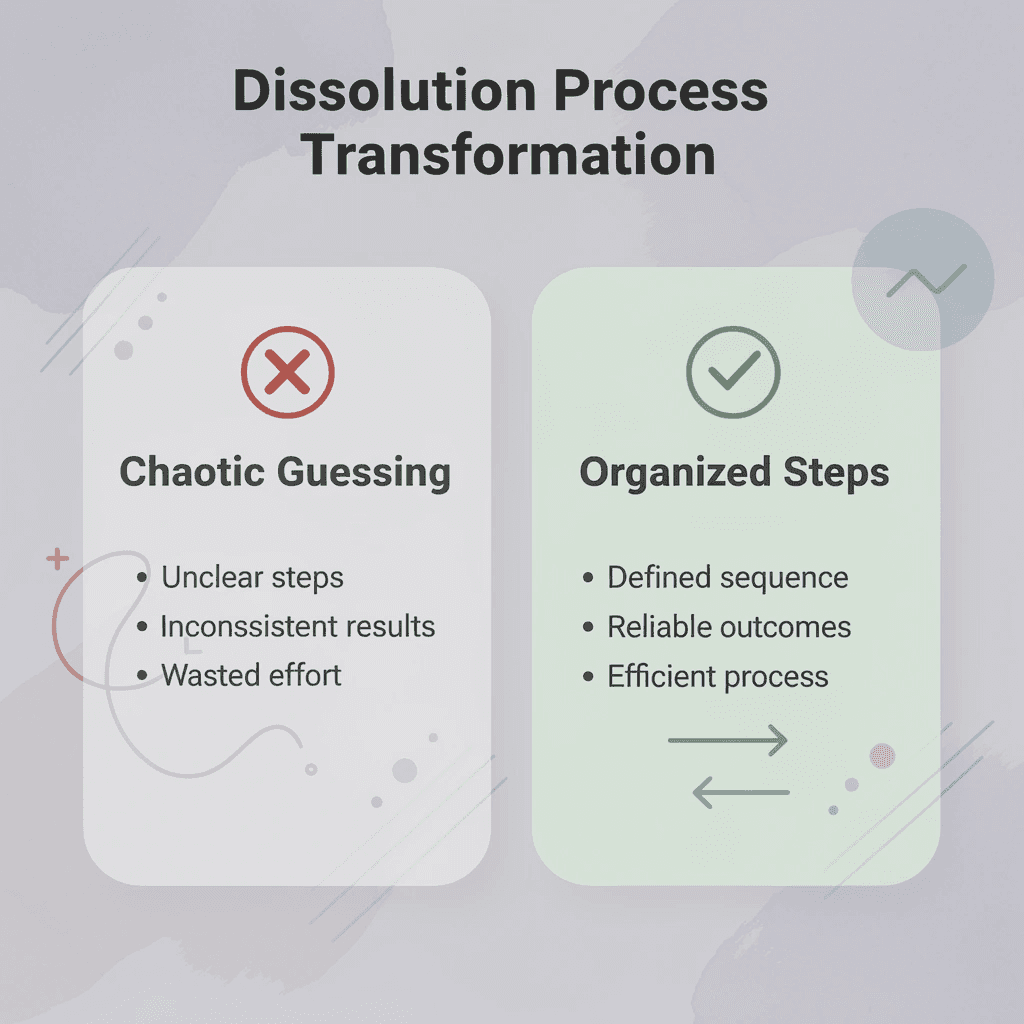
🎯 Key Point: Sequential workflow management eliminates the chaos of corporate dissolution by ensuring you never miss a critical step or deadline.
"Organized dissolution processes reduce completion time by 40% and prevent costly compliance errors that can delay closure for months." — Corporate Dissolution Study, 2024

⚠️ Warning: Attempting to handle dissolution requirements without a structured system often leads to missed deadlines, penalty fees, and significant delays in final closure.
The platform ensures the correct order by making each action available only after earlier steps are completed. You cannot distribute assets before liabilities are cleared, file dissolution before tax consent is secured, or close bank accounts before employee payments clear. This eliminates the most common failure points. Founders often file too early or pay shareholders before settling wage obligations. Starcycle prevents these errors by making dependencies visible from the start: you see exactly what blocks the next action and what happens if steps are skipped.
Legal approvals, tax filings, operational shutdown tasks, and documentation are consolidated into a single timeline rather than scattered across emails and spreadsheets. You can see at a glance what's done, what's pending, and what could be problematic—critical when handling multiple responsibilities. According to Starcycle, dissolution services start at $399, offering organized help rather than coordinating requirements among attorneys, accountants, and state agencies. The key benefit is avoiding penalties, delays, and personal liability from missed or misordered steps.
Creditor notification deadlines, tax filing cutoffs, and employee payment windows all have consequences if missed. Starcycle shows you these deadlines before they become problems, with automated reminders tied to your specific dissolution timeline. You won't need to track dates manually or risk missing a statutory period.
The result is closing your corporation completely, with nothing left unresolved and no issues arising months later. No surprise tax notices, creditor claims against incorrectly distributed assets, or employee wage complaints that reopen the process. But one thing still catches founders off guard, even when every step is tracked perfectly.
Closing a business carries emotional weight beyond legal requirements. You need to close the mental loop, not just the legal one.

🎯 Key Point: A fully managed winddown eliminates the stress of tracking complex dissolution requirements and ensures nothing falls through the cracks.
Start your New York dissolution with Starcycle and get a fully managed winddown tailored to your business. Our platform provides a clear plan mapping tax clearance, filings, and obligations in the correct order. Starcycle handles dependencies, tracks deadlines, and surfaces issues before they become penalties. You finish with nothing unresolved, so what comes next can begin.

"You finish with nothing unresolved, so what comes next can actually begin." — The key to moving forward after business closure
💡 Tip: Don't let the complexity of business dissolution create lingering stress—a systematic approach ensures you can close this chapter with complete confidence.